
Last updated: 8 October 2026. New guides get added here as they go live.
"Can I sell my product in this country?" It's the question every exporter asks sooner or later. And the honest answer is: it depends. Who's allowed to import? How long does registration take? Who buys, pharmacies, hospitals or the government? Does the country want it made locally instead? So I've put it all down, one region at a time, in plain words.
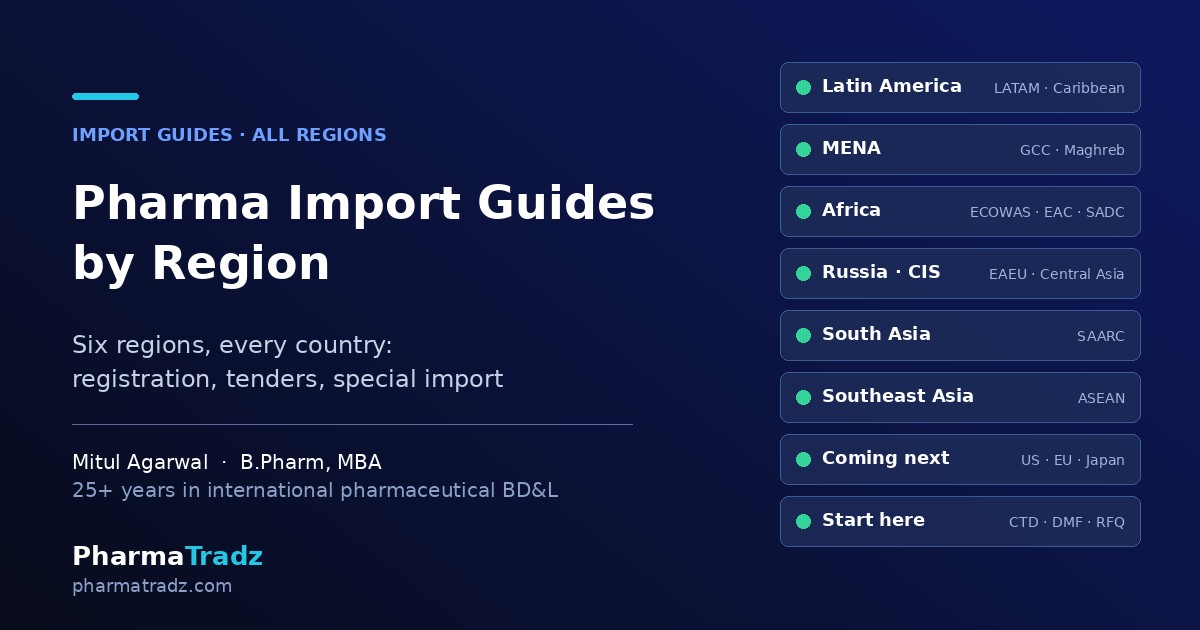
Every guide covers every country, not just the big names. Start with the region you care about.
In a hurry?
- Buying or bidding on a tender? Post an RFQ and we'll find you GMP-certified manufacturers for your market.
- Need an unregistered medicine for a patient? Send us an RFP.
- A manufacturer? List your products so buyers can find you.
Looking at one market? Our country guides cover each country on its own, many of them in the local language.
The guides
Latin America and the Caribbean
Brazil and Mexico get the most attention, but don't skip the rest of the region. Some good openings are in places like Guatemala, Paraguay or the Caribbean islands. Also in Spanish and Portuguese.
Middle East and North Africa
Get registered with the Gulf Health Council and six Gulf markets open up at once. Egypt, Algeria and Iraq each have their own twists, and getting paid is half the job. Also in Arabic and French.
Sub-Saharan Africa
Lots of regulators, but also real shortcuts: one dossier can now be reviewed for several countries together. Check the local-manufacturing lists before you file. Also in French and Portuguese.
Russia and the CIS
The EAEU is moving to one set of rules, Uzbekistan is opening up fast, and Ukraine is going EU-style. Plan how you'll get paid before you quote. Also in Russian.
South Asia (SAARC)
India makes most of its own generics, but still imports new medicines, biologicals and APIs. Bangladesh's patent waiver is ending, and the Maldives can approve in 20 days.
Southeast Asia (ASEAN)
Same dossier format everywhere, very different rules. Singapore and Malaysia move fast if you have FDA or EMA approval. Indonesia only lets local manufacturers register. Also in Indonesian and Vietnamese.
Fast-track routes at a glance: 45 countries
Most regulators now offer a shorter route for medicines that a reference authority, such as the US FDA or the European Medicines Agency, has already approved. The table below brings together the "at a glance" rows from the six guides. Each guide explains every route in full and lists its sources.
| Country | Regulator | Fast track for products approved abroad |
|---|---|---|
| Latin America and the Caribbean | ||
| Brazil | ANVISA | Reliance on WHO, EMA, FDA, Health Canada, Swissmedic, MHRA, TGA |
| Mexico | COFEPRIS | 45 working days for FDA, EMA, Swissmedic, Health Canada, TGA, WHO PQ; ANVISA from about Oct 2026 |
| Colombia | INVIMA | Reliance resolution adopted Aug 2026 |
| Argentina | ANMAT | Simpler route for "Annex I" countries (US, Japan, Canada, Switzerland, main EU states, UK, Israel) |
| Chile | ISP | Reliance for new and biological products approved by two of EMA, FDA, MHRA, TGA, PMDA |
| Peru | DIGEMID | Shorter timelines for products registered in "high surveillance" countries |
| Ecuador | ARCSA | Homologation for products approved by listed agencies |
| Middle East and North Africa | ||
| Saudi Arabia | SFDA | 30–60 working days relying on FDA/EMA, for new medicines and biologicals |
| UAE | EDE | Fast track for innovative and orphan medicines |
| Egypt | EDA | Reliance procedures; generics limited by the "box" system |
| Algeria | ANPP | Temporary authorisation for products approved by recognised regulators |
| Morocco | AMMPS | None found |
| Iraq | MOH | About one month for FDA/EMA-approved products |
| Israel | MOH | 70–120 days relying on FDA, EMA, MHRA and others |
| Jordan | JFDA | 60–90 days relying on FDA/EMA |
| Sub-Saharan Africa | ||
| South Africa | SAHPRA | Reliance routes on FDA, EU, MHRA and other reference approvals |
| Nigeria | NAFDAC (ML3) | Reliance decision in 60 working days |
| Kenya | PPB | Verification and abridged reviews |
| Ethiopia | EFDA (ML3) | Abbreviated route for SRA-approved and WHO-prequalified products |
| Ghana | FDA (ML3) | Reliance on well-resourced regulators |
| Tanzania | TMDA (ML3) | Abridged route |
| Côte d'Ivoire | AIRP | Reliance decisions |
| Senegal | ARP (ML3) | UEMOA reliance |
| Russia and the CIS | ||
| Russia | Ministry of Health | No reliance on foreign approvals found; EAEU recognition after a reference state |
| Kazakhstan | NCEMMD (WHO ML3) | EAEU recognition |
| Uzbekistan | Center for Pharmaceutical Products Safety | Recognition of WHO-listed and ML4 authorities' approvals |
| Ukraine | Ministry of Health / State Expert Center | Simplified route for EMA, US, Swiss, Japanese, Australian and Canadian approvals |
| Belarus | Ministry of Health / RCETH | Simplified route for products approved elsewhere in the EAEU |
| Georgia | RAMPA | Recognition registration in 7 working days |
| Azerbaijan | Analytical Expertise Center | Recognition of foreign registrations |
| Moldova | AMDM | 10-working-day route for EU approvals (proposed) |
| South Asia (SAARC) | ||
| India | CDSCO | Local trial waiver for some products approved in the US, UK, EU, Japan, Australia or Canada |
| Pakistan | DRAP | Lighter dossier for products approved by reference regulators |
| Bangladesh | DGDA | None found; CPP from one of seven reference countries required |
| Sri Lanka | NMRA | Reliance guideline |
| Nepal | DDA | No inspection for plants in stringent-regulator countries |
| Bhutan | BFDA | Draft reliance guideline |
| Maldives | MFDA | 20-day reliance route |
| Afghanistan | AFDA | None found |
| Southeast Asia (ASEAN) | ||
| Indonesia | BPOM (WHO-listed authority) | Reliance review in 90 working days |
| Vietnam | DAV | Reference route in 9 months using EMA or stringent-regulator reports |
| Thailand | Thai FDA | None found for medicines |
| Philippines | FDA Philippines | Abridged (45 working days) and verification (30) |
| Malaysia | NPRA | Abridged (90 working days) and verification (30) |
| Singapore | HSA (WHO ML4) | Verification in 60–120 working days |
ML3 and ML4 are WHO maturity levels for regulators. "None found" means we found no published fast-track route when the guide was written. Rules change often, so confirm with the regulator before you plan a filing.
Developed markets
The US, Europe, Japan, Korea, Australia and the rest are a different game: less about who imports, more about how you get approved in the first place. These guides cover them country by country:
- Importing medicines into the United States and Canada: FDA and Health Canada routes, import entry, state importation programmes and 2026 tariffs.
- Importing medicines into Europe and Turkey: EU/EEA procedures, QP release, the UK, Switzerland and Turkey. Also in German, French, Spanish and Italian.
- Importing medicines into Japan, South Korea, Australia and New Zealand: PMDA, MFDS, TGA and Medsafe, local holders and reliance routes. Also in Japanese and Korean.
- China: NMPA explained: registration, the API associated review and port clearance.
For unregistered medicines in these markets, see early access and managed access programmes and unlicensed medicines in the UK.
New to exporting? Start here
- CTD vs ACTD: which dossier format you need.
- CEP vs DMF vs ASMF: which API document you need.
- How to check a supplier before you buy.
- How dossier licensing deals are priced.
- How to write an RFQ that actually gets quoted.
Can't find your answer?
Rules change and no guide covers every product. Just tell us the product and the country, and we'll point you to a manufacturer or a local partner who can help. Post an RFQ, or send an RFP for a patient.