
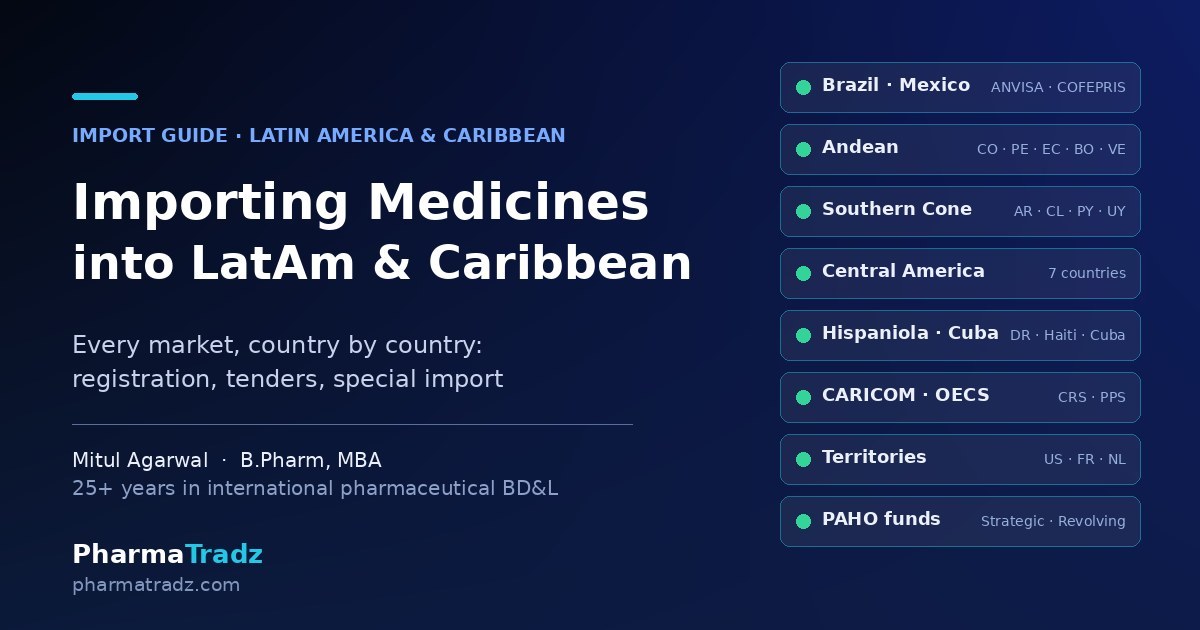
Last updated: 25 September 2026. Part of our region-by-region import guide series. Covers all of Latin America and the Caribbean.
Also available in Español and Português.
Latin America and the Caribbean together make up one of the most rewarding regions for pharma exporters, and one of the easiest to get wrong. In every major market there are three doors in: register the product and sell it through a local partner, supply public tenders, or use a special import route for unregistered medicines when patients need something that isn't available. You'll almost always need a local company to hold the registration or import licence. And the fastest registrations now go to products already approved by regulators like the FDA or EMA, or, from late 2026, by Brazil's ANVISA for Mexico.
This guide covers the whole region, not just the big markets, because some of the most interesting opportunities are in markets that often get overlooked:
- South America: Brazil, Argentina, Chile, Colombia, Peru, Ecuador, Bolivia, Venezuela, Paraguay and Uruguay.
- Mexico, and Central America: Guatemala, Honduras, El Salvador, Nicaragua, Costa Rica, Panama and Belize.
- The Caribbean: the Dominican Republic, Cuba and Haiti; the CARICOM countries, including Jamaica, Trinidad and Tobago, Barbados, the Bahamas, Guyana and Suriname; the Eastern Caribbean islands; and the US, French and Dutch territories.
It's written in plain language for manufacturers in India, China, Europe and elsewhere who export to the region, and for the regional distributors who work with them. The biggest markets get full sections; the others get a short profile covering the same four points.
Three doors into every market
Before the country details, it helps to see the pattern. Wherever you look in Latin America, there are three ways a medicine gets to patients:
- Registered and sold commercially. The product gets a marketing authorisation (a registro sanitario, or registro in Brazil) and is sold to pharmacies, hospitals and distributors. This is the main business, and it takes the longest.
- Public tenders. Ministries of health and social security institutes buy in bulk. In most countries you'll need the product registered to bid, and sometimes more.
- Special import without registration. Every country has a legal route for bringing in an unregistered medicine when a patient needs it and nothing registered will do. The names differ: "Vital No Disponible" in Colombia, RAEM in Argentina, exceptional import in Brazil. They're for patients, not for building a business.
And one rule runs through almost all of it: you need a local partner. Registration holders and importers generally have to be companies established in the country, or at least legally represented there.
Importing into Latin America or the Caribbean? Tell us what you need.
- Distributors, importers and tender bidders: post a sourcing RFQ with the product, destination country and registration status, and we'll match you with GMP-certified manufacturers who can supply your market.
- Hospitals, doctors and patients who need an unregistered medicine through a route like Vital No Disponible, RAEM or exceptional import: submit a request for proposal (RFP) for named-patient import.
The biggest markets at a glance
| Country | Regulator | Fast track for products approved abroad | Import without registration |
|---|---|---|---|
| Brazil | ANVISA | Reliance on WHO, EMA, FDA, Health Canada, Swissmedic, MHRA, TGA | Exceptional import (Ministry of Health only); personal import |
| Mexico | COFEPRIS | 45 working days for FDA, EMA, Swissmedic, Health Canada, TGA, WHO PQ; ANVISA from about Oct 2026 | Personal-use import permit; donations |
| Colombia | INVIMA | Reliance resolution adopted Aug 2026 | Vital No Disponible |
| Argentina | ANMAT | Simpler route for "Annex I" countries (US, Japan, Canada, Switzerland, main EU states, UK, Israel) | RAEM |
| Chile | ISP | Reliance for new and biological products approved by two of EMA, FDA, MHRA, TGA, PMDA | Exceptional authorisation; bulk import for shortages |
| Peru | DIGEMID | Shorter timelines for products registered in "high surveillance" countries | Exceptional authorisation |
| Ecuador | ARCSA | Homologation for products approved by listed agencies | Import by exception |
Brazil
Who can import. A foreign manufacturer can't hold a Brazilian registration or import licence itself. You need a Brazilian company with an ANVISA company authorisation (AFE) that covers importing.
Registering for the private market. By law, ANVISA has 365 days to decide an ordinary registration and 120 days for priority cases, extendable once by a third. In practice there has been a backlog. ANVISA launched a plan in November 2025 to halve its queue and get back to legal deadlines by the end of 2026. Priority criteria were updated in December 2025 and include rare and neglected diseases, children without alternatives, and local production.
Foreign plants need a Brazilian GMP certificate (CBPF), valid for two years. Rules adopted in 2025 let ANVISA rely on inspection reports from trusted foreign regulators and a risk analysis, inspecting only where the risk calls for it.
The fast track. Since April 2024, ANVISA can rely on assessments by WHO, the EMA, FDA, Health Canada, Swissmedic, MHRA and TGA, provided the product is identical to the one they approved.
Without registration. Exceptional import is reserved for the Ministry of Health and its bodies, for situations like no alternative on the market or a health emergency. The product must be WHO-prequalified or registered by an ICH-member regulator. Individual patients can also import small quantities for personal use.
Tenders. Brazil's 2021 procurement law lets foreign companies bid with translated equivalent documents and a legal representative in Brazil. Health buyers can require ANVISA compliance, so in practice plan on needing the registration.
Mexico
Who can import. Mexico is more open than most. A foreign manufacturer can hold a registro sanitario itself, without a Mexican plant, as long as it has a legal representative with a Mexican address.
The fast tracks, and why they matter. Mexico now has some of the region's most generous reliance routes:
- Since July 2025, medicines approved by the FDA, EMA, Swissmedic, Health Canada, TGA or WHO Prequalification can be decided within 45 working days. Generics and biosimilars qualify, with a CTD dossier, GMP certificate and certificate of free sale.
- An older 2020 equivalence route, with a 60-working-day decision, covers a wider list of reference regulators.
- From around mid-October 2026, a new agreement gives products approved by Brazil's ANVISA the same 45-working-day route. Only ordinary ANVISA approvals count, not ones ANVISA itself granted through reliance.
That last change is worth pausing on. For a manufacturer already registered in Brazil, Mexico just got much closer.
Without registration. COFEPRIS issues import permits for unregistered medicines for personal use against a prescription. The permit is free and filed online, with a decision in up to 10 working days. There's also a route for donations to health facilities.
Tenders. Mexico's public sector buys through large consolidated purchases, and it's been a bumpy few years. The 2025–2026 purchase was annulled in April 2025 over overpricing. The 2027–2028 purchase, published in July 2026 and run by Birmex for eight institutions, including IMSS and ISSSTE, covered 766 product codes. It used a reverse auction, and bidders needed a registro sanitario and GMP certificates. That tender was international but limited to goods from countries with trade agreements covering government purchases, so rules of origin matter. Check each tender's terms carefully.
Colombia
Who can import. The importer is named on the registration, and an imported product needs the manufacturer's written authorisation plus a Certificate of Pharmaceutical Product from the country of origin. Good news for holders: since 2023, Colombian registrations no longer expire.
Registering. The legal timeline for the pharmaceutical evaluation is 30 business days, but INVIMA had a backlog of more than 12,400 pending procedures in May 2026, so plan for much longer. INVIMA accepts GMP certificates from a listed set of countries (including the US, Canada, Switzerland, UK, major EU states, Japan, Korea and Australia) and from WHO and PAHO. A plant without one of those will generally need INVIMA's own certification.
The fast track. In August 2026 INVIMA adopted a reliance resolution for new registrations and changes, with a technical guide to follow. It's too early to say how it will work for generics.
Without registration. Colombia's "Medicamento Vital No Disponible" route is one of the best known in the region. It covers medicines that aren't marketed or are in short supply in Colombia, with no substitute available. A patient or any legally constituted entity can apply for one patient. For multiple patients, an authorised distributor applies. INVIMA keeps a published list of products that qualify.
Tenders. Foreign bidders without a Colombian domicile can bid and don't need to join the national bidders' register. Companies from countries with a trade agreement with Colombia get national treatment. Some centralised purchases, such as HIV medicines, go through the PAHO Strategic Fund.
Argentina
Who can import. Importers need a quality-control laboratory and a pharmacist as technical director.
Registering, and the Annex that matters. Argentina's 1992 decree sorts countries into two annexes. Products approved in Annex I countries follow a simpler route. These are the US, Japan, Canada, Switzerland, Israel, the UK and the main EU states. India is in Annex II, alongside Brazil, Mexico and China, which means a certificate from the origin-country regulator and verification of the plant.
Argentina has been simplifying fast. In 2025, ANMAT shortened its evaluation stages. It also started issuing GMP certificates without routine inspection for plants in PIC/S or Mercosur countries, or with certificates from recognised regulators.
Without registration. The RAEM (exceptional access regime) lets a patient, family member or health facility import an unregistered medicine for an individual patient, or for emergencies, or when a registered medicine isn't available. It covers up to 90 days' supply, or 180 days for long treatments, and ANMAT answers within 10 working days. Intermediaries can't import on a patient's behalf.
Tenders. National purchases go through the COMPR.AR system, and tender documents typically require an ANMAT product certificate. In October 2024 the government also said provinces could import medicines for their own use without ANMAT approval. Watch how that develops.
Chile
Who can import. A registration can be held by a Chilean or foreign person or company that's properly represented and domiciled in Chile.
Registering. The ISP has up to six months to decide, and foreign plants need an official GMP certificate from their own regulator. Since 2025 there's a reliance procedure for new and biological products approved by at least two of the EMA, FDA, MHRA, TGA and Japan's PMDA. I found no equivalent fast track for generics.
Without registration. Chile allows exceptional authorisations for emergencies, urgent need without alternatives, and research. The ISP has also clarified that companies can import unregistered medicines in bulk to address shortages. Personal-use imports are handled in one to three days.
Tenders. Foreign suppliers can register on the Mercado Público platform. CENABAST, the central supply agency, buys a large share of its imports through PAHO. In 2022 it was 61%.
Peru
Who can import. Licensed distributors (droguerías) or laboratories authorised by DIGEMID.
Registering. The law sets three speeds:
- up to 60 days for medicines on the national essential medicines list;
- 45–90 days for products registered in "high surveillance" countries;
- up to 12 months for everything else.
Reported real-world times have run from nine months to four years. A 2025 law created a 45-day expedited route, with automatic approval if DIGEMID doesn't answer, for products registered in high-surveillance countries for rare diseases, cancer and other priority conditions. Its implementing regulation was still being finalised at the time of writing.
Without registration. The law allows exceptional authorisation for emergencies, individual treatment with medical justification, and public-health needs where no registered product is available.
Tenders. A new procurement law took effect in April 2025. Foreign firms can register as state suppliers with a legal representative in Peru.
Ecuador
Ecuador has one of the clearest fast tracks in the region. Homologation is an abbreviated registration for medicines approved by listed high-surveillance agencies or WHO-prequalified. Under rules in force since June 2025, dossiers use CTD format and homologation is decided within three months. The official fee for a foreign generic is US$565.21.
The January 2026 list of reference agencies has 46 entries, including ANVISA, ANMAT, COFEPRIS, INVIMA, ISP and EU regulators. India's CDSCO isn't on it, so an Indian product needs another reference approval to use homologation.
For patients, import by exception covers emergencies, unavailable specialised treatments and rare diseases. It's free, is decided within seven days, and is valid for 180 days.
Bolivia, Venezuela, Paraguay and Uruguay
Bolivia
- Who imports: only companies registered with the regulator AGEMED, as manufacturers or importers, that hold the product's registration. Importers need legalised proof that they represent the foreign manufacturer.
- Registration: imported products need a Certificate of Pharmaceutical Product from the origin authority, legalised by a Bolivian consulate, plus GMP and analysis certificates. I found no general fast track for products approved abroad; a reliance route created in 2020 appears to have been for COVID products only.
- Without registration: commercial import of unregistered products is prohibited, and I found no current named-patient route. Registered cancer medicines get fast import permits.
- Tenders: CEASS, the Ministry of Health's central supplier, and it has bought through the PAHO Strategic Fund since 2021.
- Watch out for: foreign exchange. A dollar shortage hit the industry hard in 2025, and in June 2026 the government ended the fixed exchange rate, a devaluation of roughly 40%. Payment terms matter here.
Venezuela
- Who imports: every product must be registered by a sponsoring pharmacist. Applications are filed online with the INHRR.
- Registration: a 2024 rule allows registration of products whose innovator isn't registered locally, if they've been on the international market for at least five years. I found no reliance route.
- Without registration: a 2019 resolution let foreign firms with no Venezuelan company import unregistered medicines through an alliance with a state company or a representative office, under a special one-year permit. Pharmacists' groups said in 2022 it was still widely used, including for imports of Indian-made medicines. Check its current status before relying on it.
- Tenders: Venezuela has used the PAHO Strategic Fund since 2011.
- Watch out for: sanctions and banking. US sanctions exempt medicines under a general licence, but payments need case-by-case diligence.
Paraguay
- Who imports: a company with a business registration and import licence, whose pharmacist in charge signs the filing.
- Registration: the regulator DINAVISA has an ordinary route and, since 2025, an abbreviated one for WHO essential medicines already registered in high-surveillance countries. These include the EU, US, Japan, Canada, Australia and Mercosur neighbours Argentina, Brazil and Uruguay. Documents must be apostilled and translated.
- Without registration: since 2025, compassionate or urgent use of unregistered medicines is possible via court order or Ministry request, but not if an equivalent registered product exists.
- Tenders: the Ministry of Health and the social security institute (IPS) tender through the national procurement portal. Local production gets a 10% preference in international tenders.
Uruguay
- Who imports: an MSP-licensed company that is the exclusive representative of the foreign registration holder.
- Registration: needs a CPP and a GMP certificate from an ICH-member regulator or a PAHO regional reference authority. Without one, the Ministry inspects the plant at the applicant's cost, which matters for many Indian plants. Each review cycle takes up to 120 days, and registrations last five years. A new health surveillance agency was created in 2025.
- Without registration: a licensed laboratory can import an unregistered medicine for an urgent need, with a doctor's request and patient consent. There's no fee.
- Tenders: central purchasing goes through the Finance Ministry's unit (UCA). Foreign firms can register as state suppliers.
Central America
Central America is more joined-up than most people realise. Guatemala, Honduras, El Salvador, Nicaragua, Costa Rica and Panama all apply a common technical regulation for medicine registration. There's also a mutual-recognition procedure: a product registered in one member state can be recognised in another, in as little as 10 business days in El Salvador and Nicaragua. On the buying side, COMISCA runs a joint price negotiation for the region's health ministries and social security institutes plus the Dominican Republic. It uses two-stage supplier prequalification and awards contracts of up to three years, and reports US$209.8 million in savings over 2009–2025.
Several countries have also opened fast tracks for products approved by stringent regulators, some remarkably fast.
Guatemala
- Who imports: a licensed distributor with a technical director. The manufacturer, technical director and legal representative share responsibility.
- Registration: products approved by the FDA or EMA can get a registration number within 10 business days under technical standard NT-77. Otherwise expect a long wait: consultants reported a backlog of over 21,000 files in 2025, with new registrations taking six to eight months and mutual recognition three to four.
- Without registration: the import rules list exceptions for personal use with a prescription, donations, clinical trials and special cases.
- Tenders: the social security institute IGSS is the big buyer, and a 2025 court order pushed it towards more open competition.
Honduras
- Who imports: registration is held through a licensed local pharmacist (regente), valid five years.
- Registration: up to 60 business days on paper, four to eight months in practice, according to a local law firm. I found no fast track.
- Without registration: only investigational products; I found no named-patient route.
- Tenders: the health ministry's large 2025 tender largely failed, and it turned to direct purchases, COMISCA and the PAHO Strategic Fund. The social security institute (IHSS) buys through UNOPS, which runs open international tenders on the UN Global Marketplace. That makes it a genuine opening for foreign suppliers.
El Salvador
- Who imports: a locally represented registration holder. The regulator is now the Superintendencia de Regulación Sanitaria (SRS), which replaced the DNM in 2023.
- Registration: the law lets the SRS formally recognise decisions of reference agencies. Its predecessor relied on the EMA, FDA, Health Canada, INVIMA and COFEPRIS. Central American mutual recognition takes about 10 business days.
- Without registration: the medicines law allows patient-specific import when a medicine isn't available.
- Tenders: the health ministry and social security institute buy jointly, US$121.6 million for 2026, and also through COMISCA.
Nicaragua
- Who imports: import and distribution must be directed by a pharmacist.
- Registration: three to six months on the standard route; mutual recognition in 10 business days. The regulator adopted reliance guidelines in 2024.
- Without registration: I found no named-patient route.
- Tenders: an important detail for Indian exporters. Recent health ministry tender documents give priority to products whose manufacturer is in the People's Republic of China, under a 2025 government circular. Read each tender's terms carefully.
Costa Rica
- Who imports: a locally represented applicant, with a responsible professional.
- Registration: since 2022, Costa Rica recognises registrations from ICH-member regulators (the FDA, EMA, Health Canada, Swissmedic, PMDA, ANVISA, COFEPRIS and others), with a decision within 30 calendar days. A new competition law published in February 2026 widens recognition to WHO-listed authorities and PAHO reference regulators. It also allows parallel imports.
- Without registration: only the social security fund (CCSS) and other state bodies can acquire unregistered medicines, for urgency or public need.
- Tenders: the CCSS is one of the region's biggest single buyers. Foreign firms can register on the SICOP procurement platform without a local entity.
Panama
- Who imports: no nationality restriction on the registration holder, but you need a notarised power of attorney and a qualified pharmacist.
- Registration: since January 2025, products registered by WHO-listed authorities can be recognised in 10 business days. There's also an abbreviated route for products from high-standard countries.
- Without registration: exemptions exist for emergencies, humanitarian reasons, research or critical shortages.
- Tenders: the health ministry and social security fund (CSS) can run joint emergency purchases open to international bidders. The CSS launched US$77.9 million of emergency purchases in 2026 to address shortages.
Belize
- Who imports: licensed importers; all pharmaceutical customs entries are processed centrally by the Ministry of Health.
- Registration: products must be registered and licensed by the Director of Health Services before sale, with GMP and CPP certificates. The fee is BZ$100 per product. As a CARICOM member, Belize also takes part in the Caribbean Regulatory System (see below).
The Dominican Republic, Cuba and Haiti
Dominican Republic
- Who imports: a foreign company can hold the registration, but it needs local representation with a pharmacist. Only persons authorised by the Ministry of Health can import.
- Registration: one of the fastest routes in the region. Since 2023, products registered by the FDA or EMA can get a provisional registration in two business days and a final one within 30 days, for an official fee of RD$42,000. The standard route takes about three to six months.
- Tenders: PROMESE/CAL, the state medicines programme, runs large tenders: RD$1.155 billion for 425 items in 2025. Past tender documents required bidders to be legally domiciled and registered as state suppliers.
Cuba
- Who imports: state importers, principally Medicuba (Ministry of Public Health), Farmacuba and Emcomed. Even the new private pharmacies must import through them. Selling to Cuba means selling to the state.
- Registration: the regulator is CECMED. I couldn't verify its current registration rules, as its website was unavailable.
- Watch out for: Cuba faces severe shortages, with 69% of essential medicines reported short in September 2025. Shipping is disrupted: major container lines halted Cuba services in 2026 after new US measures. The US Treasury said in August 2026 that it doesn't intend to target non-US companies for supplying medicines, but products with US-origin content still need US authorisation. Take specialist advice on payments and logistics.
Haiti
- Who imports: manufacturers, licensed agents and distributors, central purchasing bodies and NGOs can apply for authorisation.
- Registration: the regulator DPM/MT's published procedures give six to nine months and set lower fees for generics than brands, but they date from 2008.
- Without registration: exceptions exist for donations and emergencies.
- Tenders: PROMESS is the national essential-medicines channel. Much donor-funded supply runs through separate programmes.
- Watch out for: the security crisis. The main port has been hard to reach and commercial flights suspended since late 2024, and about 70% of medicines are imported.
The English- and Dutch-speaking Caribbean
Each Caribbean island has its own rules, but two regional systems make the islands far easier to reach than they look.
The Caribbean Regulatory System (CRS)
Run by CARPHA, the Caribbean Public Health Agency, the CRS reviews medicines on behalf of CARICOM member states. It relies on WHO prequalification or approval by a recognised stringent regulator, then recommends the product to member states, which make the final decision. Since 2017 it has recommended 353 products.
How much each country uses it varies a lot. Guyana has registered 164 CRS-recommended products; the Bahamas only two. For a product already approved by a stringent regulator, it's a sensible first step into the region.
The OECS Pharmaceutical Procurement Service (PPS)
For public supply to the Eastern Caribbean, the OECS PPS pools demand from nine members: Anguilla, Antigua and Barbuda, the British Virgin Islands, Dominica, Grenada, Montserrat, St Kitts and Nevis, Saint Lucia, and St Vincent and the Grenadines. It then issues one central tender. In its 2023–2025 cycle, 840 products were tendered and 749 awarded to 20 suppliers. Suppliers register and are prequalified on the OECS e-procurement portal, and bids are judged on price, quality and past performance. PAHO and the OECS agreed a joint action plan for 2026–27.
Jamaica
- Registration: products are registered by the Ministry of Health and Wellness, which also issues import permits, only for approved products. In 2025 it announced plans for a fast track for products meeting US, UK or EU standards, and said 80% of delays come from incomplete dossiers.
- Tenders: the National Health Fund runs international tenders for three-year contracts. The 2023–2026 round awarded J$27 billion to 34 suppliers. Bidders need either Jamaican registration or FDA, Health Canada, MHRA or EMA approval, or WHO prequalification.
Trinidad and Tobago
- Registration: the Chemistry, Food and Drugs Division registers medicines and publishes the list of registered products.
- Tenders: NIPDEC manages public-sector supply through open tenders, and the health ministry told Parliament in 2024 that it buys only registered medicines.
Barbados
- Registration and buying: the Barbados Drug Service handles regulatory functions and runs national competitive tenders for the national formulary, with product prequalification. The most detailed public profile of its rules is old, so confirm current requirements directly.
The Bahamas
- Registration: the Ministry of Health began registering products on the basis of CRS recommendations and said it would extend this to all medical products.
- Buying: the Bahamas National Drug Agency supplies the public hospitals.
Guyana
- Registration: every imported medicine must be registered with the Government Analyst – Food and Drug Department and appear on the national formulary. Guyana is also the heaviest user of CRS recommendations.
- Import rules: each shipment needs its own import licence and each batch a certificate of analysis. Goods must arrive with at least 75% of their shelf life remaining.
Suriname
- Registration: by the medicines registration committee under the health ministry.
- Buying: BGVS, the state-owned company that imports, manufactures and distributes medicines, is the main public channel. Don't mistake it for the regulator.
US, French and Dutch territories
- Puerto Rico and the US Virgin Islands follow US FDA rules.
- Guadeloupe, Martinique and French Guiana are part of France, so French and EU rules apply: an ANSM authorisation and an authorised pharmaceutical importer.
- Aruba requires a licensed importer and inspectorate approval of the product list before import. Sint Maarten requires registered products and a licensed wholesaler.
- Curaçao has had new registrations on hold since December 2023 because no assessors were appointed, with temporary measures keeping existing products available.
The PAHO funds: one door to many countries
For public-sector supply, the Pan American Health Organization's pooled funds are hard to ignore. The Revolving Fund buys vaccines, and the Strategic Fund buys essential medicines and supplies. Almost every country in the Americas except the US and Canada takes part, and the funds procured more than US$900 million in 2025.
Suppliers register on the UN Global Marketplace (UNGM) and respond to PAHO tenders. Quality requirements generally mean WHO prequalification or approval by a recognised regulator. For a qualified manufacturer, it's one of the few ways to reach many Latin American health systems through a single tender.
What this means for exporters in India
Put the country sections side by side and a pattern jumps out. The fast tracks favour products already approved by a stringent regulator, meaning the FDA, EMA, Swissmedic, Health Canada, TGA or WHO Prequalification. An India-only approval generally means the full route, and in Argentina, Annex II treatment.
That doesn't close the region. It shapes the strategy:
- If you have EU, US or WHO-prequalified approval, lead with Mexico, Ecuador and Brazil's reliance routes.
- If you have Brazilian approval, Mexico's new ANVISA route, from around October 2026, is the obvious next step.
- If you have FDA or EMA approval, the Dominican Republic (provisional registration in two business days), Guatemala (10 business days), Panama (10 business days for WHO-listed authorities) and Costa Rica (30 days) are among the quickest wins in the region. In the Caribbean, a CRS recommendation and Jamaica's NHF tenders accept stringent-regulator approvals too.
- If you have neither, pick one or two anchor markets, find a strong local registration holder, and budget for the full timeline and a local GMP inspection.
- For public supply, look at the PAHO Strategic Fund, COMISCA, the OECS PPS and UNOPS-run tenders alongside national ones. Read origin and preference rules carefully: Mexico's latest consolidated tender limited foreign goods to trade-agreement countries, Paraguay gives a local preference, and Nicaragua's recent tenders prioritise Chinese-made products.
- For patient needs, the special import routes (Vital No Disponible, RAEM, exceptional import) are real and fast, but they run through patients, hospitals and local distributors, not direct exporter sales.
Ready to source for your market?
- Importers, distributors and tender bidders in Latin America and the Caribbean: post your sourcing RFQ. It takes about five minutes, and our RFQ guide shows what to include.
- Hospitals and patients needing an unregistered medicine: submit an RFP for named-patient import.
- Manufacturers looking to supply the region: tell us about your products and we'll connect you with registration partners and buyers in the markets that fit.
This guide summarises public regulations and official sources as of September 2026. Rules change often in this region. Confirm current requirements with the regulator or a local regulatory partner before acting.
Selling into more than one region? Here are the other guides:
- Middle East and North Africa
- Sub-Saharan Africa
- Russia and the CIS
- South Asia (SAARC)
- Southeast Asia (ASEAN)
Or see them all in one place: import guides by region.
Sources
- ANVISA company authorisation (D&Q Lawyers)
- Law 13.411/2016 on ANVISA deadlines (Brazil)
- RDC 497/2021 on GMP certification (Trench Rossi Watanabe, May 2021)
- ANVISA updates GMP certification flow (ANVISA, June 2026, Portuguese)
- ANVISA reliance regulations (Demarest, March 2024)
- ANVISA measures to reduce queues (Futuro da Saúde, November 2025, Portuguese)
- Foreign companies under Law 14.133 (Assis e Siqueira, April 2026, Portuguese)
- COFEPRIS equivalence agreement (Diario Oficial, January 2020, Spanish)
- Mexico opens abbreviated pathway for health products (ClarkeModet, 2025)
- COFEPRIS–ANVISA equivalence agreement (Arochi & Lindner, September 2026, Spanish)
- COFEPRIS-01-010-D personal-use import permit (Spanish)
- Consolidated medicines purchase annulled (El Financiero, April 2025, Spanish)
- Birmex consolidated tender 2027–2028 (July 2026, Spanish)
- Decree 677/1995 as amended (INVIMA, Spanish)
- INVIMA backlog (Olarte Moure, May 2026, Spanish)
- Decree 335/2022 on GMP certificates (Colombia, Spanish)
- INVIMA adopts reliance (Olarte Moure, August 2026, Spanish)
- Decree 481/2004, Vital No Disponible (Colombia, Spanish)
- Guide for foreign suppliers (Colombia Compra Eficiente, Spanish)
- Decree 150/1992 (Argentina, Spanish)
- ANMAT simplifies approval processes (Argentina, May 2025, Spanish)
- New GMP certificate guidelines (ANMAT, October 2025, Spanish)
- Disposición 4616/2019, RAEM (Boletín Oficial, Spanish)
- Provinces and medicine imports (Chequeado, November 2024, Spanish)
- Chile DS 3/2010 (WIPO Lex, Spanish)
- ISP reliance procedure (Carey, February 2025, Spanish)
- ISP clarifies import of unregistered medicines (Puranoticia, September 2026, Spanish)
- Foreign suppliers on Mercado Público (ChileCompra, Spanish)
- CENABAST imports (CENABAST, Spanish)
- Import requirements (DIGEMID Peru, Spanish)
- Law 29459 (Peru, Spanish)
- Express registration law (Salud con Lupa, April 2025, Spanish)
- Law 32319 (Peru, Spanish)
- Homologation of foreign medicines (ARCSA Ecuador, Spanish)
- ARCSA 2025 registration rules (Meythaler Zambrano, February 2025, Spanish)
- List of high-surveillance agencies (ARCSA, January 2026, Spanish)
- Import by exception (ARCSA Ecuador, Spanish)
- RTCA 11.03.59:11, Central American medicine registration (Spanish)
- COMISCA joint negotiation (Spanish)
- PAHO Strategic Fund (PAHO)
- PAHO Revolving Funds 2025 results (PAHO, February 2026)
- Become a PAHO vendor (PAHO)
- Supreme Decree 25235 (Bolivia, Spanish)
- Venezuela Medicines Law (Spanish)
- SIVERC online registration (INHRR Venezuela, Spanish)
- OFAC FAQ 519 on medicine exports to Venezuela (US Treasury)
- Chemical medicines registration (DINAVISA Paraguay, Spanish)
- Decree 18/020 (Uruguay, Spanish)
- Import of unregistered medicines (Uruguay, Spanish)
- COMIECO Resolution 446-2021, RTCA 11.03.59:18 (SIECA, Spanish)
- NT-77 homologated products in Guatemala (Latin Alliance, February 2024, Spanish)
- MSPAS evaluation update (Latin Alliance, October 2025)
- Medicine registration in Honduras (Pineda y Asociados, Spanish)
- UNOPS and Honduras partnership (UNOPS)
- Law of the Superintendencia de Regulación Sanitaria (El Salvador, Spanish)
- MINSAL and ISSS medicine purchases for 2026 (El Diario de Hoy, November 2025, Spanish)
- Health registration in Nicaragua (GCH, Spanish)
- MINSA tender LP-32-08-2026 (Nicaragua, Spanish)
- Decree 43590-S on recognition of registrations (Costa Rica, Spanish)
- Costa Rica's new pharmaceutical competition law (García Bodán, February 2026)
- Foreign suppliers in Costa Rican tenders (Officium Legal, February 2025, Spanish)
- Automatic recognition of registrations in Panama (Icaza, January 2025, Spanish)
- Executive Decree 27 of 2024 (Panama, Spanish)
- Food and Drugs Regulations 2017 (Belize)
- Homologation of FDA/EMA-registered medicines (Dominican Republic, Spanish)
- DIGEMAPS registration efficiency (DIGEMAPS, July 2024, Spanish)
- PROMESE/CAL medicines tender (Diario Libre, August 2025, Spanish)
- Cuba's health care under strain (Think Global Health, May 2026)
- OFAC FAQs added August 2026 (US Treasury)
- DPM/MT norms and procedures (Haiti, French)
- Supply chain emergency in Haiti (Partners In Health, April 2026)
- CARPHA strengthens medicine oversight through the CRS (CARPHA, June 2025)
- The Caribbean Regulatory System (DIA Global Forum, October 2023)
- OECS PPS 28th tender meeting (OECS, May 2023)
- OECS e-procurement portal
- PAHO and OECS joint action (PAHO, June 2026)
- Policy changes ahead for pharmaceutical approvals (MOHW Jamaica, June 2025)
- NHF pharmaceutical tender 2023–2026 (National Health Fund, Jamaica)
- Chemistry, Food and Drugs Division (Ministry of Health, Trinidad and Tobago)
- NIPDEC pharmaceutical supply (Trinidad and Tobago)
- Frequently asked questions (GA-FDD Guyana)
- BGVS products and services (Suriname, Dutch)
- Importing medicines (French customs, French)
- Medicines (IVA Aruba, Dutch)
Frequently Asked Questions(FAQs)
Can a foreign manufacturer register a medicine directly in Latin America?
Mostly not. Brazil, Colombia, Argentina and Peru require a local company as importer or registration holder. Mexico allows a foreign manufacturer to hold the registration with a legal representative in Mexico. Chile allows a foreign holder that's represented and domiciled there.
Which Latin American country registers generics fastest?
For products already approved by the FDA or EMA, the Dominican Republic (provisional registration in two business days), Guatemala and Panama (about 10 business days) and Costa Rica (30 days) are among the fastest, followed by Mexico (45 working days) and Ecuador (three months). Without a stringent-regulator approval, timelines are much longer almost everywhere.
How do I sell medicines in the Caribbean?
For CARICOM countries, start with the CARPHA Caribbean Regulatory System, which recommends products already approved by stringent regulators or WHO. For public supply to the Eastern Caribbean, register with the OECS Pharmaceutical Procurement Service. Larger markets like Jamaica and Trinidad and Tobago have their own registration and national tenders.
Can unregistered medicines be imported for patients?
Yes. Every major market has a route, for example Colombia's Vital No Disponible, Argentina's RAEM, Mexico's personal-use permit and Ecuador's import by exception. They're for specific patients or public-health needs, not commercial sale.
Do I need registration to bid in public tenders?
Usually, in practice. Mexico's consolidated purchase and Argentina's national tenders require it, and Brazilian health buyers can require ANVISA compliance. PAHO's funds use their own quality criteria, generally WHO prequalification or approval by a recognised regulator.