
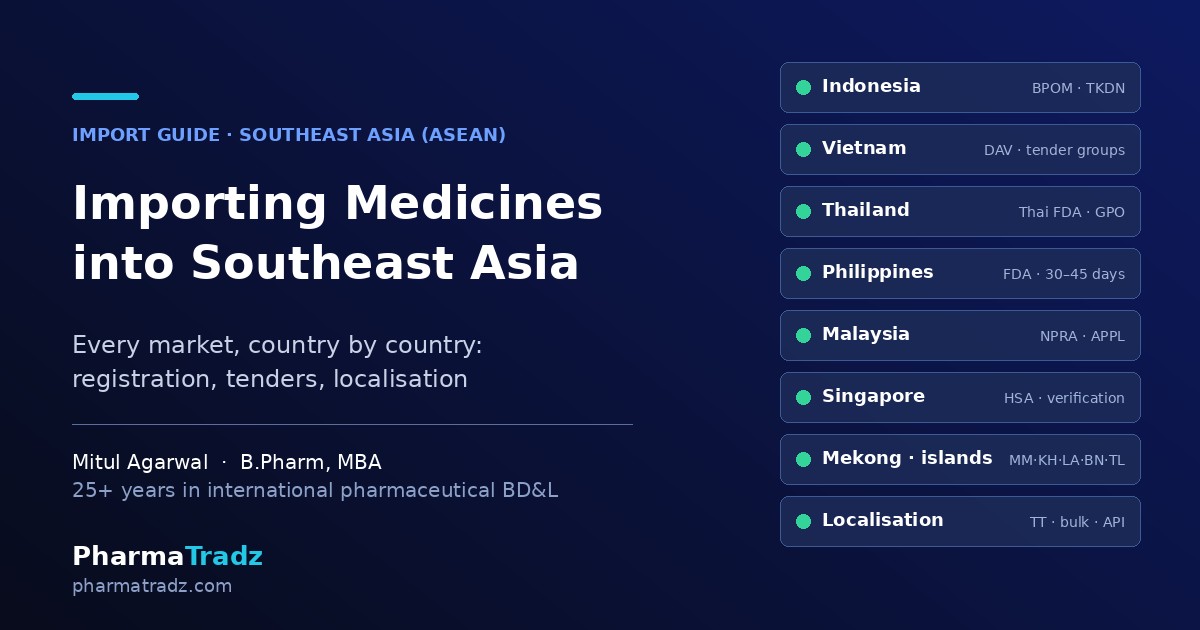
Last updated: 27 September 2026. Part of our region-by-region import guide series. Covers all eleven ASEAN members.
Also available in Bahasa Indonesia and Tiếng Việt.
Southeast Asia shares one dossier format, the ACTD, but not one set of rules. Singapore, Malaysia and the Philippines fast-track products already approved by trusted regulators. Vietnam's tenders reward EU-GMP plants. Indonesia only lets local manufacturers register medicines and pushes imports towards local production. Thailand and Vietnam steer public buyers towards local makers. Myanmar, Cambodia, Laos, Brunei and Timor-Leste are import-led but bring their own payment and access challenges. Almost everywhere you need a locally registered company to hold the registration, and the fastest routes go to products with FDA, EMA or similar approvals.
This guide walks through every market in plain language:
- The big six: Indonesia, Vietnam, Thailand, the Philippines, Malaysia and Singapore.
- The other five: Myanmar, Cambodia, Laos, Brunei and Timor-Leste, which joined ASEAN in October 2025.
It's written for manufacturers in India, China, Korea, Europe and the US who export to the region, and for the regional distributors and importers who work with them.
Importing into Southeast Asia? Tell us what you need.
- Distributors, importers and tender bidders: post a sourcing RFQ with the product, destination country and registration status, and we'll match you with GMP-certified manufacturers who can supply your market.
- Hospitals, doctors and patients who need an unregistered medicine through a named-patient or special import route: submit a request for proposal (RFP).
How the region works
The same three doors exist here as everywhere else: register and sell commercially, supply public tenders, or use a special import route for an unregistered medicine a patient needs. A few regional features shape all of them:
- One dossier format. All ASEAN members accept the ASEAN Common Technical Dossier (ACTD), and several also take the ICH CTD. Our guide to CTD vs ACTD explains the differences.
- A GMP deal that mostly helps ASEAN plants. Under the ASEAN GMP mutual recognition arrangement, members accept GMP inspection reports from Singapore, Malaysia, Indonesia, Thailand and the Philippines. Plants outside ASEAN still need their own GMP evidence, such as a PIC/S certificate, or an inspection.
- A local holder is almost always required. Registrations are held by a locally incorporated company, importer or representative.
- Reliance is strong in some markets, absent in others. Singapore, Malaysia, the Philippines, Vietnam, Indonesia and Cambodia have routes built on approvals from trusted regulators. Thailand has none for medicines that we could find.
- Local makers get a leg up. Indonesia, Vietnam, Thailand, the Philippines and Malaysia all favour local production in public tenders, in different ways.
- Joint work is coming. ASEAN runs joint assessments of dossiers, and Indonesia, Malaysia, Thailand and Singapore met in July 2026 to discuss wider reliance and work-sharing.
The biggest markets at a glance
| Country | Regulator | Fast track for products approved abroad | Main public buyer | Local preference |
|---|---|---|---|---|
| Indonesia | BPOM (WHO-listed authority) | Reliance review in 90 working days | Ministry of Health e-catalogue (JKN) | Local content (TKDN) thresholds; imports only in set cases |
| Vietnam | DAV | Reference route in 9 months using EMA or stringent-regulator reports | Public hospital tenders | Tender groups by GMP standard; priority list of 93 local drugs |
| Thailand | Thai FDA | None found for medicines | NHSO, GPO, Rajavithi Hospital | State-owned GPO central to public supply |
| Philippines | FDA Philippines | Abridged (45 working days) and verification (30) | Government agencies (PhilGEPS) | 25% price preference for domestic bidders |
| Malaysia | NPRA | Abridged (90 working days) and verification (30) | Single logistics concession (APPL) | Off-take contracts proposed for local makers |
| Singapore | HSA (WHO ML4) | Verification in 60–120 working days | ALPS | None; price negotiated through HTA and subsidy lists |
Indonesia
- Who can register: only an Indonesian pharmaceutical manufacturer with an industry licence. A foreign manufacturer registers through a local manufacturer, usually its affiliate or a licensed partner, with written authorisation.
- When imports are allowed: BPOM's rules allow imported finished products only in set cases: special technology, not enough local capacity, products it isn't economic to make locally (including orphan drugs), or central manufacture abroad by a multinational that also has a plant in Indonesia. The rules also expect gradual technology transfer towards local production.
- Registration: ACTD format. BPOM cut its reliance review from 120 to 90 working days in 2025, and says new drugs from companies investing in Indonesia can be approved in 50 working days. Imported products made up only about 14% of approvals from 2023 to 2025.
- Foreign plants: since December 2025, BPOM assesses foreign plants by document review, then remote inspection, then on-site inspection if needed. GMP decisions last up to two years.
- Tenders: public supply for the national health insurance scheme (JKN) runs through the Ministry of Health's e-catalogue, which sets minimum local content (TKDN) thresholds. BPOM says 85% of JKN medicines are made in Indonesia.
- Status: BPOM became a WHO-listed authority in December 2025, a first for a standalone regulator from a middle-income country.
Vietnam
- Who can register: a foreign company with a representative office in Vietnam, or a licensed Vietnamese pharmaceutical company acting for it. Dossiers use ACTD, and DAV may inspect foreign plants.
- Fast track: under Circular 12/2025, in force since July 2025, standard review takes about 12 months. A reference route of about nine months uses EMA or stringent-regulator assessment reports issued within five years.
- New law: the amended Law on Pharmacy, effective July 2025, lets foreign-invested companies import raw materials for contract manufacturers and buy back products made through their technology transfer.
- Pricing: wholesale prices must be declared before launch, and the Ministry of Health can step in when a price is well above comparable products.
- Tenders: generics are grouped by quality standard in public tenders:
- Group 1: EU-GMP lines or stringent-regulator approval.
- Group 2: EU-GMP or PIC/S GMP.
- Group 3: proven bioequivalence.
- Group 4: made in Vietnam with GMP.
- Group 5: everything else.
- Localisation: a domestic vaccine company and a multinational originator are building a vaccine plant due to finish at the end of 2027, and dozens of branded drugs have been transferred to local makers.
Thailand
- Who imports: only a licensed importer of modern drugs. Foreign plants need Thai FDA GMP clearance before a sample import licence is issued.
- Registration: about 120 working days for generics and 220 for new drugs. From July 2026, renewals every seven years become a real reassessment and need a current foreign GMP certificate. We found no reliance route for medicines.
- Pricing: the Department of Internal Trade sets maximum retail prices, and public hospitals must buy at or below a maximum purchasing price.
- Tenders: central purchasing runs through the National Health Security Office, Rajavithi Hospital and the state-owned Government Pharmaceutical Organization (GPO). Industry sources say public buyers must source a large share of essential medicines from the GPO or military factories.
- Without registration: government hospitals can import for individual patients when there's no alternative in Thailand.
- Partnerships: the GPO partners with foreign companies, for example a Korean vaccine maker on flu vaccine technology.
The Philippines
- Who imports: an FDA-licensed local importer or distributor with a licence to operate.
- Fast track: an abridged route takes up to 45 working days for products approved by one reference regulator in the past three years, and a verification route takes 30 working days with two. The product must be identical to the reference-approved one, with stability data for hot and humid climates. ICH CTD and ACTD are both accepted.
- Pricing: maximum retail prices under the Cheaper Medicines Act cover about 120 molecules.
- Tenders: government buying is based on the Philippine National Formulary. Since 2024, the New Government Procurement Act gives domestic bidders a 25% price preference, and allows negotiated purchase of specialised life-saving medicines.
- Without registration: a Compassionate Special Permit covers unregistered medicines, under rules updated in December 2025.
Malaysia
- Who can register: the registration holder must be a locally incorporated company, and each import needs an import licence.
- Timelines: 245 working days for new chemical entities and biologics, 210 for generics.
- Fast track: since 2024, a facilitated route relies on approvals from the FDA, EMA, TGA, Health Canada, PMDA, Swissmedic and MHRA, as well as ASEAN joint assessments and WHO decisions. Abridged review takes 90 working days and verification 30.
- Tenders: a single logistics concession covers more than 700 products on the Approved Products Purchase List, renewed for ten years in 2023. The Ministry of Health has proposed three-year off-take contracts for local makers of single-source off-patent drugs.
- Pricing: a 2025 order requiring clinics and pharmacies to display drug prices was stayed by the High Court in May 2026.
Singapore
- Regulator: HSA, a WHO maturity level 4 regulator and WHO-listed authority for medicines.
- Routes: full, abridged and verification. Verification relies on approval by two of the FDA, EMA, Health Canada, MHRA, Swissmedic and TGA. Target timelines are 60 working days for a new drug and 120 for a generic on verification, against 270 on the full route.
- Pricing: there are no statutory price caps. Prices are managed through health technology assessment, subsidy lists and bulk buying.
- Tenders: ALPS handles central sourcing for public healthcare, open to Singapore-registered companies. Its current round covers contracts from December 2026 to March 2030.
- Without registration: the Special Access Route lets licensed hospitals, clinics, pharmacies and importers bring in unregistered medicines for named patients, with a target of 14 working days and no fee.
Myanmar, Cambodia, Laos, Brunei and Timor-Leste
Myanmar
- Registration: a Myanmar-resident representative applies to the FDA with the manufacturer's authorisation, using ACTD, a GMP certificate and a CPP. Since 2024, applications are online, imported drugs pay annual fees and are lab-tested every five years.
- Importing: after registration, the FDA issues an import approval certificate and the Department of Trade an import licence.
- Watch out for: since September 2024, pharma import licences have been tied to the importer's export earnings and foreign-exchange approval. Conflict has also cut supply routes, and US sanctions rules apply, so screen your counterparties.
Cambodia
- Registration: a Cambodian pharmaceutical company applies to the Department of Drugs and Food through its online system, using CTD or ACTD with a home-country GMP certificate.
- Fast track: DDF's guidance describes an abridged route for products approved by PIC/S members and a verification route for products approved by the FDA, EMA, TGA, Health Canada, Medsafe, Japan or WHO.
- Importing: each shipment needs an import permit. The market is import-led, and the Ministry of Health buys once a year from the essential medicines list.
Laos
- Registration: foreign companies apply through licensed local representatives to the Food and Drug Department, online only since January 2026. Laos takes part in WHO's collaborative schemes for prequalified and stringent-regulator-approved products.
- Tenders: the Medical Products Supply Centre runs national tenders, with preference for local makers.
- Watch out for: importing unregistered drugs is banned, and the kip has weakened sharply against the Thai baht.
Brunei
- Registration: a local representative applies to the Medicines Control Authority, using ACTD in English or Malay. Brunei takes part in WHO's scheme for stringent-regulator-approved products, and consultants describe an abridged route for some products registered in benchmark countries.
- Tenders: the Ministry of Health publishes medicine supply tenders, and special-approval import permits cover unregistered products.
Timor-Leste
- Registration: oversight is split across Ministry of Health directorates, and a single national regulator is planned. Only registered or ministry-authorised medicines may enter the market.
- Tenders: the national pharmacy institute, INFPM (formerly SAMES), buys and stores medicines for the public sector. Timor-Leste takes part in WHO's collaborative registration schemes.
- Market: fully imported, with no local production yet.
Localisation isn't only a barrier: bulk, API, tech transfer and partnerships
Across Southeast Asia, the rules push the same way: Indonesia expects imports to move towards local manufacture, Vietnam rewards local EU-GMP lines in tenders, and Malaysia and the Philippines are adding preferences for local makers. In our experience of business development in the region, that creates real partnership demand:
- Tech transfer to a local manufacturer. In Indonesia it's often the only long-term way to stay in the market. Bio Farma and a multinational vaccine originator, for example, signed a technology transfer for a pneumococcal vaccine in 2025, building on their HPV vaccine deal.
- Contract manufacturing and buy-back. Vietnam's 2025 law lets foreign-invested companies supply raw materials to local contract manufacturers and buy back products made through their technology.
- Ready-to-fill bulk and APIs for local plants in Vietnam, Indonesia, Thailand and the Philippines that want to add products quickly. See our guide to CEP vs DMF vs ASMF.
- Licensing and joint ventures, especially in vaccines and biologicals. The new vaccine plant in Vietnam and the GPO's partnerships in Thailand are examples. Our guide to out-licensing a dossier explains how licence deals are priced.
If you're a regional company looking for a licence, bulk supply or technology partner, post an RFQ and choose dossier licensing as the registration need.
What this means for exporters in India, China, Korea, Europe and the US
For every exporter
- Prepare an ACTD dossier. It works everywhere in ASEAN, though the Philippines and some others also take ICH CTD.
- Have your plant's GMP evidence ready. Outside ASEAN, PIC/S or EU-GMP certificates carry the most weight, and Thailand, Indonesia and Vietnam may inspect.
- Pick markets by route. If your product has FDA or EMA approval, Singapore, Malaysia and the Philippines can be quick wins. If not, plan for standard review.
- Think local early in Indonesia. Finished imports are limited, so plan a local partner and a path to local manufacture.
Exporters in India
- Vietnam's tender groups matter most. Products made in Indian plants without EU-GMP usually fall into lower groups. An EU-GMP-approved line or a PIC/S certificate moves you up and opens higher-value tenders.
- The Philippines and Cambodia are practical entry points. Both are import-led and have routes built on reference approvals. Cambodia's abridged route covers products approved by PIC/S members.
- Myanmar needs caution. Import licences depend on the importer's export earnings, so confirm your buyer can pay before shipping.
Exporters in China
- APIs and partnerships are the natural way in. Local manufacturers across the region need API sources, and Indonesia's rules favour companies that invest locally.
- Expect standard review. The reliance routes in Singapore, Malaysia and the Philippines are built on Western and WHO approvals.
Exporters in Korea
- Vaccines and biologicals are the opening. A Korean vaccine maker's work with Thailand's GPO shows how Korean companies partner in the region.
- Check each reference list. Malaysia's and Singapore's reference regulators don't include Korea's MFDS, so plan for full review there unless you also hold a Western approval.
Exporters in Europe
- EMA approval and EU-GMP are powerful here. They open Singapore's and Malaysia's verification routes, the Philippines' fast tracks and Vietnam's reference route, and they put you in Vietnam's top tender group.
- Expect partnership requests. Indonesia and Vietnam actively encourage technology transfer from European originators.
Exporters in the US
- FDA approval opens the fastest routes in Singapore, Malaysia, the Philippines and Cambodia.
- Named-patient demand is real. Singapore's Special Access Route, the Philippines' Compassionate Special Permit and Thailand's hospital imports get newer medicines to patients before registration.
- Check sanctions for Myanmar. US rules apply, so screen every counterparty.
Ready to source for your market?
- Importers, distributors and tender bidders in Southeast Asia: post your sourcing RFQ. Our RFQ guide shows what to include.
- Hospitals and patients needing an unregistered medicine: submit an RFP for named-patient import.
- Manufacturers looking to supply the region, whether finished products, bulk, APIs or tech transfer and licensing: list your company and products so buyers and agents can find you.
This guide summarises public regulations and official sources as of September 2026. Rules change often in this region. Confirm current requirements with the regulator or a local regulatory partner before acting.
Selling into more than one region? Here are the other guides:
- Latin America and the Caribbean
- Middle East and North Africa
- Sub-Saharan Africa
- Russia and the CIS
- South Asia (SAARC)
Or see them all in one place: import guides by region.
Sources
- List of regulators operating at WHO maturity levels 3 and 4 (WHO, August 2026)
- Australia and Indonesia achieve WHO-listed authority status (WHO, December 2025)
- ASEAN sectoral MRA on GMP inspection of manufacturers of medicinal products (ASEAN)
- ASEAN joint assessment (HSA, March 2026)
- Four-country regulatory collaboration (BPOM, July 2026)
- BPOM Regulation 24/2017 on drug registration (BPOM)
- BPOM Regulation 23/2025 (BPK)
- BPOM speeds up drug registration in 2025 (BPOM, December 2025)
- 50-working-day approval for investing companies (Inilah, April 2026)
- BPOM Regulation 33/2025 on imported-drug manufacturing sites (Veritask)
- Local content requirements for the e-catalogue (Mondaq / SSEK, 2025)
- Ministry of Industry Regulation 35/2025 on local content (BPK)
- Bio Farma PCV15 vaccine technology transfer (West Java Provincial Government, February 2025)
- Vietnam amends the Law on Pharmacy (Tilleke & Gibbins)
- Vietnam's new drug registration rules (Tilleke & Gibbins, 2025)
- Circular 12/2025 on marketing authorisation (Aliat Legal)
- Decree 163/2025 guidance on the amended Law on Pharmacy (Tilleke & Gibbins)
- Circular 07/2024 on drug bidding at public health facilities (LuatVietnam)
- Vietnam's next-generation vaccine manufacturing (VietNamNet, July 2026)
- FAQs on medicines (Thai FDA)
- New Thai FDA requirements for registration renewals (Mahanakorn Partners)
- Thailand medical products profile (WHO, 2025)
- Korean vaccine maker's deal to support vaccine manufacturing in Thailand (Fierce Pharma, July 2023)
- FDA Circular 2022-004-A on abridged and verification pathways, extended to generics (FDA Philippines)
- Maximum drug retail prices fully implemented (Philippine News Agency, 2022)
- Republic Act 12009, New Government Procurement Act (Lawphil, 2024)
- Administrative Order 2025-0024 on Compassionate Special Permits (FDA Philippines)
- Drug Registration Guidance Document, July 2025 (NPRA Malaysia)
- Malaysia's NPRA updates regulatory pathways (RAPS, November 2023)
- High Court stays drug price display enforcement (CodeBlue, May 2026)
- Drug logistics concession renewed for ten years (CodeBlue, June 2023)
- Proposed three-year off-take contracts for local makers (CodeBlue, January 2025)
- Evaluation routes (HSA Singapore)
- Target processing timelines (HSA Singapore, April 2026)
- Cost of medicines and improving affordability (Ministry of Health Singapore)
- Pharmaceutical sourcing events (ALPS)
- Special Access Route: import for patients (HSA Singapore, May 2026)
- Myanmar FDA Notification 161/2023 (WTO import licensing)
- Drug registration guideline (Myanmar Trade Portal, 2014)
- Myanmar import licensing procedure for medicines (WTO)
- Import curbs on medicines in Myanmar (The Irrawaddy, September 2024)
- Burma healthcare (US International Trade Administration, March 2026)
- Therapeutic product registration in Cambodia (DDF, 2019)
- Cambodia import licensing procedure for medicines (WTO)
- Cambodia healthcare (US International Trade Administration, November 2025)
- Drug registration regulation (Lao Trade Portal)
- Laos implements online registration (Tilleke & Gibbins, February 2026)
- Decision 1820/MoH on pharmaceutical import businesses (Lao Trade Portal)
- Lao PDR economic outlook (ADB, April 2026)
- Countries in the SRA collaborative registration procedure (WHO, November 2024)
- Pharmaceutical services (Ministry of Health Brunei)
- Timor-Leste admitted into ASEAN (ASEAN, October 2025)
- National Medicines and Health Products Policy (Timor-Leste, 2025)
- National Institute of Pharmacy and Medical Products (INFPM, Timor-Leste)
Frequently Asked Questions(FAQs)
Is there one registration for all of ASEAN?
No. ASEAN shares a dossier format (ACTD) and runs joint assessments, but each country issues its own registration.
Can a foreign company register medicines in Indonesia?
Not directly. Only an Indonesian pharmaceutical manufacturer can register, and imports are allowed only in set cases, with an expectation of moving towards local production.
Which Southeast Asian markets fast-track products approved abroad?
Singapore, Malaysia and the Philippines have verification and abridged routes, Vietnam has a reference route, Indonesia a reliance review, and Cambodia abridged and verification routes. Laos, Brunei and Timor-Leste take part in WHO's collaborative schemes.
What are Vietnam's tender groups?
Public tenders group generics by quality: EU-GMP or stringent-regulator approval first, then PIC/S GMP, then proven bioequivalence, then Vietnamese GMP products, then all others. Your group largely decides which tenders you can win.
Can unregistered medicines be imported for patients?
Yes, in several markets: Singapore's Special Access Route, the Philippines' Compassionate Special Permit, Thai government hospital imports and Brunei's special-approval permits. Laos bans imports of unregistered drugs.