
Last updated: 25 September 2026. Part of our region-by-region import guide series. Covers every country in sub-Saharan Africa.
Also available in Français and Português.
Africa isn't one market. It's more than 45 regulators, a handful of regional shortcuts, and some of the fastest-changing rules anywhere in pharma. The basics hold almost everywhere: you need a local agent or licensed importer, a CTD dossier and a GMP-cleared plant, and public supply runs through central medical stores and donor programmes. What's changing fast is localisation. Nigeria, Ghana, Senegal, Ethiopia, Uganda and Kenya now reserve some products for local manufacturers or favour them in tenders. That narrows the door for finished imports, but it opens a bigger one for bulk, APIs, tech transfer and licensing.
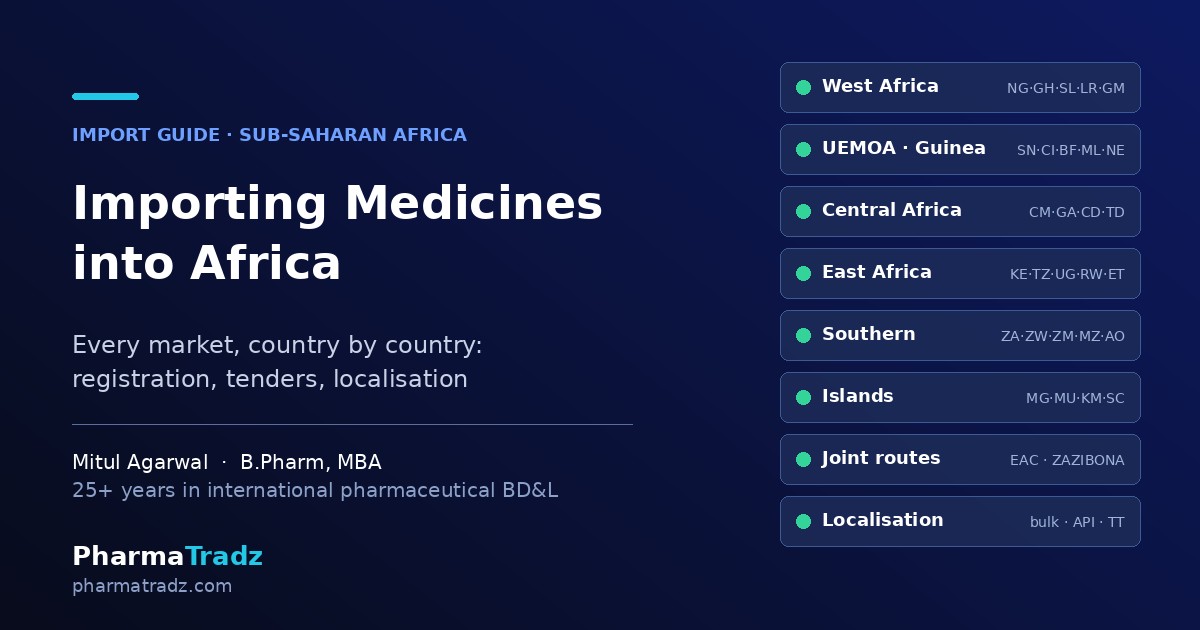
This guide walks through every market in plain language:
- West Africa: Nigeria, Ghana, Sierra Leone, Liberia, The Gambia, Cabo Verde and Guinea-Bissau.
- Francophone West Africa: Senegal, Côte d'Ivoire, Burkina Faso, Mali, Niger, Togo, Benin and Guinea.
- Central Africa: Cameroon, Gabon, the DR Congo, the Republic of Congo, Chad, the Central African Republic, Equatorial Guinea, and São Tomé and Príncipe.
- East Africa: Kenya, Tanzania (including Zanzibar), Uganda, Rwanda, Burundi, Ethiopia, Eritrea and South Sudan.
- Southern Africa: South Africa, Zimbabwe, Zambia, Mozambique, Malawi, Botswana, Namibia, Angola, Lesotho and Eswatini.
- The Indian Ocean islands: Madagascar, Mauritius, the Comoros and Seychelles.
Egypt, Libya, Tunisia, Algeria, Morocco, Sudan, Djibouti, Somalia and Mauritania are covered in our Middle East and North Africa guide. This one is written for manufacturers in India, China, Korea, Europe and the US who export to Africa, and for the African distributors and importers who work with them.
Importing into an African market? Tell us what you need.
- Distributors, importers and tender bidders: post a sourcing RFQ with the product, destination country and registration status, and we'll match you with GMP-certified manufacturers who can supply your market.
- Hospitals, doctors and patients who need an unregistered medicine through a named-patient or special import route: submit a request for proposal (RFP).
How the region works
The same three doors exist here as everywhere else: register and sell commercially, supply public tenders, or use a special import route for an unregistered medicine a patient needs. A few things shape all of them in Africa:
- You need a local partner. Almost every regulator requires a local agent, local technical representative or licensed importer to hold or manage the registration.
- The plant matters as much as the product. Nigeria, Ghana, Sierra Leone, Tanzania and others inspect foreign plants or require proof they've been inspected. Some charge the inspection to you.
- Regulators are getting stronger. Ten African regulators now operate at WHO maturity level 3: Egypt, Ghana, Nigeria, Tanzania, Rwanda, Senegal, Ethiopia, Zimbabwe and Mozambique for medicines, and South Africa for vaccines. That usually means more rigour, but also better reliance routes.
- Public supply runs through central stores and donors. Most countries have a central medical store that tenders for the public sector. HIV, TB, malaria and vaccines are often bought separately by the Global Fund, UNICEF, Gavi and US government programmes.
- Localisation is real and growing. Several countries now reserve products for local manufacturers, suspend imports of locally made molecules, or give local makers a price preference in tenders.
- Foreign exchange decides who gets paid. In Malawi, Zimbabwe, Ethiopia, Mozambique and elsewhere, access to dollars is often the real bottleneck, not registration.
Regional shortcuts worth knowing
Africa has several ways to get one dossier reviewed for many countries at once. None of them replaces national registration yet, but they can cut the work and time a lot.
| Route | Countries | How it works |
|---|---|---|
| ECOWAS joint assessment (WAHO) | 15 ECOWAS states | One eCTD dossier through the WAHO portal. Fees of US$500 screening plus US$8,000–12,000 evaluation. Member states are meant to register within 60 days of a regional recommendation. |
| UEMOA Regulation 04/2020 | Senegal, Côte d'Ivoire, Mali, Burkina Faso, Niger, Togo, Benin, Guinea-Bissau | Harmonised CTD registration rules and fees, with room for one state to rely on another's assessment. Marketing authorisations stay national and last five years. |
| EAC joint assessment | Kenya, Tanzania, Uganda, Rwanda, Burundi, South Sudan and other EAC states | One CTD dossier assessed jointly, led by Tanzania's TMDA. Targets a recommendation by day 300, then national registration, though each country decides for itself. |
| IGAD joint assessment | Ethiopia, Kenya, Uganda, South Sudan, Sudan, Somalia, Djibouti | The March 2026 round took CTD dossiers with no IGAD fee, targeting 210 days plus 90 days for national registration. Applicants commit to marketing in at least two member states. |
| ZAZIBONA (SADC) | Active: Botswana, DRC, Malawi, Mozambique, Namibia, South Africa, Tanzania, Zambia, Zimbabwe | A CTD dossier filed in at least two active members is assessed jointly. Countries then fast-track it; Malawi decides within 90 days. |
Above all of these sits the African Medicines Agency (AMA), based in Kigali. Its first Director General, Dr Delese Mimi Darko, was appointed in June 2025, and the agency's own site lists 32 ratifications as of May 2026. For now it coordinates national regulators rather than issuing its own approvals, but it's the direction of travel.
The biggest markets at a glance
| Country | Regulator | Fast track for products approved abroad | Main public buyer | Localisation rule |
|---|---|---|---|---|
| South Africa | SAHPRA | Reliance routes on FDA, EU, MHRA and other reference approvals | National Department of Health tenders | Tender points for specific goals |
| Nigeria | NAFDAC (ML3) | Reliance decision in 60 working days | Federal and state programmes; donors | Import ceiling list; "5+5" policy |
| Kenya | PPB | Verification and abridged reviews | KEMSA | 15% price preference for local makers |
| Ethiopia | EFDA (ML3) | Abbreviated route for SRA-approved and WHO-prequalified products | EPSS | No international tenders for locally supplied products |
| Ghana | FDA (ML3) | Reliance on well-resourced regulators | Central Medical Stores; framework contracts | About two dozen formulations reserved for local makers |
| Tanzania | TMDA (ML3) | Abridged route | MSD | Local products bought first |
| Côte d'Ivoire | AIRP | Reliance decisions | NPSP | Investment incentives |
| Senegal | ARP (ML3) | UEMOA reliance | PNA | One-year import suspensions for locally made molecules |
West Africa
Nigeria
- Who imports: a Nigerian importer or agent applies to NAFDAC, holding a notarised power of attorney from the manufacturer. Your GMP certificate must be authenticated by the Nigerian embassy or high commission.
- Registration: a CTD dossier with bioequivalence data, a target of 240 working days, and five-year registration. NAFDAC has been at WHO maturity level 3 since 2022, re-confirmed in 2025.
- Fast track: since September 2025, a reliance route covers products approved for over six months by the FDA, EMA, Japan, Swissmedic, Health Canada, TGA and others, or prequalified by WHO. Decisions come in 60 working days. But the foreign plant inspection isn't waived. A reference regulator's GMP certificate just lowers its priority.
- The big restriction: NAFDAC won't take new applications for products on the federal import prohibition list, its own "ceiling list" of products made locally, or banned formulations. The ceiling list grew from 9 items to 34 by 2024, and press reports in 2026 put it at 36.
- "5+5" policy: an importer of a product that can be made locally gets one final five-year renewal. By year three, it must show a plan to move to local manufacture or partner with a local maker. That makes partnerships a practical necessity for many products.
- Incentives: since March 2025, pharma inputs, including APIs, excipients and packaging, have come in free of duty and VAT for two years, under a 2024 executive order.
- Tenders: public supply is split between federal and state programmes, with donors (Gavi, the Global Fund, US programmes) buying for their own disease programmes.
Ghana
- Who imports: a foreign applicant appoints one local representative, a Ghanaian company with a wholesale licence authorised to import. Only registered products can be imported, under a one-year import permit.
- Registration: a CTD dossier (Modules 1–5), and only products made at sites the FDA has found GMP-compliant. The FDA has been at WHO maturity level 3 since 2020. Full review takes about 180 days, and a reliance route takes the reference regulator's assessment reports.
- The big restriction: the FDA's import guideline reserves around two dozen formulations for local manufacturers, including amoxicillin, paracetamol, metronidazole, ibuprofen and lisinopril. Check the list before you file.
- Without registration: a September 2025 guideline lets doctors import unregistered biologicals and vaccines for named patients, up to three months' supply.
- Tenders: the Ministry of Health uses framework contracts through the Central Medical Stores and Ghana Health Service. Reimbursement follows the NHIS Medicines List.
Sierra Leone
- Who imports: a foreign applicant needs a local agent, either a registered import company or a pharmacist. The regulator is the Pharmacy Board of Sierra Leone.
- Registration: a CTD dossier with a three-month target. Fees run from US$250 for a generic to US$720 for a new drug.
- GMP: foreign plants are inspected before first approval and every three years, for a US$7,500 fee. The inspection can be waived for sites inspected by a reference regulator.
- Tenders: the National Medical Supplies Agency handles all public procurement.
Liberia
- Who imports: a local responsible person incorporated in Liberia, registering with the LMHRA.
- Registration: WAHO CTD format, a three-month target and three-year registration. A product with a positive WAHO recommendation is registered once the decision arrives and fees are paid.
- Tenders: the Ministry of Health and Central Medical Stores buy for the public sector, while the Global Fund and US programmes buy their own supplies.
The Gambia
- Who imports: a local agent registers with the Medicines Control Agency.
- Registration: CTD (WHO, ICH and WAHO formats accepted). Standard review takes 180 days. An abridged 90-day review covers WHO-prequalified products and those approved by recognised regulators.
- Tenders: the Central Medical Stores buys for the public sector.
Cabo Verde
- Registration: the regulator, ERIS, must authorise every medicine before sale, for five years, and has a recognition (reliance) procedure.
- Without registration: a special import route (IEM) covers essential medicines not sold locally.
- Pricing: ERIS sets maximum wholesale and retail prices. EMPROFAC is the state importer, though the government has said it wants a more competitive import market.
Guinea-Bissau
- The pharmacy directorate (DIFALRM) requires all products to be registered, and UEMOA's harmonised rules apply. The regulator has limited capacity and relies on WHO support, and much public supply comes through donor programmes.
Francophone West Africa
The eight UEMOA countries share the CFA franc and, since 2020, harmonised registration rules under Regulation 04/2020/CM/UEMOA. It uses a CTD dossier, a five-year marketing authorisation (AMM), a standard timeline of about 120 days that can stretch to a year with questions, and a special import authorisation for exceptional public-health needs. Locally made products pay half the registration fee. Mali, Burkina Faso and Niger left ECOWAS in January 2025 but remain in UEMOA.
The private market here runs through a few large wholesaler-importers, and prices are usually set by fixed coefficients on the landed price.
Senegal
- Regulator: the Agence sénégalaise de Réglementation Pharmaceutique (ARP), set up in 2022. In 2024 it became the first francophone African regulator to reach WHO maturity level 3.
- Registration: UEMOA rules, with a new fee decree in force since December 2025. ARP also has a temporary authorisation (ATU) route for unregistered products.
- The big restriction: since 22 September 2025, imports of specific molecules made locally have been suspended for a year, as long as local makers hold three months of national stock. The first list covered indapamide, levofloxacin, omeprazole, albendazole, ibuprofen and a diclofenac–paracetamol combination. Check whether the list has been renewed or extended.
- Market: imports were around €310 million in 2023, about 70% private. PNA is the public buyer, and the government's target is 50% local production by 2035.
Côte d'Ivoire
- Who imports: only establishments licensed by the regulator, AIRP, and every import needs its authorisation. Wholesalers get annual authorisations, others get one per shipment, and decisions come within 72 hours.
- Without registration: a special import authorisation (ASI) covers unregistered products, and a 2026 decision added emergency-use authorisations.
- Market: worth around €537 million, over 90% imported. NPSP is the public buyer, and a Chinese-owned plant for antimalarials and antibiotics is part of a push to build local production.
Burkina Faso
- Regulator: the Agence Nationale de Régulation Pharmaceutique (ANRP).
- Tenders: CAMEG, the central buyer, prequalifies each product and manufacturer pair for three years, then invites them to restricted tenders. Get prequalified early.
- Pricing: in May 2025 the government cut prices on many essential medicines and vaccines, some by more than half, and trimmed public-sector margins.
Mali, Niger, Togo and Benin
- Mali: registration is still handled by the Direction de la Pharmacie et du Médicament, under UEMOA rules. Insecurity affects supply routes inland.
- Niger: a national regulatory agency (ANRP) was created in 2022.
- Togo: the government approved a decree creating a new national medicines agency on 7 September 2026. Expect procedures to change as it gets going.
- Benin: ABMed, created in 2023, handles registration and import authorisations.
Guinea
- Guinea isn't in UEMOA and uses its own currency. The Direction Nationale de la Pharmacie et du Médicament registers products, and an EU-backed reform of the pharmaceutical law began in 2026, aiming to lower prices and close informal supply channels.
Central Africa
The CEMAC countries share the Central African CFA franc, but there's no regional marketing authorisation. OCEAC, the regional health body, is working towards mutual recognition, starting with priority and emergency medicines.
Cameroon
- Registration: the Ministry of Health's DPML takes a CTD dossier. The national commission gives its opinion within three months and the minister decides within two more. The AMM lasts five years, and there's an abridged route for WHO-prequalified and SRA-approved products.
- Who imports: a local liaison pharmacist is required, and every import needs a prior technical import visa.
- Tenders: CENAME, reorganised in 2024, tenders for essential medicines, though most imports come through private wholesalers.
Gabon
- The regulator, ANMAPS, grants five-year authorisations and two-year temporary ones, takes CTD dossiers in French, and accepts WHO prequalification. The Office Pharmaceutique National buys for the public sector.
DR Congo
- Regulator: ACOREP, which took over from the old pharmacy directorate in 2020. Authorisations last five years.
- Imports: ACOREP now checks import permits and the cold chain at the port of Matadi.
- Market: huge and fragmented, with a national supply programme coordinating public procurement. The DRC is an active ZAZIBONA member, which can help.
Chad, the Republic of Congo, the Central African Republic, Equatorial Guinea, and São Tomé and Príncipe
Official information on these five markets is thin. In each, registration runs through the Ministry of Health's pharmacy department, and donor programmes (the Global Fund, UNICEF and others) carry much of the public supply. Chad's public buyer is the Centrale Pharmaceutique d'Achats. Equatorial Guinea works in Spanish, and São Tomé and Príncipe in Portuguese. Before quoting in any of them, confirm current requirements directly with the ministry or an experienced local importer.
East Africa
Kenya
- Who imports: a foreign applicant appoints one local technical representative (LTR), a Kenyan company with a wholesale licence. The regulator is the Pharmacy and Poisons Board (PPB), which is working towards WHO maturity level 3. A bill to replace it with a new authority is still before Parliament.
- Registration: a CTD dossier through the PRIMS portal, with a CPP. The targets are 90 days for verification review, 105 for abridged and 262 for full review, but full generic reviews have taken much longer in practice. New fees under the 2022 rules apply in full from January 2026.
- Tenders: KEMSA gives local manufacturers a 15% price preference, and a large share of the public budget has been set aside for local makers.
- Watch out for: Kenya has approved no parallel imports since October 2025, and track-and-trace rules are rolling out from August 2026.
Tanzania and Zanzibar
- Regulator: TMDA, WHO maturity level 3 since 2018 and the lead on the EAC joint assessment. Zanzibar has its own regulator, ZFDA, which registers products and issues import permits separately.
- Fees: the 2021 regulations set US$2,000 to register an imported product (US$3,000 for a biological), US$300 a year to keep it, and foreign GMP inspections from US$4,000 to US$7,500 depending on the region. Import permits cost 2% of FOB value.
- Timelines: a 180-day target for full review, and 126 days for the abridged route.
- Without registration: special permits under Section 57 cover unregistered products.
- Tenders: the Medical Stores Department (MSD) buys locally made products first if they meet quality standards. MSD also hosts the SADC pooled procurement service.
Uganda
- Regulator: the National Drug Authority. A new law replacing the 1993 act was signed in April 2026. It adds lot release for vaccines and biologicals, and routes for unregistered medicines for trials, personal, compassionate and emergency use.
- Timelines: targets of 90 days for verification, 105 for abridged and 261 for full review.
- Tenders: National Medical Stores buys 37 molecules only from local makers, and local sourcing reached 64% by March 2026. Industry wants that list expanded to 100.
Rwanda
- Regulator: Rwanda FDA, WHO maturity level 3 since 2024 and home to the African Medicines Agency.
- Fast track: since February 2024, an abbreviated route covers products approved by stringent regulators, WHO-listed authorities or WHO prequalification, or assessed by the EMA, AMA or the EAC joint assessment. Decisions come in 90 days, but you'll need zone IVb stability data.
- Tenders: Rwanda Medical Supply tenders on its own e-procurement portal.
Burundi
- The regulator, ABREMA, handles registration, and import authorisations go through the electronic single window. Foreign exchange is tight, so agree payment terms carefully.
Ethiopia
- Who imports: the local agent must be a pharmacist based in Ethiopia. The regulator, EFDA, reached WHO maturity level 3 in September 2025.
- Registration: a CTD dossier through the eRIS system. There's an abbreviated route for SRA-approved, WHO-prequalified and collaborative-registration products, and a fast track for HIV, TB, malaria, cancer and vaccines. Foreign sites may be inspected.
- The big restriction: a 2025 Ministry of Finance directive stops EPSS, the public buyer, from running international tenders for products local manufacturers can supply. Local production now covers more than 40% of supply.
- Watch out for: foreign-exchange risk after the birr was floated in 2024, and government caps on price rises in public outlets.
Eritrea
- A closed, state-controlled market. PHARMECOR, the state company, imports and distributes medicines. Eritrea left IGAD in December 2025 and hasn't signed the AMA treaty.
South Sudan
- The Drug and Food Control Authority licenses importers and requires registration before import. With renewed conflict in 2026 and falling donor funding, most supply comes through UN and donor channels.
Southern Africa
South Africa
- Who imports: the applicant must be resident in South Africa. A foreign company applies through a local responsible person, and a registered pharmacist signs the application. Dossiers are in ZA-CTD format, with eCTD preferred.
- Fast track: SAHPRA's 2025 reliance guideline accepts approvals from the EU, US FDA, Health Canada, MHRA, PMDA, Swissmedic, TGA and WHO-listed authorities, plus WHO prequalification and ZAZIBONA. The product must be identical to the one the reference regulator assessed. A site approved by a recognised regulator in the past three years may not need a SAHPRA inspection.
- Timelines: trade press reports targets of about 250 working days for generics without clinical data, 360 for new medicines and biosimilars, and 200 for reliance routes. SAHPRA ran a backlog clearance project through 2025.
- Pricing: the Single Exit Price (SEP) is the only price at which a manufacturer may sell to anyone other than the state. The 2026 adjustment was 1.47%, and news reports say a further 2.88% rise takes effect on 1 October 2026.
- Tenders: the National Department of Health runs central contracts, scored on price plus points for "specific goals". The 2024 Public Procurement Act, which would have added set-asides, was struck down by the Constitutional Court in September 2026, so the current rules continue for now.
- Without registration: Section 21 authorisations let a doctor get an unregistered medicine for named patients through a licensed importer, with a stated turnaround of up to three working days.
Zimbabwe
- Regulator: MCAZ, WHO maturity level 3 since 2024. Only licensed professionals or approved persons may import, from licensed premises. Section 75 covers unregistered medicines.
- Tenders: NatPharm, the central store, is badly underfunded and owed money by hospitals, with stock-outs of basics.
- Watch out for: most business still runs in US dollars, and reserves are thin.
Zambia
- ZAMRA is an active ZAZIBONA member and, since July 2025, recognises Egyptian EDA approvals for Egyptian-made medicines within 30 working days. ZAMMSA buys for the public sector.
Mozambique
- Regulator: ANARME, which reached WHO maturity level 3 in August 2026, the first Portuguese-speaking African regulator to do so.
- Registration: a CTD dossier with Module 1 in Portuguese and zone IVb stability data. There are full, abridged, recognition and collaborative routes.
- Tenders: CMAM buys for the public sector. Watch foreign-exchange availability and public debt.
Malawi
- PMRA fast-tracks products recommended by ZAZIBONA, deciding within 90 days. But the central store, CMST, is reported to owe US$18 million to foreign suppliers, with very limited access to foreign exchange. New import duties of 20–25% on paracetamol, ibuprofen, aspirin, artemether-lumefantrine and amoxicillin aim to push local production.
Botswana
- BoMRA is implementing a new 2025 medicines act. Its draft regulations add reliance on trusted regulators, mutual recognition and lot release. A public health emergency over medicine shortages was declared in August 2025.
Namibia
- The NMRC requires a CTD dossier and a local representative, and sets no fixed timelines because of its backlog. Fast-track, SRA-reliance, WHO collaborative and ZAZIBONA routes exist. The government has announced direct government-to-government purchasing, including with India and Egypt.
Angola
- The regulator, ARMED, launched an electronic registration system (SIREMA) in 2024. CECOMA, the state central buyer, runs e-auctions, and the government is backing new local plants.
Lesotho and Eswatini
- Lesotho: a new medicines authority act came into force on 1 March 2026, making registration and licensing mandatory.
- Eswatini: a 2016 act provides for an autonomous medicines authority, which is still being set up.
- Both mainly import through South Africa, so check the current requirements with the ministry of health.
The Indian Ocean islands
- Madagascar: registration goes through the Agence du Médicament de Madagascar. It's a non-active ZAZIBONA member.
- Mauritius: only wholesale pharmacies licensed by the Pharmacy Board may import, and products need Pharmacy Board registration or authorisation.
- Comoros: the national medicines agency, ANAMEV, created in 2017, handles registration and import control.
- Seychelles: Pharmaceutical Services endorses imports. The AU's regulatory profile says there's no formal registration system, so confirm the current process.
Donors and pooled buyers
For many African markets, the biggest buyers of HIV, TB, malaria, reproductive health products and vaccines aren't the governments. They're the donor programmes, and they have their own supplier rules:
- The Global Fund buys through its pooled procurement mechanism and wambo.org, and suppliers must meet its quality policy (usually WHO prequalification or SRA approval). Its 2026–2028 country allocations total US$10.78 billion, with higher co-financing from countries.
- UNICEF publishes its technical requirements for pharmaceutical products, now in the seventh edition (May 2026).
- US government programmes changed in 2025 when USAID was dissolved and commodity buying moved to the State Department, with funding set to decline after 2026.
- The SADC pooled procurement service, hosted by Tanzania's MSD, expects savings of up to 40% and aims to be fully operating by the end of 2026.
- Africa CDC's African Pooled Procurement Mechanism is accrediting suppliers. A Ugandan manufacturer joined in September 2026.
As donor funding shrinks and countries pay more themselves, national tenders will matter more. That's a good reason to get registered now.
Localisation isn't only a barrier: bulk, API, tech transfer and partnerships
Across Africa, governments want more medicines made at home. Nigeria's "5+5" policy literally tells importers to plan a move to local manufacture or partner with a local maker. Senegal suspends imports of locally made molecules. Ethiopia keeps international tenders away from products local plants can supply, and Uganda's National Medical Stores buys 37 molecules only from local makers.
For exporters of finished doses, that's a narrowing door. But in our experience of business development in the region, the partnership door is opening wider, and local companies need foreign partners to build what governments are asking for:
- Ready-to-fill bulk. Many local plants start by filling and packing imported bulk, whether that's sterile solution, tablets or granules. It gets them to market quickly while they build full capability.
- APIs and inputs. Nigeria has removed duty and VAT on APIs, excipients and packaging to encourage local production. New plants need qualified API sources, ideally with a CEP or US DMF. See our guide to CEP vs DMF vs ASMF.
- Technology transfer. The foreign manufacturer transfers the process and know-how, and the local partner registers and sells. In the UEMOA countries, locally made products even pay half the registration fee.
- Licensing and royalties. Instead of a supply margin, the manufacturer earns upfront fees, milestones and royalties. Our guide to out-licensing a dossier explains how those deals are priced.
- Joint ventures. For bigger commitments, the foreign partner supplies bulk at first, then transfers technology, then becomes a co-owner or licensor.
It's strongest in vaccines, insulin, biologicals and other products that local companies can't easily develop alone. Some recent examples:
- In South Africa, a local vaccine producer won a state vaccine contract starting in January 2027 that includes a hexavalent vaccine finished locally under a tech transfer from a European originator. IFC and the EIB are backing its new vaccine plant.
- A South African manufacturer received approval in 2026 to release the first commercial batches of human insulin made in Gqeberha for a European originator.
- Kenya launched an mRNA technology transfer programme with WHO and the Medicines Patent Pool in February 2026.
- Senegal's Institut Pasteur de Dakar is building the MADIBA vaccine plant, with IFC, DFC and AfDB financing.
- Ghana's National Vaccine Institute is working with local partners on a tetanus-diphtheria vaccine fill-finish product.
- Ethiopia's local production now covers more than 40% of supply, with around 30 investors in the Kilinto industrial zone.
If you're a manufacturer, ask your African distributors whether they're planning local production. The partner who supplies bulk today is often first in line for the tech transfer and licence tomorrow. And if you're an African company building local capability, post an RFQ and choose dossier licensing as the registration need, and we'll help you find manufacturers open to bulk supply, tech transfer or licensing.
What this means for exporters in India, China, Korea, Europe and the US
For every exporter
- Use the regional shortcuts. One dossier through ZAZIBONA, the EAC, IGAD or ECOWAS can reach several countries. It's still slower than it should be, but far cheaper than filing a dozen times.
- Check the local-manufacturing lists first. Nigeria's ceiling list, Ghana's reserved formulations, Senegal's import suspensions and Uganda's 37 molecules can make a registration worthless before you start.
- Prepare for plant inspections. Nigeria, Ghana, Sierra Leone and Tanzania can all inspect your plant, and the cost usually falls on you.
- Price the payment risk. In Malawi, Zimbabwe, Ethiopia, Mozambique and elsewhere, access to foreign exchange matters more than the tender price. Letters of credit, advance payment or strong local partners make the difference.
- Know your buyers. Central medical stores (KEMSA, MSD, NMS, EPSS, CAMEG, PNA and others) and donor programmes each have their own supplier registration. Get registered before the tender you want is published.
- Offer more than finished doses. Where localisation shuts out imports, bulk, APIs, tech transfer and licensing can keep you in the market.
Exporters in India
- Get your paperwork right for Nigeria. Your GMP certificate must be authenticated by the Nigerian mission, and NAFDAC will still inspect your plant even with a reliance application.
- WHO prequalification is valuable here. It opens reliance routes in Nigeria, The Gambia, Rwanda, Ethiopia and South Africa, and it's the usual ticket for Global Fund and UNICEF supply.
- Watch the local lists closely. Many of the molecules reserved for local makers, such as amoxicillin, paracetamol, ibuprofen and metronidazole, are exactly where Indian generics compete. That's where bulk supply and tech transfer can replace lost finished-dose sales.
- Government-to-government deals are opening. Namibia has announced direct purchasing from countries including India.
Exporters in China
- Expect standard review unless you have WHO prequalification or an SRA approval. Most African reliance routes are built on FDA, EMA, other stringent regulators and WHO prequalification.
- APIs and inputs are the natural way in. Nigeria's duty-free inputs and every new local plant in Ethiopia, Kenya, Ghana and elsewhere create demand for qualified API suppliers.
- Local plants with foreign investment are already a model. A Chinese group's plant in Côte d'Ivoire is one example of the shift from exporting to making locally.
Exporters in Korea
- Vaccines and biologicals are the opening. Senegal, Kenya, Ghana, Rwanda and South Africa are all building vaccine and biological capacity and need licensing and fill-finish partners.
- Reference approvals still count most. Reliance routes in South Africa, Rwanda and Nigeria lean on FDA, EMA and WHO prequalification. For biologicals, plan for lot release requirements, now being added in Uganda and Botswana.
Exporters in Europe
- EMA approval and EU GMP open reliance routes almost everywhere. They count in South Africa, Nigeria, Rwanda, Ethiopia, Kenya, Ghana and The Gambia.
- Francophone markets are familiar ground. The UEMOA and CEMAC markets use French-language dossiers and a price structure inherited from France, and France supplied over half of Senegal's medicine imports in 2023.
- Expect to be asked about local production. European partners are already behind many of the region's localisation projects, from originator tech transfers to the EIB's vaccine financing.
Exporters in the US
- FDA approval is accepted by nearly every reliance route in this guide.
- Plan for changing US-funded programmes. With USAID gone and US commodity funding set to decline after 2026, more demand will move to national tenders and the Global Fund.
- Named-patient demand is real. South Africa's Section 21, Ghana's named-patient route and Côte d'Ivoire's special import authorisations get newer medicines to patients before full registration.
Ready to source for your market?
- Importers, distributors and tender bidders in Africa: post your sourcing RFQ. Our RFQ guide shows what to include.
- Hospitals and patients needing an unregistered medicine: submit an RFP for named-patient import.
- Manufacturers looking to supply Africa, whether finished products, bulk, APIs or tech transfer and licensing: list your company and products so buyers and agents can find you.
This guide summarises public regulations and official sources as of September 2026. Rules, fees and payment conditions change often in this region, and several regulators are being restructured. Confirm current requirements with the regulator or a local regulatory partner before acting.
Selling into more than one region? Here are the other guides:
- Latin America and the Caribbean
- Middle East and North Africa
- Russia and the CIS
- South Asia (SAARC)
- Southeast Asia (ASEAN)
Or see them all in one place: import guides by region.
Sources
- List of regulators operating at WHO maturity levels 3 and 4 (WHO, August 2026)
- Mozambique reaches maturity level 3 (WHO, August 2026)
- Senegal and Rwanda reach maturity level 3 (WHO, December 2024)
- Ethiopia reaches maturity level 3 (WHO, September 2025)
- Zimbabwe reaches maturity level 3 (WHO, June 2024)
- First Director General of the African Medicines Agency (African Union, June 2025)
- AMA treaty ratifications (African Medicines Agency)
- Interview with the AMA Director General (Health Policy Watch, July 2026)
- ECOWAS joint assessment eCTD portal (WAHO)
- Navigating the ECOWAS joint assessment procedure (IFPMA, May 2023)
- Evaluation of the ECOWAS medicines regulatory harmonisation (Frontiers in Medicine, September 2023)
- Regulation 04/2020/CM/UEMOA on registration procedures (UEMOA, via ARP Senegal)
- Review of UEMOA registration procedures (JATPB, March 2026)
- EAC medicines regulatory harmonisation programme (TMDA)
- EAC joint assessment performance (Frontiers in Pharmacology, 2022)
- Regulatory review timelines in East African regulators (Frontiers in Medicine, 2024)
- IGAD joint assessment call (IGAD, March 2026)
- Eritrea's withdrawal from IGAD (IGAD, December 2025)
- About ZAZIBONA
- Registration of ZAZIBONA-recommended medicines (PMRA Malawi, August 2024)
- SADC pooled procurement services (SADC, April 2026)
- Guidelines for registration of imported drug products (NAFDAC, March 2025)
- Reliance procedure guidelines (NAFDAC, September 2025)
- Federal Government statement on medicine costs and the ceiling list (NAFDAC, May 2024)
- 5+5 policy cuts drug imports (Vanguard, September 2026)
- Executive order on zero VAT for pharmaceutical manufacturers (Federal Ministry of Information, October 2024)
- Customs implements zero tariff on pharmaceutical inputs (Channels TV, March 2025)
- Guidelines on registration of allopathic drugs (Ghana FDA, January 2024)
- Guidelines on importation of drugs (Ghana FDA, January 2024)
- Import of unregistered biologicals for named patients (Ghana FDA, September 2025)
- Health Supply Chain Master Plan 2025–2029 (Ghana Ministry of Health)
- National Vaccine Institute progress (Ghana News Agency, June 2025)
- GMP guideline (Pharmacy Board of Sierra Leone, May 2024)
- Medicines registration guideline (Pharmacy Board of Sierra Leone, via NIH ClinRegs)
- Sierra Leone regulatory profile (AUDA-NEPAD AMRH)
- Guidelines for registration of medicines (LMHRA Liberia)
- Registration of medicines guideline (Medicines Control Agency, The Gambia, April 2020)
- Marketing authorisation (ERIS, Cabo Verde)
- Special import of medicines (ERIS, Cabo Verde)
- Guinea-Bissau regulatory profile (AUDA-NEPAD AMRH)
- Start of the medicine import "correlation" (Senegal Ministry of Health, September 2025)
- Senegal medicines market (Team France Export)
- IFC and partners support Institut Pasteur de Dakar (IFC, December 2024)
- Importing pharmaceutical products into Côte d'Ivoire (GUCE single window)
- Côte d'Ivoire medicines market (Team France Export, November 2025)
- IFC financing for a pharmaceutical plant in Côte d'Ivoire (Agence Ecofin, June 2023)
- Pharmaceutical regulation in Burkina Faso (LEEM Afrique)
- Burkina Faso cuts medicine prices (Burkina24, May 2025)
- Direction de la Pharmacie et du Médicament (Mali)
- Pharmaceutical regulation in Niger (LEEM Afrique)
- Council of Ministers decisions, 7 September 2026 (Togo)
- About ABMed (Benin)
- Guinea pharmaceutical reform (Guinéenews, March 2025)
- CEMAC countries harmonise medicine policy (Gabonactu, March 2024)
- Registration guide for pharmaceutical products (DPML Cameroon, June 2023)
- Pharmaceutical regulation in Cameroon (LEEM Afrique)
- Medicine registration (ANMAPS Gabon)
- DR Congo regulatory profile (NIH ClinRegs, December 2025)
- ACOREP opens office in Matadi (Radio Okapi, January 2026)
- Marketing authorisation FAQ (Pharmacy and Poisons Board, Kenya)
- Implementation of regulatory fees under the 2022 rules (PPB Kenya)
- Pharmaceutical sector pack (Invest Kenya, March 2026)
- Kenya bans parallel drug imports (People Daily, July 2026)
- Kenya launches mRNA technology transfer programme (KEMRI, February 2026)
- Fees and charges regulations 2021 (TMDA Tanzania)
- Import and export control (TMDA Tanzania)
- Medicines and cosmetics (Zanzibar Food and Drug Agency)
- Tanzania to prioritise local products (The Respondents, May 2026)
- Parliament passes medicines reforms (Parliament of Uganda, March 2026)
- New National Drug and Health Products Authority law signed (Nile Post, April 2026)
- Local pharmaceutical procurement in Uganda (UBC, September 2026)
- Ugandan pharma joins the AU pooled procurement mechanism (The EastAfrican, September 2026)
- Abbreviated registration procedures (Rwanda FDA, February 2024)
- Rwanda Medical Supply
- Pharmaceutical regulation in Burundi (LEEM Afrique)
- Guideline for registration of medicines (EFDA Ethiopia, 2023)
- Directive on EPSS international tenders (The Reporter Ethiopia, June 2025)
- Price caps after the birr float (The Reporter Ethiopia, September 2024)
- Building Ethiopia's pharmaceutical future (World Bank, May 2026)
- Medicine supply in Eritrea (Shabait, August 2025)
- Drug and Food Control Authority (South Sudan)
- Conflict in South Sudan (UN News, September 2026)
- Reliance guideline v5 (SAHPRA, August 2025)
- General information guideline v10 (SAHPRA, July 2019)
- SAHPRA steps into 2026 (Vet's Hub, February 2026)
- Annual single exit price adjustment (South African Government)
- Medicine prices rise 2.88% (BusinessDay, September 2026)
- Constitutional Court rules Public Procurement Act invalid (BusinessDay, September 2026)
- Section 21 overview (SAHPRA)
- IFC, EIB Group and European Commission back a South African vaccine plant (IFC, April 2026)
- Local producer secures state vaccine contract (BusinessDay, May 2026)
- First locally made human insulin batches approved for release (Engineering News, May 2026)
- Frequently asked questions (MCAZ Zimbabwe)
- Hospital debt cripples NatPharm (CITE, September 2026)
- ZAMRA–EDA reliance notice (ZAMRA Zambia, July 2025)
- Marketing authorisation (ANARME Mozambique)
- CMST debt to foreign suppliers (Nyasa Times, September 2026)
- Malawi's new tariffs on imported medicines (Nyasa Times)
- BoMRA regulatory reform (BoMRA Botswana, August 2026)
- Registration (NMRC Namibia)
- Namibia moves to direct procurement (New Era, July 2025)
- ARMED launches medicine registration system (Angola Ministry of Health, June 2024)
- Lesotho Medicines and Medical Devices Control Authority Act in force (Mayet & Associates, March 2026)
- Import regulations for pharmaceuticals (Mauritius Trade Easy)
- Strengthening ANAMEV (WHO Africa, November 2018)
- Seychelles regulatory profile (AUDA-NEPAD AMRH)
- Information for suppliers (Global Fund)
- Eighth replenishment outcome (Global Fund, February 2026)
- Technical requirements for pharmaceutical products (UNICEF, May 2026)
- The America First global health strategy and pooled procurement (KFF)
Frequently Asked Questions(FAQs)
Do I need a local agent to sell medicines in Africa?
Almost always. Nigeria, Ghana, Kenya, Ethiopia, South Africa, Cameroon and most other markets require a local agent, representative or licensed importer to hold or manage the registration.
Is there one registration for all of Africa?
Not yet. The African Medicines Agency coordinates national regulators but doesn't issue its own approvals. Regional joint assessments through ECOWAS, the EAC, IGAD and ZAZIBONA can cover several countries with one dossier, followed by national registration.
Which African regulators are at WHO maturity level 3?
For medicines: Egypt, Ghana, Nigeria, Tanzania, Rwanda, Senegal, Ethiopia, Zimbabwe and Mozambique. South Africa is at level 3 for vaccines.
Can I import generics that are made locally?
Often not. Nigeria's ceiling list, Ghana's reserved formulations, Senegal's import suspensions, Ethiopia's tender rules and Uganda's local-only list all restrict imports of products made locally. Check before you invest in registration.
Can unregistered medicines be imported for patients in Africa?
Yes, in many countries. Examples include South Africa's Section 21, Tanzania's Section 57 permits, Ghana's named-patient route, Côte d'Ivoire's special import authorisation, Cabo Verde's special import route and Zimbabwe's Section 75.