
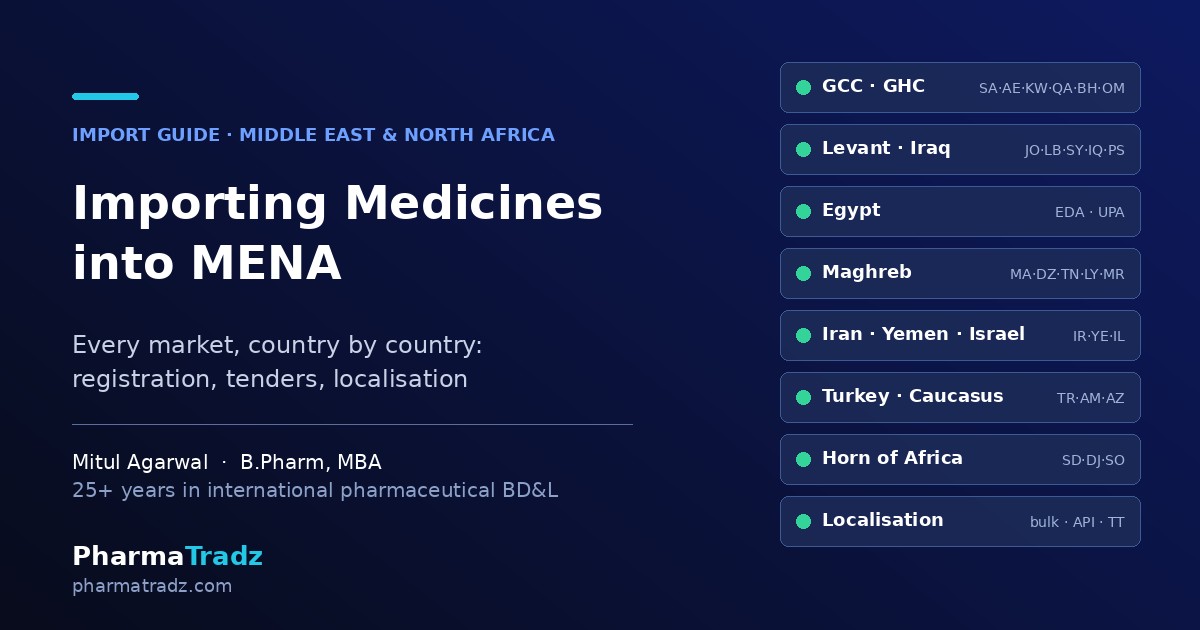
Last updated: 25 September 2026. Part of our region-by-region import guide series. Covers every country in the Middle East and North Africa.
Also available in العربية and Français.
The Middle East and North Africa rewards exporters who respect how different each market is. The Gulf is organised and well funded, with a shared registration system and joint tenders, but you need a local agent and a GMP-cleared plant. Egypt and North Africa are big, price-sensitive and increasingly protective of local manufacturing. Iraq, Iran, Lebanon, Syria, Yemen, Libya and Palestine can be real opportunities, but payment, sanctions and security shape every deal. Almost everywhere, a local company holds the registration or controls the import, and products already approved by the FDA or EMA move faster. And as governments push local manufacturing, the growing opportunity is shifting from finished doses to bulk, APIs, tech transfer and partnerships.
This guide walks through every market in plain language:
- The Gulf: Saudi Arabia, the UAE, Kuwait, Qatar, Bahrain and Oman, plus the Gulf Health Council's shared registration and joint procurement.
- The Levant and Iraq: Jordan, Lebanon, Syria, Iraq (including Kurdistan) and Palestine.
- North Africa: Egypt, Libya, Tunisia, Algeria and Morocco.
- Iran, Yemen and Israel.
- The countries sometimes counted in MENA: Turkey, Armenia, Azerbaijan, Sudan, Djibouti, Somalia (including Somaliland), Mauritania and Western Sahara.
- Localisation as an opportunity: ready-to-fill bulk, API supply, tech transfer, licensing and joint ventures.
It's written for manufacturers exporting to the region from India, China, Korea, Europe and the US, and for the regional distributors and importers who work with them.
Importing into the Middle East or North Africa? Tell us what you need.
- Distributors, importers and tender bidders: post a sourcing RFQ with the product, destination country and registration status, and we'll match you with GMP-certified manufacturers who can supply your market.
- Hospitals, doctors and patients who need an unregistered medicine through a named-patient or special import route: submit a request for proposal (RFP).
How the region works
The same three doors exist here as everywhere else: register and sell commercially, supply public tenders, or use a special import route for an unregistered medicine a patient needs. But MENA has a few features of its own that shape everything:
- Agents are central. In most countries, a licensed local agent or company must hold the registration or handle the import, often with an exclusive, registered agency agreement.
- The plant is registered, not just the product. In the Gulf, Iraq and elsewhere, the manufacturing company and site are registered or GMP-cleared first, then the product.
- Price is set at registration. Most regulators fix the price as part of approval, usually by comparing reference countries.
- Localisation is rising. Saudi Arabia, the UAE, Egypt, Algeria and Morocco all favour local manufacturing, in tenders and sometimes by restricting imports.
- Some state buyers dominate. In several countries, one state body does the importing: Iraq's Kimadia, Tunisia's PCT, Algeria's PCH for hospitals, Libya's MSO and Egypt's UPA.
The biggest markets at a glance
| Country | Regulator | Fast track for products approved abroad | Main public buyer |
|---|---|---|---|
| Saudi Arabia | SFDA | 30–60 working days relying on FDA/EMA, for new medicines and biologicals | NUPCO |
| UAE | EDE | Fast track for innovative and orphan medicines | Emirates Health Services; Rafed (Abu Dhabi) |
| Egypt | EDA | Reliance procedures; generics limited by the "box" system | UPA |
| Algeria | ANPP | Temporary authorisation for products approved by recognised regulators | PCH |
| Morocco | AMMPS | None found | Ministry of Health tenders |
| Iraq | MOH | About one month for FDA/EMA-approved products | Kimadia |
| Israel | MOH | 70–120 days relying on FDA, EMA, MHRA and others | Health funds (HMOs) |
| Jordan | JFDA | 60–90 days relying on FDA/EMA | Government Procurement Department |
The Gulf: one council, six markets
Before looking at each Gulf country, it's worth knowing about the Gulf Health Council (GHC), because it can open all six at once.
- Central registration. The GHC registers both manufacturing companies and products centrally, with two member states leading each assessment. After central approval, each country still issues its own national certificate, including the price. GMP inspection can be waived if a member state inspected the site within the past two years without issues. Average approval times fell from 838 days in 2015 to 321 days in 2019. Abridged reviews averaged about 61 days and verification reviews about 21.
- Joint procurement. The GHC runs group purchasing for the six GCC states plus Yemen. Only companies registered with the Council may bid, and it publishes an annual tender schedule. For a manufacturer, being GHC-registered is the entry ticket to some of the region's largest public tenders.
Saudi Arabia
- Who imports: foreign product owners can't file directly. They need a Saudi agent licensed by the Ministry of Commerce and a Saudi-based pharmacovigilance officer, and every manufacturing site needs SFDA GMP clearance. The marketing authorisation holder must own the product or be linked to an SFDA-registered site. A pure trading company doesn't qualify.
- Registration: the SFDA's verification (30 working days) and abridged (60 working days) routes rely on FDA and/or EMA approval. They cover new chemical entities and biologicals, not biosimilars or generics, and have conditions on timing and manufacturing location. Generics follow the standard route. Prices are set under the SFDA's pricing rules as part of approval.
- Tenders: NUPCO buys for the public health sector. Supplier registration needs a Saudi commercial registration and related certificates, so foreign firms bid through a Saudi entity, and products need SFDA registration. Local products get a 10% price preference in government tenders, and a mandatory list steers public buyers to local products. A new government tenders law was approved in August 2026.
United Arab Emirates
- Who imports: the federal regulator is now the Emirates Drug Establishment (EDE), which took over the Health Ministry's medicine services at the end of 2025. Under the medical products law in force since January 2025, the marketing authorisation holder names one main local pharmaceutical company for regulatory, vigilance and quality matters. It must also appoint at least two importers and at least one distributor.
- Registration: a law firm puts standard registration at three to six months, with a registration fee of AED 7,000. A fast track exists for innovative and orphan medicines with a positive opinion from an accredited international regulator.
- Without registration: unregistered medicines can be imported for emergencies or when unavailable, and for government hospitals, generally if registered in the country of origin, the US, EU or GCC.
- Tenders: Emirates Health Services buys through the federal supplier registration, which requires a UAE legal entity. Rafed buys for Abu Dhabi. In-country value (ICV) scores give local contributors an edge in awards.
Kuwait
- Who imports: a local agent licensed by both the Commerce and Health ministries, with a legalised letter naming it the sole or exclusive agent. The agency agreement must be registered.
- Registration: the company is registered first, then the product, using the GHC dossier format. Biologicals and biosimilars must already be approved by the FDA or EMA. Certificates last five years. Reforms announced in December 2025 set out several registration pathways with defined timelines, but the details weren't yet public when this was written.
Qatar
- Who imports: agents register with the Ministry of Public Health's pharmacy department, and health facilities buy only from authorised agents or licensed importers.
- Tenders: Hamad Medical Corporation's tender committee buys medicines for both HMC and the Ministry. Vendors register on HMC's e-business portal.
Bahrain
- Who imports: the National Health Regulatory Authority (NHRA) licenses manufacturers and distributors, and imports go through NHRA-authorised Bahraini entities.
- Registration: the NHRA publishes a medicine licensing guideline, updated in October 2025, covering registration, pricing and variations. Check the current version for any reliance route.
Oman
- Who imports: a company with a commercial registration, a pharmaceutical warehouse licence and a registered commercial agency.
- Registration: the Ministry of Health's Drug Safety Center registers companies and products, sets prices (landed cost plus a fixed margin) and monitors GMP. Its published service time for product registration is up to 360 working days.
- Without registration: the Drug Safety Center issues permits to import unregistered medicines for the private market and government hospitals, including for named patients. A law firm notes unregistered products may even be accepted in public tenders if the price is better.
The Levant and Iraq
Jordan
- Who imports: in practice, a local distributor or agent.
- Registration: a Certificate of Pharmaceutical Product is required, and the product must be marketed in its country of origin. A pricing committee can reject a product on price. Since 2019 the JFDA has had reliance routes: verification in 60 days with both FDA and EMA approval, and abridged review in 90 days with either. In 2024 a special registration route for shortage medicines approved 90 life-saving products.
- Without registration: individuals can import up to three months' supply with JFDA approval and a prescription.
- Tenders: the Government Procurement Department buys for the public sector and can now sign framework agreements of up to five years.
Lebanon
- Who imports: all imports must be under Ministry of Public Health control. About eight importers hold roughly 85% of the market, and most multinationals work through them.
- Registration: needs a CPP, proof of marketing in FDA or EMA jurisdictions, and reference prices. Prices reference seven European and seven Middle Eastern countries, and imported generics are capped at 30% below the originator. Be realistic about timing: registrations of innovative products have effectively stalled since 2020, with delays of more than four years.
- Watch out for: the currency has lost more than 95% of its value, and the grey market is estimated at a quarter of consumption. Public supply for the poorest relies heavily on donor-funded programmes.
Syria
- Registration: a 2026 Health Ministry decision set new conditions for registering and importing foreign medicines; check the details with a local partner. Local factories cover more than 80% of demand, and the government is prioritising local production of specialised medicines it currently imports.
- Watch out for: sanctions have eased considerably. The US Caesar Act was repealed in December 2025, and the UK and EU have also relaxed measures. Some designations remain, so do sanctions checks on every counterparty.
Iraq
- Who imports: the manufacturing company registers first, with GMP and a CPP from a recognised authority (FDA, EMA, UK, Swiss, Canadian, Australian, Japanese or GCC); without one, the Ministry inspects. The product is registered second.
- Registration: products approved by the FDA or EMA can get temporary registration and an import licence in about a month. The standard route takes about a year.
- Tenders: Kimadia is the state importer for the public sector. A local agent isn't mandatory to bid, but a local scientific office helps. Budget delays have hit Kimadia's payments in recent years, so check funding and payment terms before committing stock.
- Kurdistan Region: products are registered separately with the regional authority, but only after federal registration. The regional step takes about 14–30 working days.
Palestine
- Who imports: a trader registered with the Palestinian Authority, and imports need approval from both the Palestinian and Israeli health ministries.
- Watch out for: the Palestinian health system faces severe shortages and heavy debts in 2026, and many major suppliers have halted imports.
Egypt
Egypt is the region's largest market by population, with a capable regulator. In December 2024 WHO rated the Egyptian Drug Authority (EDA) at maturity level 3. But it has one rule every generic exporter needs to understand first.
- Who imports: a company registered with the EDA, and foreign manufacturers need a local representative.
- The "box" system: Egypt limits how many products with the same active ingredient can be registered. Each box holds 12: one brand and 11 generics. Only one imported product is allowed per box, and for complex products the box is the innovator plus five generics. So the first step is asking the EDA whether a place is free. Average time to market has been around two years, with a newer fast-track option.
- Reliance: the EDA has published reliance procedures for products approved by listed regulators, including shorter timelines for biologicals.
- Pricing: prices are set by reference to the lowest price in reference countries.
- Without registration: import of unregistered medicines is allowed when no registered equivalent is available or local supply is insufficient.
- Tenders: since 2020 the Unified Procurement Authority (UPA) has been the exclusive buyer for government health bodies. New three-party contracting rules came in during 2025, and its powers were reportedly trimmed amid unpaid debts. Foreign suppliers may bid in foreign currency.
- Watch out for: the 2023–2024 dollar shortage caused serious medicine shortages, and the government is pushing hard to localise manufacturing, including APIs.
North Africa
Morocco
- Who imports: only a Moroccan industrial pharmaceutical establishment can hold a marketing authorisation or import medicines, under an import visa from the new agency, AMMPS.
- Registration: AMMPS became operational in 2025. Its published procedure has no reliance route, though a 2026 bill would add conditional and emergency authorisations.
- Pricing: a July 2026 decree reshapes pricing. Products above MAD 300 ex-factory take the lowest reference-country price, the import mark-up falls from 10% to 2.5%, and all products are to be re-priced within 12 months. Expect margin pressure on imports.
- Without registration: named-patient, hospital-use and shortage authorisations, decided in 30 days, or seven if urgent.
- Tenders: the Ministry of Health buys by public tender; bidders must be commercial companies.
Algeria
- Who imports: imports are reserved to approved pharmaceutical establishments, and a foreign marketing authorisation holder must appoint a local operator, with joint liability.
- The big restriction: since 2009 Algeria has banned importing generics that are produced locally. Rules adopted in October 2025 require an annual import programme approved by the ministry and allow imports only to complement local production. DataMatrix coding follows from 2027.
- Without registration: temporary authorisations of up to a year cover serious diseases with no local equivalent, for products approved by a recognised authority such as the FDA. A 2024 list names 467 unregistered products that only PCH, the central hospital pharmacy, may import for public facilities.
- Tenders: PCH runs national and international open tenders for hospital medicines.
Tunisia
- Who imports: the Pharmacie Centrale de Tunisie (PCT) is the only establishment authorised to import medicines. Foreign companies need a local representative for registration.
- Registration: a new agency, ANMPS, was created in 2023 and launched an online portal in 2025. Imported products need proof of marketing in the country of origin, a CPP and price documents.
- Tenders: PCT runs international tenders through the national e-procurement system, with no nationality restriction.
- Watch out for: PCT carries heavy receivables from hospitals and social security, and foreign currency is tight, so payment terms matter.
Libya
- Who imports: the Medical Supply Organization (MSO) buys centrally for the public sector. In the private market, large Libyan companies act as agents for foreign manufacturers.
- Registration: products must be registered with the health authorities before import. In August 2026 Libya launched its first national formulary, which will determine which medicines, brands and source countries are imported. Getting onto it matters.
- Watch out for: foreign exchange. The central bank controls access to letters of credit by sector, and the dinar was devalued in both 2025 and January 2026, with a wide parallel-market gap.
Iran, Yemen and Israel
Iran
- Who imports: a local Iranian agent is mandatory, and the regulator prefers one importer per foreign supplier.
- Registration: needs a CPP legalised by an Iranian embassy and a CTD dossier. Imports with cheaper domestic equivalents are barred, so the opportunity is in medicines Iran doesn't make.
- Watch out for: US rules authorise medicine exports, but transactions can't involve designated persons or banks. The reimposition of UN sanctions in 2025 tightened foreign-currency access. Payment is the hard part.
Yemen
- Who imports: a local agent, with registration by the Supreme Board of Drugs and Medical Appliances. Suppliers report separate authority structures in Aden and Sana'a, and shipments to Hodeidah need UN inspection clearance.
- Watch out for: conflict and shortages. Much public supply runs through humanitarian and UN channels, and the Gulf joint procurement programme includes Yemen.
Israel
- Who imports: the registration holder must be the manufacturer's official Israeli representative, working through a licensed pharmacist.
- Registration: since March 2025, a two-year pilot has sped up reliance. Originals and biosimilars approved by at least two of the FDA, EMA, MHRA, Health Canada, Swissmedic or TGA within three years can be decided in 70 days, or 120 days with one approval. Generics of originals already registered in Israel, approved by one of those regulators within three years, can also be decided in 120 days. Maximum prices reference the lowest prices in several European countries.
- Without registration: pharmacies can apply for named-patient import permits ("Regulation 29") online, free, with processing in five business days.
The countries sometimes counted in MENA
Definitions of MENA vary. Some include Turkey, the South Caucasus and the Horn of Africa. These markets work very differently from the Gulf, so here's a short guide to each. Turkey will get a full guide in our developed-markets series, and Armenia and Azerbaijan will be covered again in the Russia and CIS guide.
Turkey
- Who imports: the licence holder must be established in Turkey, with a qualified responsible person. The regulator is TİTCK.
- Registration: a CTD dossier, with a target review time of 210 days once the file is accepted as complete. Foreign plants need a TİTCK GMP inspection or certificate, valid for three years. For years, waiting for that inspection has been the slowest step, so plan for it early.
- Pricing: the reference price is the lowest ex-factory price across a basket of European countries, converted at a fixed "medicine euro" set at 65% of the previous year's average exchange rate. From 1 April 2026 that rate is 29.1164 lira. Generics are generally priced at 60% of the reference price, with a higher price for the first generic in its early years.
- Reimbursement and tenders: for pharmacy sales, being on the SGK reimbursement list is what counts. Public hospitals buy through tenders on the EKAP e-procurement system.
- Without registration: medicines not available in Turkey can be imported for named patients with TİTCK approval, a prescription and a medical report, supplied through the Turkish Pharmacists' Association (TEB) or SGK.
- Watch out for: localisation. Turkey removed some imported products from reimbursement when companies wouldn't commit to local production, a measure that lost a WTO arbitration in 2022.
Armenia
- Registration: Armenia is a member of the Eurasian Economic Union (EAEU). Its expert centre still lists a national route alongside EAEU registration. Both use CTD dossiers, and a representative needs a power of attorney. Consultants describe a simplified national route of about 30 days for products approved in the EU, US or Japan or prequalified by WHO.
- EAEU transition: national registrations have to move onto EAEU rules. According to consultants, keeping a product on the market required filing for EAEU conformity by 31 December 2025, so check the status of any existing Armenian registration.
- Without registration: 2026 amendments to the Law on Medicines allow unregistered essential and cancer medicines to be imported.
- Tenders: public buying runs through the ARMEPS e-procurement system.
Azerbaijan
- Registration: Azerbaijan is not in the EAEU. The Analytical Expertise Center under the Ministry of Health handles registration and import authorisation under rules adopted in July 2024. Certificates last five years, and the patient leaflet needs a notarised Azerbaijani translation. There is also a route based on recognition of a foreign registration.
- Pricing: the Tariff Council sets maximum wholesale and retail prices.
- Public supply: since March 2026, TABIB supplies medicines to insured patients.
- Localisation: since June 2025, medicines packaged in Azerbaijan count as local goods and get preference in public procurement for five years. That makes local packing a real option for exporters.
Sudan
- Who imports: the National Medicines and Poisons Board (NMPB) registers products and controls imports at designated ports. Foreign manufacturers need a local agent with a legalised agency agreement.
- Registration: a CTD dossier and a plant GMP inspection. Indian export council data has put registration at around 12 months.
- Public supply: the National Medical Supplies Fund, now headquartered in Port Sudan, buys for the public sector. The Global Fund buys nearly all HIV, TB and malaria medicines, and UNICEF and WHO supply essential medicines under World Bank funding.
- Watch out for: the war that began in April 2023. Many health facilities are out of action, smuggled medicines are widespread, and shipping and insurance costs have risen sharply. The US also imposed wider export restrictions on Sudan in July 2026, so check sanctions rules and your bank's position before quoting.
Djibouti
- Registration: the regulator is the DMPL (Direction du Médicament, de la Pharmacie et des Laboratoires). The country's own 2023–2027 pharmaceutical policy says a full registration system is still being built.
- Who imports: there's no private wholesaler, so private pharmacies import directly from abroad. Prices are regulated.
- Public supply: CAMME is the central purchasing body, and UN agencies and the Global Fund supply disease-programme products.
Somalia and Somaliland
- Registration: an interim National Medicines Regulatory Authority (NMRA) was set up in 2023. A new Medicines Bill passed the lower house in January 2026.
- Import control: since 10 January 2025, all imported health products fall under NMRA import control and pre-shipment inspection. Much of the private market was previously unregulated, so expect the rules to keep tightening.
- Somaliland runs its own medicines regulatory authority. Check its requirements separately.
- Public supply: largely through UNICEF and other donor-funded channels.
A shortcut for the Horn of Africa: the IGAD joint assessment covers Sudan, Somalia and Djibouti, along with Ethiopia, Kenya, Uganda and South Sudan. The March 2026 round took CTD dossiers with no IGAD fee, targeting a decision in 210 days, after which each country adopts it nationally.
Mauritania
- Registration: the Direction de la Pharmacie et des Laboratoires grants marketing authorisations through an expert committee and controls imports, under the 2004 pharmacy law.
- Market: almost entirely import-dependent, with a government-led pharmaceutical reform under way to tackle counterfeits.
- Public supply: CAMEC is the central purchasing body for the public sector.
Western Sahara
- In the Moroccan-administered part, Moroccan rules apply, through the AMMPS (see Morocco above).
- The Sahrawi refugee camps near Tindouf in Algeria are supplied through humanitarian agencies, including UNHCR, WHO and UNICEF.
Localisation isn't only a barrier: bulk, API, tech transfer and partnerships
Read this guide end to end and one theme keeps coming back. Saudi Arabia, Egypt, Algeria, Morocco, Iran, Turkey and Azerbaijan are all pushing local manufacturing. For exporters of finished doses, that door is narrowing. But in our experience of business development in the region, another one is opening, and it's often the bigger one.
Local companies are building their own capabilities, and they need partners to do it. Here's what they're buying:
- Ready-to-fill bulk. Many start by buying bulk product (sterile bulk solution, bulk tablets or granules) and filling and packing it locally. It gets the product to market quickly, and rules like Azerbaijan's already treat local packing as local production.
- APIs. Every new local plant needs a qualified API source, with a CEP or DMF the local regulator will accept. See our guide to CEP vs DMF vs ASMF.
- Technology transfer. The local partner eventually wants to make the product itself. The foreign manufacturer transfers the process, analytical methods and know-how, and supports the local registration.
- Licensing and royalties. Instead of a supply margin, the manufacturer earns an upfront fee, milestones and a royalty on local sales. Our guide to out-licensing a dossier covers how these deals are priced.
- Joint ventures. For bigger commitments, the two sides share the plant, and roles shift over time: the foreign partner supplies bulk at first, then transfers technology, then becomes a co-owner or licensor.
This matters most in niche products, biosimilars and plasma-derived medicines, where local companies can't easily build the know-how from scratch. Some recent examples:
- In September 2026, an Indian biologics developer signed an exclusive licence and commercialisation deal with the biotech arm of a Saudi pharmaceutical group for PD-1 inhibitor biosimilars across MENA, including a phased tech transfer to build manufacturing in Saudi Arabia.
- In Egypt, a European plasma-medicines group set up a joint venture with the state's National Service Projects Organization. In 2023, Egyptian hospitals received their first albumin made from Egyptian plasma donations, fractionated in Spain for now, with local fractionation and purification plants under construction in the New Administrative Capital.
- The same group and Saudi Arabia's Public Investment Fund announced plans in 2020 for a joint venture covering plasma collection, fractionation and purification in the Kingdom.
If you're a manufacturer, it's worth asking your distributors in the region whether they're planning local production. Being the partner who supplies the bulk today often puts you first in line for the tech transfer and licence tomorrow. And if you're a regional company building local capability, we can help you find manufacturers open to bulk supply, tech transfer or licensing: post an RFQ and choose dossier licensing as the registration need.
What this means for exporters from India, China, Korea, Europe and the US
Where your plant sits matters in this region. Most fast tracks are built around a handful of reference regulators, and payment and sanctions rules depend on where you and your bank are based. Start with the points that apply to everyone, then read the notes for your home market.
For every exporter
- The Gulf is a system, so treat it as one. Get your plant GMP-cleared and registered with the Gulf Health Council, and you have a route into six markets and their joint tenders. Saudi Arabia's fastest routes are for new medicines, not generics, so budget for the standard timeline there.
- Check localisation before you invest. In Algeria, locally produced generics can't be imported at all. In Saudi Arabia and the UAE, local products get tender preferences. In Iran, anything with a cheaper local equivalent is barred.
- In Egypt, ask about the box first. If the box for your molecule already has its imported product, registration may simply not be possible.
- FDA or EMA approval opens doors. It gives you about a month in Iraq, 60–90 days in Jordan and 120 days in Israel.
- Price the payment risk. In Iraq, Libya, Lebanon, Tunisia and Iran, getting paid on time is often harder than getting registered. Letters of credit, advance payment or reliable local partners make the difference.
- Offer more than finished doses. Where localisation shuts out imports, bulk supply, APIs, tech transfer and licensing can keep you in the market, especially for biosimilars and complex injectables.
- Know your state buyers. Kimadia, UPA, PCH, PCT, MSO, NUPCO and the Gulf joint procurement programme each have their own supplier registration. Get registered before the tender you want is published.
Exporting from India
- A WHO-GMP certificate alone won't get you into the Gulf. Saudi Arabia and the Gulf Health Council register the plant itself and usually inspect it, so budget for the inspection and have the site ready before you file.
- Your US FDA or EU approvals are your fast track. A product approved only in India goes through the standard route almost everywhere. The same product with FDA or EMA approval can be decided in about a month in Iraq and 120 days in Israel.
- Price wins tenders, but check the rules first. Indian generics compete well in Kimadia, UPA, PCH and Gulf joint tenders. But Egypt allows only one imported product per box, Algeria bars imports of locally made generics, and Iran bars anything with a cheaper local equivalent.
- Look at partnerships early. The September 2026 PD-1 biosimilars deal shows the model: an Indian developer supplies and transfers technology, and the local partner registers and sells. It's worth offering bulk supply and tech transfer to your regional distributors before a competitor does.
Exporting from China
- Expect the standard route. None of the fast tracks in this guide names China's NMPA as a reference regulator. Unless the product also has FDA or EMA approval, plan for full review and, in the Gulf, a plant inspection.
- APIs are the natural way in. Every new local plant in Saudi Arabia, Egypt, Algeria and Morocco needs qualified API sources, and a CEP or US DMF makes you much easier to accept. See our guide to CEP vs DMF vs ASMF.
- Bulk and tech transfer fit the localisation push. Ready-to-fill bulk, biosimilars and tech transfer deals line up with what governments in the region are asking local companies to build.
Exporting from Korea
- Biosimilars and complex injectables are the opportunity. Saudi Arabia, Egypt and the wider region want local biosimilar capability, and Korean developers are well placed for licensing and tech transfer deals.
- PIC/S GMP helps, but reference approvals help more. Korea's MFDS is a PIC/S member, which supports your GMP evidence. But the fastest reviews in Saudi Arabia, Israel, Iraq and Jordan rely on FDA or EMA approval, not MFDS approval.
- Pick the right partner for the Gulf. For biologicals, the local agent needs cold-chain capacity, a pharmacovigilance set-up and tender experience with NUPCO and the Gulf joint procurement programme.
Exporting from Europe
- EMA approval and EU GMP open the fast routes. They unlock Saudi Arabia's reliance routes for new medicines and biologicals, about a month in Iraq, 60–90 days in Jordan and 70–120 days in Israel.
- Your European prices travel. Turkey and Israel set prices by reference to European prices, and Morocco's July 2026 decree takes the lowest reference-country price. Launch sequence and list prices in Europe will shape what you can charge in the region.
- Localisation will come to you. For originals and biosimilars in Saudi Arabia, Egypt, Algeria and Turkey, expect partners and governments to ask about local fill-finish, tech transfer or a joint venture. The plasma projects in Egypt and Saudi Arabia are examples.
Exporting from the US
- FDA approval is the strongest ticket in the region. Nearly every reliance or fast-track route in this guide accepts it, from Saudi Arabia to Israel.
- Sanctions compliance is your job. Medicine exports to Iran are authorised under US rules, but no designated person or bank can be involved. In July 2026 the US imposed wider export restrictions on Sudan. Screen distributors, banks and shipping routes in Syria, Yemen, Lebanon and Iraq too.
- Named-patient demand is real. Newer US-approved medicines can reach patients in the region first through special import routes, such as Israel's Regulation 29, Morocco's named-patient authorisations and Algeria's temporary authorisations, before full registration.
Ready to source for your market?
- Importers, distributors and tender bidders in the Middle East and North Africa: post your sourcing RFQ. Our RFQ guide shows what to include.
- Hospitals and patients needing an unregistered medicine: submit an RFP for named-patient import.
- Manufacturers looking to supply the region, whether finished products, bulk, APIs or tech transfer and licensing: list your company and products so buyers and agents can find you.
This guide summarises public regulations and official sources as of September 2026. Rules, sanctions and payment conditions change often in this region. Confirm current requirements with the regulator or a local regulatory partner, and run sanctions checks where relevant, before acting.
Selling into more than one region? Here are the other guides:
- Latin America and the Caribbean
- Sub-Saharan Africa
- Russia and the CIS
- South Asia (SAARC)
- Southeast Asia (ASEAN)
Or see them all in one place: import guides by region.
Sources
- Gulf Health Council central registration performance (Pharmaceutical Medicine, June 2022)
- Central registration (Gulf Health Council)
- Joint procurement (Gulf Health Council)
- MAH requirements in Saudi Arabia (MRG, July 2026)
- Verification and abridged process guideline v2.2 (SFDA, May 2024)
- Pricing rules for pharmaceutical products (SFDA)
- Supplier relations FAQ (NUPCO, May 2025)
- Saudi Arabia healthcare (US International Trade Administration, May 2026)
- Local content in Saudi Arabia (Clyde & Co, September 2026)
- UAE enacts new pharma law (Baker McKenzie, January 2025)
- Emirates Drug Establishment replaces MOHAP as regulator (Baker McKenzie, February 2024)
- Pharmaceutical licensing and drug registration in the UAE (Kayrouz & Associates, March 2026)
- Decree on registration of innovative and rare-disease medicines (MOHAP, January 2018)
- Importation of unregistered drugs in the UAE (Al Tamimi)
- Purchases system (Emirates Health Services)
- ICV agreement with DoH, Rafed and PureHealth (MoIAT, March 2023)
- Kuwait's pharmaceutical registration guidelines (Al Tamimi, January 2020)
- New rules for medicines in Kuwait (Arab Times, December 2025)
- Agent registration for pharmaceutical products (Hukoomi, Qatar)
- HMC vendors (Hamad Medical Corporation)
- Pharmaceutical products regulation (NHRA Bahrain)
- Drug Safety Center (Ministry of Health, Oman)
- Pharmaceutical registration in Oman (Al Tamimi)
- Jordan FDA adopts reliance review model (DIA Global Forum, October 2019)
- JFDA registers 90 new medicines (Jordan Times, March 2025)
- Pharmaceutical procurement in Jordan (MTaPS, March 2024)
- Pharmaceuticals (Ministry of Public Health, Lebanon)
- Lebanon pharmaceutical sector review (World Bank, 2024)
- Access to innovative medicines in Lebanon (PLOS One, 2025)
- Syria sets conditions for registration and import of foreign medicines (Syria Report, 2026)
- US repeals the Caesar Act (Curtis, December 2025)
- Pharmaceutical regulation in Iraq (Eastern Mediterranean Health Journal, WHO, 2021)
- Kimadia funding delays (Shafaq News, June 2024)
- Medicine registration in the Kurdistan Region (KRG)
- West Bank and Gaza import requirements (US International Trade Administration, October 2023)
- West Bank health system falters (Times of Israel, June 2026)
- Egypt pharmaceutical guide (Adsero via Mondaq, February 2025)
- Pharmaceutical regulation in Egypt (Youssry Saleh via PharmaBoardroom, April 2025)
- Reliance guideline (Egyptian Drug Authority, 2024)
- Egypt reaches WHO maturity level 3 (WHO, December 2024)
- Egyptian Drug Authority and unified procurement law (Riad & Riad, November 2019)
- New contracting mechanism for public pharmaceutical procurement (Adsero, 2025)
- Medicine shortages in Egypt (The National, February 2024)
- Marketing authorisation procedure (AMMPS Morocco, French)
- Import and export guideline (AMMPS Morocco, February 2026, French)
- Changes to Morocco's medicine pricing regime (IR Global, September 2026)
- Algeria's pharmaceutical policy (Lex Africa, June 2022)
- New technical framework for pharmaceutical imports in Algeria (Legal Doctrine, October 2025)
- Algeria pharmaceutical industry (US International Trade Administration)
- Algeria trade barriers (US International Trade Administration, January 2023)
- List of unregistered products authorised for import (37degrés, July 2024, French)
- Pharmaceutical regulation in Tunisia (LEEM Afrique, French)
- Creation of Tunisia's medicines agency (Team France Export, November 2023, French)
- Medicines in Tunisia (La Presse, March 2025, French)
- Launch of the Libyan National Formulary (Libya Herald, August 2026)
- Central Bank of Libya devalues the dinar (Libya Herald, January 2026)
- Iran humanitarian trade FAQs (US Treasury OFAC)
- Iran medicine prices and imports (Iran International, November 2025)
- Medicine crisis in Yemen (The New Arab, July 2025)
- Israel's drug registration reform (US International Trade Administration)
- Application to import unregistered drug products (Israel Ministry of Health)
- Human Medicinal Products Licensing Regulation, consolidated text (Turkey, amended December 2025)
- TİTCK guideline on GMP inspections of foreign sites (Zümbül, June 2024)
- Presidential Decree 11031 on medicine pricing (Turkey, March 2026)
- Medicine euro rate from 1 April 2026 (Bloomberg HT, April 2026)
- Supply of medicines from abroad (SGK, March 2025)
- DS583: Turkey — certain measures concerning pharmaceutical products (WTO)
- Medicines registration (Scientific Centre of Drug and Medical Technology Expertise, Armenia)
- EAEU pharma regulations and the 2025 transition (MSP, August 2025)
- Armenia's new drug control mechanisms (ARKA, July 2026)
- Notice to applicants on recognition-based registration (Analytical Expertise Center, Azerbaijan, January 2025)
- New medicine registration rules in Azerbaijan (Bureau 28A, August 2024)
- TABIB takes over medicine supply to insured persons (APA, March 2026)
- Locally packaged medicines treated as local goods (Trend, July 2025)
- Sudan regulatory profile (AUDA-NEPAD AMRH)
- Sudan market and regulatory report (Pharmexcil, August 2020)
- Sudan medicine imports in the first half of 2026 (Sudan Tribune, August 2026)
- Delivering health services in Sudan (Global Fund, April 2025)
- World Bank, WHO and UNICEF health project in Sudan (UNICEF, January 2025)
- Additional sanctions on Sudan (US Federal Register, July 2026)
- National Pharmaceutical Policy 2023–2027 (Djibouti, via FAOLEX)
- Pharmaceutical supply strategy 2023–2027 (Djibouti, via FAOLEX)
- Somalia's interim National Medicines Regulatory Authority (AUDA-NEPAD, December 2024)
- Import control and pre-shipment inspection of health products (Somalia Ministry of Health, December 2024)
- Somalia Medicines Bill approved by the House of the People (NMRA, January 2026)
- IGAD joint assessment of medicinal product dossiers (IGAD, March 2026)
- Mauritania regulatory profile (AUDA-NEPAD AMRH)
- Mauritania pharmaceutical reform and CAMEC (Rapide Info, September 2025)
- Algeria country factsheet, Sahrawi refugees (UNHCR, January 2024)
- PIC/S participating authorities (PIC/S)
- PD-1 biosimilars licensing deal for MENA (Pearce IP, September 2026)
- First plasma medicines made from Egyptian plasma donations (company announcement, June 2023)
- Saudi PIF plasma medicines self-supply plan (company announcement, February 2020)
Frequently Asked Questions(FAQs)
Do I need a local agent to sell medicines in the Middle East?
Almost always. Saudi Arabia, the UAE, Kuwait, Qatar, Iran, Iraq and most other markets require a licensed local agent or company to hold the registration or manage imports. Several require the agency agreement to be registered.
What is the Gulf Health Council central registration?
A shared system through which the six GCC states jointly assess and register manufacturing companies and products. Each country then issues its own certificate and sets the price. GHC registration is also required to bid in the Gulf joint procurement programme.
What is Egypt's box system?
A limit on how many products with the same active ingredient can be registered. Each box holds one brand and 11 generics, with only one imported product allowed per box. Exporters should check with the EDA whether a place is available before starting registration.
Can I import medicines into Algeria?
Only in limited ways. Generics produced locally can't be imported, imports must complement local production under an approved annual programme, and specific unregistered products for public hospitals are imported by PCH.
Which countries are in MENA?
The core list is Algeria, Bahrain, Egypt, Iran, Iraq, Israel, Jordan, Kuwait, Lebanon, Libya, Morocco, Oman, Palestine, Qatar, Saudi Arabia, Syria, Tunisia, the UAE and Yemen. Wider definitions add Turkey, Armenia, Azerbaijan, Sudan, Djibouti, Somalia, Mauritania and Western Sahara. This guide covers all of them.
Does localisation mean I can't sell in the region?
Not necessarily. It narrows imports of finished products that are made locally, but it creates demand for ready-to-fill bulk, APIs, tech transfer, licensing and joint ventures, especially for biosimilars, plasma products and other niche medicines.
Can unregistered medicines be imported for patients in MENA?
Yes, in most countries. Examples include Israel's Regulation 29 permits, Morocco's named-patient authorisations, Oman's permits, Algeria's temporary authorisations and Egypt's rules for unavailable medicines. They're for specific patients or public needs, not commercial sale.