
Last updated: 24 September 2026.
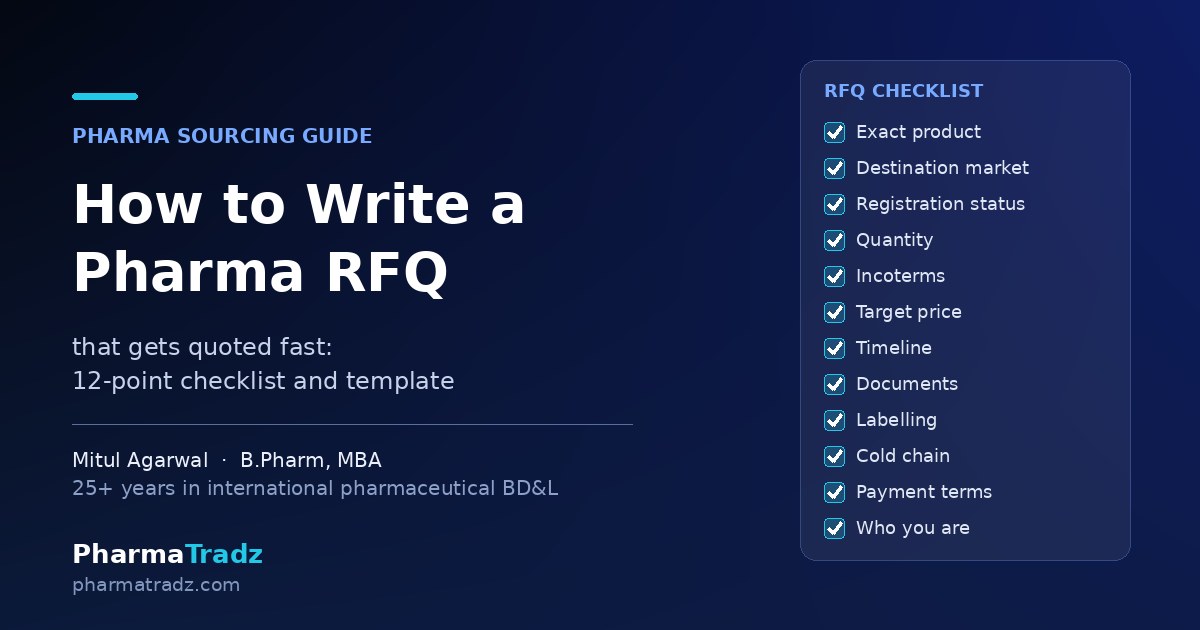
A pharmaceutical RFQ gets quoted fast when a supplier can answer three questions from the first read: exactly which product, for which market, and under which registration route. Most RFQs that go unanswered miss at least one of them. This guide lists the twelve things every pharma RFQ should contain, the mistakes that get RFQs ignored, and a template you can copy.
Already know what you need?
- Importers, distributors and tender bidders: post your sourcing RFQ. The form walks you through all twelve points below, so nothing gets missed.
- Hospitals and patients who need an unregistered medicine: submit a request for proposal (RFP) for named-patient import.
Why good suppliers ignore most RFQs
Put yourself on the other side of the table. A GMP manufacturer's export team gets RFQs every day. Many say little more than "Please quote best price for amoxicillin." That leaves the supplier guessing about almost everything that decides the price and whether they can supply at all: capsules or suspension, which strength, what pack, for which country, whether it's already registered there, how many units, and delivered how.
A supplier who has to send six questions back before quoting will usually answer the clearer RFQ first. The good ones are busy, and they prioritise buyers who look serious. A precise RFQ is how you look serious.
The single most important line in any pharma RFQ is the destination market. It decides which manufacturers can legally supply you, which GMP approvals they need, what the label must say and in what language, and which documents have to travel with the goods. A price for "amoxicillin" is meaningless until the supplier knows where it's going.
The 12 things every pharmaceutical RFQ needs
1. The exact product
Use the generic (INN) name, the dosage form, the strength and the pack size. "Ceftriaxone" isn't a product. "Ceftriaxone for injection 1 g, single vial, pack of 1" is. If you need a specific reference brand or an innovator product rather than a generic, say so. Add the pharmacopoeia standard if your market requires one, for example BP, USP, EP or IP.
2. The destination market
Name the country, not the region. "Africa" or "the Gulf" can't be quoted. Kenya and Nigeria have different regulators, different registration rules and different labelling requirements.
3. Registration status
This decides who can supply you, and it's the line most buyers leave out. Be clear which of these applies:
- Already registered in your market, in your name or your principal's, so you need supply only against that registration.
- Not yet registered, so you need a manufacturer who will provide a dossier. Say which format your regulator accepts, for example CTD, ACTD or EU-CTD.
- A DMF, CEP or ANDA is needed for a regulated market.
- Dossier licensing: you want to license a dossier and register the product yourself.
- Named Patient Import for a specific patient, where the product isn't registered locally.
- Not sure. That's a perfectly good answer, and far better than leaving it blank. A good sourcing partner will work it out with you.
4. Quantity: first order and annual volume
Give both. The first order tells the supplier whether it meets their minimum batch. The annual volume tells them whether you're worth a sharper price. "Best price" with no quantity attached will get you a list price, if you get a reply at all.
5. Incoterms
State how you want the goods delivered, using the ICC's Incoterms 2020 rules. The ones pharma buyers use most:
- EXW (Ex Works): you collect from the factory and handle everything, including export clearance. Cheapest on paper, hardest in practice.
- FOB and CIF: for sea freight only. The supplier delivers onto the vessel (FOB), or also pays freight and minimum insurance to your port (CIF).
- CIP: the air-freight equivalent of CIF, usable for any transport mode, and under Incoterms 2020 it requires a higher level of insurance cover. For temperature-sensitive products flown in, CIP is usually the right choice.
- DAP and DDP: delivered to your door, without or with import duties and clearance paid.
A common mistake is asking for CIF on an air shipment. CIF is a sea-freight rule, and using it for air cargo leaves a gap in who is responsible for what.
6. Target price
Should you share it? Usually yes, as a range. A realistic target price saves both sides a round of negotiation and tells the supplier whether a deal is possible at all. An unrealistic one tells them you haven't priced the market, and that's also useful for them to know early.
7. Timeline
Give a required-by date and say whether it's firm. Manufacturing to order takes time, and a product that needs registration in your market can take much longer than that. If your date is set by a tender or a stock-out, say so. Suppliers do respond to genuine urgency.
8. The documents you need
List them up front, because some take weeks to issue. The usual set is:
- a certificate of analysis for each batch;
- the manufacturer's GMP certificate;
- a Certificate of Pharmaceutical Product (CPP or CoPP), issued under the WHO Certification Scheme, which many importing regulators require;
- stability data, if you're registering the product.
Also state the minimum remaining shelf life you'll accept on arrival. Many tenders and hospital buyers set one, and a short-dated batch is a common reason for a shipment to be rejected.
9. Labelling, artwork and serialisation
Say which language the pack and leaflet must be in, and whether your importer's details have to appear on it. Check whether your market requires serialisation or track-and-trace codes. The EU has required unique identifiers and anti-tampering devices on most prescription medicines since February 2019, and the US has its own requirements under the Drug Supply Chain Security Act. Many other countries now have their own. Custom artwork affects both price and lead time.
10. Storage and cold chain
If the product is refrigerated or frozen, say so and describe what you can receive: temperature-controlled trucks, a cold room, a pharmacy that can take dry-ice or liquid-nitrogen shipments. The supplier will price the packaging and freight accordingly.
11. Payment terms
Say what you expect to offer, whether that's advance payment, a letter of credit or documents against payment. A new relationship almost always starts with secure terms, and it's better to state that openly than to discover it at the contract stage.
12. Who you are
Give your company name, what type of buyer you are (importer, distributor, hospital, tender agency, manufacturer) and whether you hold the import licence your market requires. A supplier will always put a licensed importer ahead of an anonymous trader. If you're buying for a tender, say which one.
A weak RFQ and a strong one
This example is illustrative. The buyer and figures are invented to show the difference.
Weak: "Dear supplier, please send best price for ceftriaxone injection. Urgent. Regards."
Strong:
- Product: Ceftriaxone for injection 1 g, single vial, USP, pack of 1
- Destination: Kenya
- Registration: not registered in our name; we need a manufacturer who can supply a CTD dossier and support registration
- Quantity: 50,000 vials first order; about 400,000 vials a year
- Incoterms: CIF Mombasa
- Target price: range available on request
- Timeline: first delivery within six months of registration
- Documents: CoA, GMP certificate, CoPP, stability data; minimum shelf life on arrival to be agreed
- Labelling: English
- Payment: letter of credit
- Buyer: licensed pharmaceutical importer and distributor, Nairobi
The first gets a price list, or silence. The second gets a real quotation, often with the dossier timeline attached, because the supplier can see a genuine, reachable business opportunity.
Mistakes that get RFQs ignored
- Blasting the same one-line request to fifty suppliers. Suppliers recognise a mass email, and they give it mass-email attention.
- Listing forty products with no priorities. If you need many products, mark the three that matter most. Suppliers quote what they can see is serious.
- Leaving out the destination market or registration status. Without them, nobody can tell whether they're even allowed to supply you.
- Asking for "urgent" without a date. Everything is urgent. A date is information.
- Forgetting controlled substances need permits. Narcotic drugs and psychotropic substances need an import authorisation from your government and an export authorisation from the supplier's, under the international drug control conventions. Many countries now exchange these through the INCB's I2ES system. If your product is controlled, say so up front, because it changes the timeline completely.
A pharma RFQ template you can copy
PRODUCT
  Generic (INN) name:
  Dosage form:
  Strength:
  Pack size / presentation:
  Reference brand or innovator required? (yes / no, which):
  Pharmacopoeia standard (BP / USP / EP / IP / other):

MARKET AND REGULATORY
  Destination country:
  Registration status: registered (supply only) / dossier needed (CTD / ACTD / EU-CTD)
    / DMF-CEP-ANDA / dossier licensing / Named Patient Import / not sure
  Controlled substance? (yes / no):

COMMERCIAL
  First order quantity:
  Estimated annual volume:
  Incoterms (EXW / FOB / CIF / CIP / DAP / DDP) and named place:
  Target price or range:
  Required by (date, firm or flexible):
  Payment terms offered:

DOCUMENTS AND PACK
  Documents required (CoA, GMP, CoPP, stability, other):
  Minimum remaining shelf life on arrival:
  Label language and importer details:
  Serialisation / track-and-trace requirement:
  Storage condition and receiving capability:

ABOUT YOU
  Company, country, buyer type:
  Import licence held (yes / no):
  Tender reference, if any:
What happens when you send an RFQ to PharmaTradz
Our sourcing requirement form is built around the same twelve points, so you don't have to remember them. When you send one:
- We review and structure your requirement the same business day, and come back to you if anything critical is missing.
- We match it to verified GMP-certified manufacturers able to supply your destination market, under the registration route you need.
- Quotes come back to you, normally within 24 to 72 business hours depending on the product.
Your requirement is shared only with matched, verified suppliers, and we don't disclose your identity without your permission. If your product turns out to need a dossier, a CEP or a Named Patient Import route, we'll tell you that at the start, not after the quotes arrive.
Frequently asked questions
What should a pharmaceutical RFQ include?
At minimum: the exact product (generic name, dosage form, strength, pack), the destination country, the registration status in that country, the quantity (first order and annual), Incoterms, a timeline, and the documents you need. Target price, labelling, cold-chain and payment terms make the quote faster and more accurate.
Should I share my target price with suppliers?
Usually yes, as a realistic range. It saves a round of negotiation and tells the supplier early whether the deal can work.
Which Incoterm should I use for pharmaceuticals?
It depends on transport and on who you want to carry the risk. FOB and CIF are for sea freight only. For air freight, including most cold-chain products, CIP is usually more appropriate, and under Incoterms 2020 it carries a higher insurance requirement.
What is a CoPP and do I need one?
A Certificate of Pharmaceutical Product is issued by the exporting country's regulator under the WHO Certification Scheme. It confirms the product's regulatory status and the manufacturer's GMP compliance. Many importing countries require it for registration, so ask for it in your RFQ.
How long does it take to get a pharma quote?
For a clear RFQ on a product that's already registered in your market, days. Where a dossier or registration is involved, the price may come quickly but the supply timeline will be months. Through PharmaTradz, quotes normally arrive within 24 to 72 business hours.
Have a requirement ready? Post it here. It takes about five minutes, and the form walks you through every point above.
Sources
- Incoterms® 2020 (International Chamber of Commerce)
- Incoterms 2020: CIP or CIF? (ICC Academy)
- WHO Certification Scheme on the quality of pharmaceutical products moving in international commerce (WHO)
- Guidelines on the implementation of the WHO certification scheme (WHO TRS 1033, Annex 9)
- New safety features for medicines sold in the EU (European Medicines Agency)
- Drug Supply Chain Security Act (US FDA)
- International Import and Export Authorization System, I2ES (INCB)
- Controls on international trade in narcotic drugs and psychotropic substances (INCB)