
Last updated: 25 September 2026.
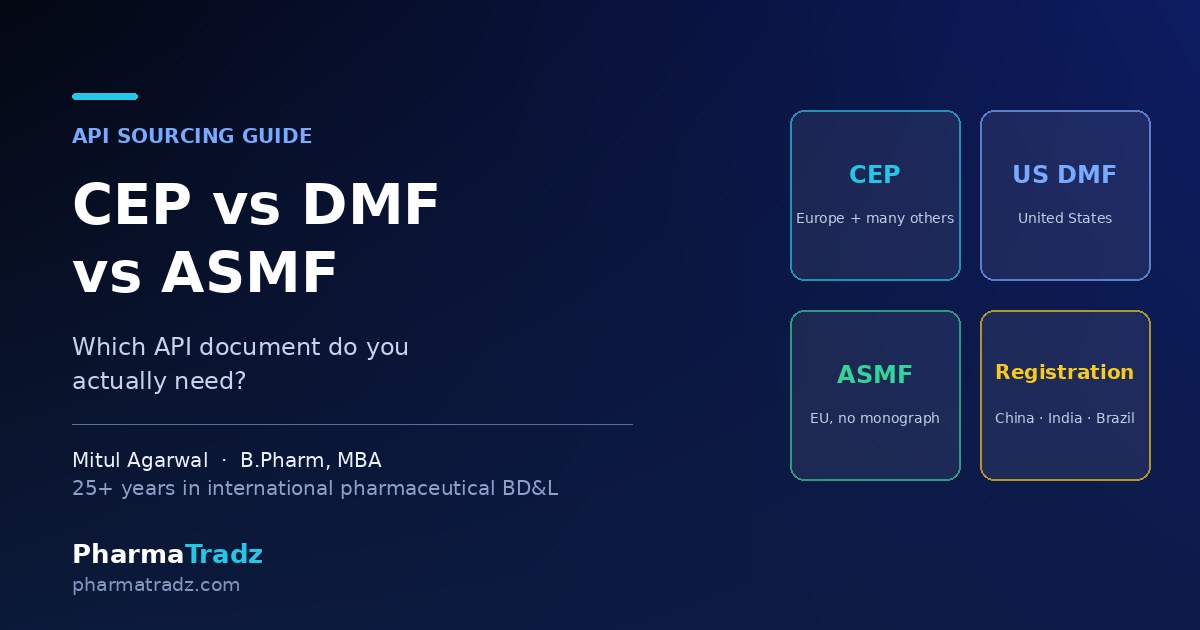
Ask an API supplier for "the DMF" and you might get back a CEP, a letter, or a polite question about which market you mean. That's fair, because they're not the same thing. A CEP is a European certificate that many countries accept. A US DMF is a confidential file the FDA reviews but never "approves". An ASMF is the EU's version of a DMF. And in China, India and Brazil, the API itself has to be registered. Which one you need depends entirely on where your finished product is going.
Let me walk through each one the way I'd explain it to a buyer or a formulator across the table, without the regulatory textbook.
First, the thing people mix up
None of these documents lets you sell a medicine. They all sit behind your finished-product dossier. They're how the API maker proves the quality of the active ingredient to a regulator, usually without handing its manufacturing secrets to you, the customer.
So when a supplier says "we have a CEP", that's good news, but you still need your own product registration in every market. The API document just makes that registration possible.
The CEP: Europe's certificate that travels well
A CEP, or Certificate of Suitability, is issued by the EDQM, part of the Council of Europe. It confirms that an API made at a given site is properly controlled by the European Pharmacopoeia monograph for that substance, plus any extra tests needed for that maker's impurities.
Three things make it useful:
- It's been assessed once, centrally. Regulators in Europe and beyond can rely on that assessment instead of reviewing the API data again.
- The EDQM inspects. It carries out about 40 site inspections a year, chosen by risk.
- It's widely accepted. Beyond Europe, countries including Canada, Australia, New Zealand, Singapore, Malaysia, Saudi Arabia, South Africa, Israel, Morocco and Taiwan accept CEPs, and WHO Prequalification uses them too. Brazil's ANVISA announced in late 2024 that it will rely on CEP assessments as well.
The catch: no monograph, no CEP. If the substance isn't in the European Pharmacopoeia, the CEP route simply isn't available, and the supplier needs a master file instead.
A few practical details worth knowing:
- More than 6,700 CEPs are currently valid, and 442 new ones were granted in 2023.
- Since September 2023, CEPs have been issued in a new "CEP 2.0" format: electronically signed, with the holder's own specification attached, and with the letter of access now a separate document. If your supplier sends only the certificate, ask for the letter too.
- A CEP is renewed once, five years after it's first issued. After that it stays valid as long as the holder keeps it up to date.
- Under the EDQM's published fee schedule, a new CEP application for a chemical substance costs €5,000.
The US DMF: filed, reviewed, never "approved"
This is where I see the most confusion. The FDA's own guidance says it plainly: a Drug Master File is never approved or disapproved. The API maker files it, and the FDA only reviews it when a finished-product application refers to it.
For generic APIs, what matters in practice is:
- The DMF fee has been paid and the completeness check passed. Only then does the DMF appear on the FDA's "available for reference" list. The fee isn't small: US$102,584 for fiscal year 2026, rising to US$109,899 from 1 October 2026.
- A Letter of Authorization. Without it, the FDA won't look at the DMF on your behalf.
- It's being maintained. Holders are expected to file an annual report and notify customers of changes.
So "we have a US DMF" is really only the start. The follow-up question is: "Is it on the available-for-reference list, and will you issue a Letter of Authorization?"
The ASMF: Europe's option when there's no CEP
If a substance has no CEP, the European route is an Active Substance Master File. It's split in two:
- an Applicant's Part, which the formulator gets to see and include in their dossier;
- a Restricted Part, with the confidential manufacturing know-how, which goes only to regulators.
The API maker issues a Letter of Access so regulators can review it. EU guidance says an application generally shouldn't cite both a CEP and an ASMF for the same substance, so pick one route.
And then there's "registration"
In some big markets, a master file isn't enough on its own. The API itself has to be registered or linked into the product review:
- China: APIs are reviewed together with the finished product. Each API gets a platform registration number, and foreign makers file through a Chinese agent or office.
- India: to import an API, the foreign site and product need a registration certificate on Form 41 before an import licence can be issued. CDSCO's guidance lists fees of US$1,500 per site and US$1,000 per product, and gives the regulator nine months to decide. You'll need an Indian agent.
- Brazil: ANVISA runs its own API certification, CADIFA, in place since 2020.
- Japan: foreign makers file a Master File through an appointed in-country caretaker.
- Canada: Health Canada has its own master file system, with fees for registration, updates and each letter of access.
So what should you actually ask your supplier for?
| If your product is going to... | Ask the API supplier for |
|---|---|
| EU, UK and CEP-accepting countries | A current CEP plus the separate letter of access, or an ASMF Applicant's Part plus a Letter of Access |
| United States | The DMF number, a Letter of Authorization, and confirmation it's on the FDA's available-for-reference list |
| Canada | A Health Canada master file and letter of access |
| China | The API's platform registration number and an authorisation letter |
| India | A valid Form 41 registration for the site and product |
| Brazil | A CADIFA |
| Japan | A Master File registered through their in-country caretaker |
| WHO-prequalified supply | A WHO-prequalified API, or one accepted through a CEP or stringent-regulator route |
The questions I'd ask before trusting any of it
A document on letterhead isn't the same as a document in good standing. Before you commit, it's worth asking:
- Is the CEP still valid? The EDQM publishes suspensions and withdrawals. Between February and July 2026 alone it listed 14 GMP-related suspensions. It takes two minutes to check.
- Is the DMF on the available-for-reference list, and when was it last updated? A DMF nobody has maintained for years is a problem waiting for your submission.
- Does it cover nitrosamines? Every new or renewed CEP since early 2019 includes a nitrosamine risk assessment. For older DMFs and ASMFs, ask to see theirs.
- Will you tell me when something changes? A change of route, site or specification at the API maker can trigger variations in every market where you're registered. Put notification in the supply agreement.
- Who's your agent? In China and India the API maker needs a local representative. If they don't have one, your timeline just got longer.
Where most of these files come from
If you're buying generic APIs, you're mostly buying from India and China. According to a USP analysis, Indian manufacturers held about 48% of active US API DMFs, with China and the EU at around 16–17% each. That concentration is exactly why the checks above matter: two countries, thousands of sites, and quality that varies a lot from one plant to the next. Our guide on how to verify a pharmaceutical supplier covers the site-level checks.
Need an API with the right paperwork for your market, or looking for a formulator who can use yours? Post your requirement and choose "CEP required" or "US DMF / ANDA" as the registration need.
Sources
- What is a CEP? (EDQM FAQ)
- Certification of suitability procedure (EDQM)
- The EDQM inspection programme (EDQM)
- What is the CEP 2.0? (EDQM)
- Notifications, revisions and renewals (EDQM)
- CEP procedure: 30 years (EDQM, 2024)
- CEP fees and inspection costs (EDQM)
- Which countries accept CEPs? (EDQM FAQ)
- Brazilian health authority to rely on CEP evaluation (EDQM, December 2024)
- Actions on CEPs (EDQM)
- Nitrosamines: update from the CEP procedure (EDQM)
- Guideline for Drug Master Files (US FDA)
- Completeness assessments for Type II API DMFs under GDUFA (US FDA)
- GDUFA fee rates for fiscal year 2026 (Federal Register, July 2025)
- GDUFA fee rates for fiscal year 2027 (Federal Register, July 2026)
- Guideline on the Active Substance Master File procedure (EMA)
- Master files: procedures and administrative requirements (Health Canada)
- Master File system (PMDA Japan)
- Linked review of APIs, excipients and packaging (NMPA, July 2019)
- Import registration guidance (CDSCO India)
- CADIFA (ANVISA Brazil, Portuguese)
- Prequalification of active pharmaceutical ingredients (WHO)
- Global API manufacturing capacity remains concentrated (USP)
Frequently Asked Questions(FAQs)
Is a CEP the same as a DMF?
No. A CEP is a certificate issued by the EDQM after it has assessed the API against the European Pharmacopoeia. A DMF is a confidential file submitted to the US FDA, which reviews it only when a product application refers to it. It's never approved on its own.
Can I use a CEP in the US?
Not in place of a DMF. The FDA works with DMFs. Many other regulators, from Canada to Singapore to Saudi Arabia, do accept CEPs.
What if my API has no Ph. Eur. monograph?
Then there's no CEP route. In Europe you'd use an ASMF, and in the US a DMF.
What is a letter of access?
It's the API maker's permission for a regulator to rely on its CEP or master file when assessing your product. Without it, the regulator won't use the file for your application.