
Last updated: 24 September 2026.
Out-licensing a generic dossier works when both sides agree early on three things: how the licensor gets paid (fee, milestones, royalty or supply), who holds the marketing authorisation in each territory, and whether the dossier will actually pass the target regulator. Most deals that fail, fail on the third point, found in due diligence after months of negotiation. This guide covers the common deal structures, what drives the price, and the checks a serious licensee runs before paying anything.
Why dossier licensing exists
Developing a generic from scratch means formulation work, stability studies, a bioequivalence study and a full registration dossier, before a single sale. A regional company that wants the product in its own market can skip most of that by licensing a dossier that already exists, then registering it in its own name.
For the manufacturer that owns the dossier, licensing turns a finished piece of development work into income in markets it would never enter alone. In many markets it also has no choice. In the EU, for example, a marketing authorisation can only be granted to an applicant established in the EU, so a manufacturer based outside the EU needs a local licensee or its own EU entity to hold it. Some other markets also require a local company to be the applicant.
The five common deal structures
1. One-time licence fee
The licensee pays a fee for the right to use the dossier to register the product, either once for a defined territory or per country. It's simple, and it suits licensees who will source the finished product elsewhere or make it themselves after a technology transfer.
2. Upfront fee plus milestones
A smaller upfront payment, with further payments at defined points such as dossier submission and registration approval. It shares the regulatory risk: the licensor gets paid in full only if the dossier does its job.
3. Royalty or profit share
The licensor takes a percentage of the licensee's sales or profit, sometimes on top of an upfront fee. It's more common for differentiated or complex products than for commodity generics, and it needs sales reporting and audit rights both sides trust.
4. Supply-tied licensing
A structure widely used by manufacturers licensing into emerging markets. The dossier comes at a low or nominal fee, and the manufacturer earns its return on an exclusive supply agreement for the finished product. Minimum order quantities and two- to three-year volume forecasts become the real commercial terms, because that's where the money is.
5. Marketing authorisation transfer
If the product is already registered in the target country, the existing marketing authorisation can sometimes be transferred to the new partner instead of starting a new registration. It's the fastest route to market, and it's priced accordingly.
Terms that matter as much as the price
- Territory and exclusivity: which countries, and whether the licensor can license the same dossier to anyone else there.
- Who holds the marketing authorisation, and what happens to it if the deal ends. A licensee that holds the registration holds the market.
- Lifecycle obligations: who files and pays for variations, who runs pharmacovigilance, and who updates the dossier when guidelines change.
- Change control: the licensor's duty to notify changes of API source, site or process, which trigger variations in every licensed market.
- Minimum purchase commitments in supply-tied deals, and what happens if they're missed.
How dossier deals are priced
There's no public price list for generic dossiers. Licensing marketplaces quote case by case, and deal terms are almost always confidential. What does exist is a clear set of factors that move the price:
- Product complexity: a common oral tablet is at the bottom of the range; injectables, modified-release products and complex generics sit much higher.
- Dossier quality and age: a recent dossier that already meets current guidelines is worth far more than one needing a gap-closure programme.
- Regulatory track record: a dossier already approved by a stringent regulator, or by WHO Prequalification, carries less risk.
- Territory: the size of the market, the number of countries, and whether the licence is exclusive.
- Competition: how many other registered generics the licensee will face.
- Supply tie: a dossier sold with an exclusive supply agreement is usually priced low because the supply margin carries the deal.
Also budget for the cost of registration itself. Government fees alone vary enormously. A study across 31 countries found generic registration fees ranging from under US$100 to about US$80,000, with most between roughly US$2,600 and US$16,400. That's before local agents, translations, samples and testing.
What it looks like in practice
From my own deals, a dossier for a common product, such as a ketoprofen tablet or a standard injectable, typically licenses for anywhere between about US$1,500 and US$50,000. Where in that range depends on the country and on whether the rights are exclusive or non-exclusive.
Complex products are in a different league. For a biosimilar such as pembrolizumab, upfront payments of US$0.5 million to US$5 million are realistic, depending on the territory.
There's no standard formula. Every BD team and every company has its own way of quoting, and no one reference is used across the industry. What decides it in the end is market potential. A common starting point for negotiation is around 10% of the product's market potential in the territory, split into milestones that begin with due diligence and run through submission and approval.
What a serious licensee checks before paying
Due diligence on a dossier is where deals are won or lost. Here's what a careful licensee, or its regulatory consultant, looks at.
1. Format and completeness
Is the dossier in the format the target regulator accepts, and is every section there?
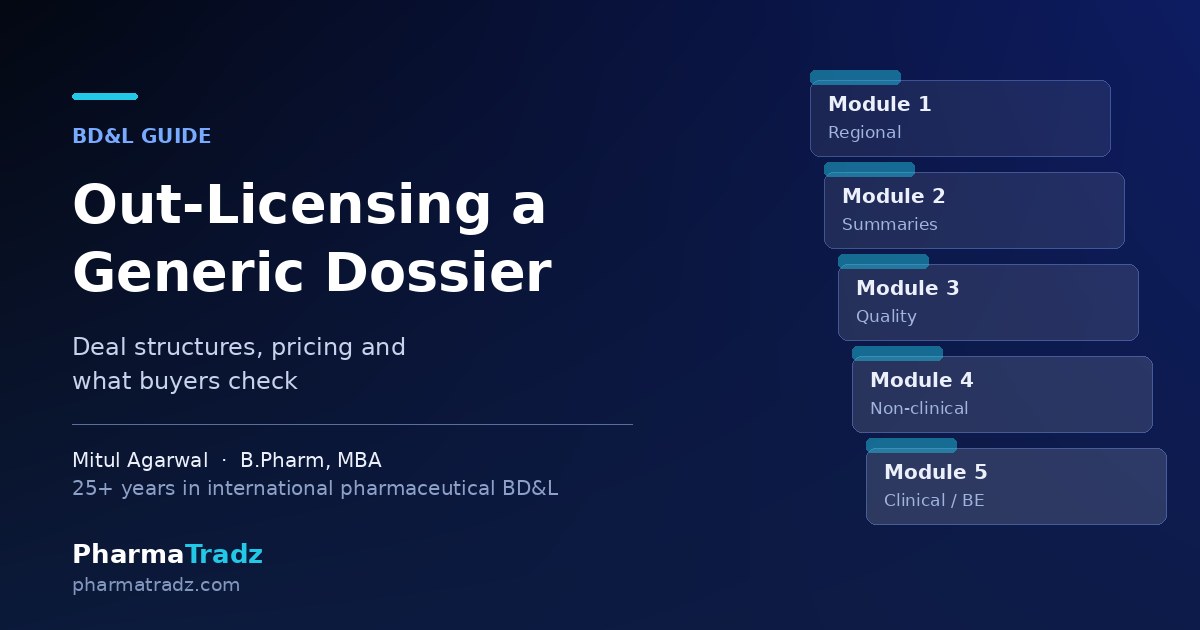
- The ICH Common Technical Document (CTD): Module 1 is regional, Modules 2 to 5 cover summaries, quality, non-clinical and clinical data.
- In ASEAN, the ACTD. For generics, its non-clinical and clinical parts aren't required, but the quality part is.
- The East African Community uses a harmonised CTD that can be submitted in any partner state.
- The Gulf states require eCTD with a GCC-specific Module 1.
A dossier in paper or an old format isn't a deal-breaker, but converting it costs time and money, and that belongs in the price.
2. The API and its master file
Who makes the active ingredient, and is there a Drug Master File, an EU Active Substance Master File or a Certificate of Suitability (CEP) behind it? The licensee will need a Letter of Access from the API maker to reference the master file in each submission. Under EU rules, the restricted part of an Active Substance Master File can't be passed to third parties without the holder's consent. If the API maker won't cooperate, the dossier may be unusable, however good it looks.
3. Stability data for the right climate
Stability studies must match the climatic zone of the target market. Hot and humid countries, which include much of Africa, South and Southeast Asia and Latin America, typically need long-term data at 30°C and 75% relative humidity. A dossier with only 25°C/60% data, suitable for Europe, may need new studies before it can be filed there. WHO guidance sets a minimum of 6 months' long-term and 6 months' accelerated data on two batches at submission.
Note that ICH is consolidating its stability guidelines into a single revised Q1, with adoption planned for November 2026. Check new dossiers against it.
4. The bioequivalence study
Which reference product was the generic compared against, and will the target regulator accept it? WHO guidance treats the innovator product as the usual comparator, but many regulators have their own rules on which country's reference product they accept. A bioequivalence study against the wrong comparator can mean repeating the study, often the single most expensive fix.
5. Nitrosamine risk assessment
Since 2020, regulators have required manufacturers to assess and control the risk of nitrosamine impurities. The EMA's first deadline for risk evaluations of chemical medicines was March 2021, and the FDA's guidance dates from September 2020, with limits for nitrosamine drug substance-related impurities (NDSRIs) following in 2023. WHO Prequalification asked manufacturers to update their assessments in 2023. A dossier compiled before 2020 may have no nitrosamine assessment at all, and that's now a standard question in any review.
6. Manufacturing: site, scale and validation
Is the manufacturing site's GMP status current and acceptable to the target regulator? (Our guide to verifying a pharmaceutical supplier covers how to check.) Were the stability and bioequivalence batches made at pilot or commercial scale, and is process validation at commercial scale done or committed?
7. Patents in the territory
A dossier is only useful where the product can legally be sold. Check the compound patent and any formulation or use patents in each target country. Our semaglutide patent guide shows how much this varies country by country.
8. Lifecycle history
What variations have been filed since approval, and are they reflected in the dossier? Who will maintain it?
The problem no checklist catches: trust
In my experience, the most common problem in a dossier review isn't technical. It's trust.
No dossier is perfect. Every serious review turns up gaps: stability data for a different climatic zone, a comparator the target regulator may question, an older dossier without a nitrosamine assessment. The real question isn't whether there are gaps. It's whether the buyer will actually move to a signed agreement and invest in closing them.
Manufacturers are cautious for good reason. Sharing a full dossier, and spending weeks answering a buyer's questions, is a real cost, and many reviews end with the buyer walking away or using the gaps to push the price down at the last minute. So manufacturers generally hold back until trust is established. Buyers, for their part, don't want to pay before they know the dossier will pass.
What breaks the deadlock is treating the gaps as a shared problem, addressed mutually, not as ammunition. In practice, the deals that close tend to move in stages:
- A confidentiality agreement.
- A dossier summary and fact sheet, before the full modules.
- A term sheet that names the known gaps, who closes each one, and at whose cost.
- Due diligence as the first milestone, so the buyer's commitment is visible early.
- The full licence agreement, with the remaining payments tied to submission and approval.
Each step gives both sides a little more certainty before the next one asks for more.
How long registration really takes
Licensees often underestimate this. Some published figures:
- South Africa: SAHPRA's median approval time for generics fell from almost six years under the old system to about 511–591 days under its newer processes.
- East African Community: the joint assessment's median fell to 240 days in 2019, though a 2023 study found timelines still above the community's own targets.
- Nigeria: NAFDAC's formal target is 120 days after an application is accepted. The real clock starts earlier, with dossier screening and sample testing.
In many emerging markets it's wise to plan on one to two years from signing to first sale, and to build that into the milestones.
If you're the manufacturer: make your dossier easy to license
- Run a gap analysis against current guidelines, including nitrosamines and the target regions' stability requirements.
- Generate 30°C/75% stability data if you want to license into hot, humid markets.
- Have Letters of Access from your API supplier ready to issue.
- Prepare a one-page dossier fact sheet: product and strengths, API source and master-file type, stability zone and months of data, bioequivalence comparator and country, dossier format, and where the product is already registered.
- Be clear about the deal you want, fee or supply, and the territories you've already licensed.
If you're the licensee: questions to ask before you pay
- Where is this dossier already approved, and by which regulators?
- Which API source, which master file, and will you issue a Letter of Access?
- Which climatic zone does the stability data cover, and how many months?
- Which reference product was used for bioequivalence, and from which country?
- Is there a nitrosamine risk assessment?
- Who else holds a licence to this dossier in my territory?
- Who maintains the dossier after approval, and at whose cost?
How PharmaTradz can help
If you're looking for a dossier, post a requirement and choose "Dossier licensing / out-licensing" as the registration need. If you're a manufacturer with dossiers to license, list your company so regional partners can find you.
Frequently asked questions
What is dossier out-licensing?
The owner of a registration dossier for a medicine licenses another company to use it to register and sell that product in a defined territory, usually in return for a fee, milestone payments, royalties or an exclusive supply agreement.
How much does a generic dossier cost?
There's no public price list. In our experience, a dossier for a common tablet or standard injectable typically licenses for about US$1,500 to US$50,000 depending on the country and exclusivity, while complex products such as biosimilars can command upfront payments of US$0.5 million to US$5 million. Registration fees and local costs come on top.
Why do manufacturers hesitate to share a full dossier?
Because sharing it, and answering a buyer's questions, takes real time and exposes confidential data, and many reviews end without a deal. Manufacturers usually share a summary first and release the full dossier under a confidentiality agreement once the buyer has shown it intends to sign and invest in closing any gaps.
What is a Letter of Access?
A letter from the API manufacturer allowing a regulator to refer to its confidential master file when assessing your application. Without it, a dossier that relies on that master file usually can't be submitted.
Can a CTD dossier be used in ASEAN countries?
ASEAN uses its own format, the ACTD. The content is similar, but the dossier needs to be reorganised, and its regional sections prepared, for each country.
Why do older dossiers need a nitrosamine assessment?
Since 2020, regulators including the EMA, FDA and WHO Prequalification have required manufacturers to assess and control nitrosamine impurity risk. Dossiers compiled before then often don't include one.
Looking for a dossier, or a partner for yours? Tell us what you need.
Sources
- Directive 2001/83/EC, Article 8 (marketing authorisation applicant established in the EU)
- Pharma licensing: why and how (Credevo, updated February 2024)
- FAQ for buyers (Pipelinepharma)
- Registration fees for generic medicines across 31 countries (PLOS One, August 2017)
- Common Technical Document overview
- ASEAN Common Technical Dossier, organisation of the dossier (ASEAN)
- The East African Community medicines regulatory harmonisation initiative (PLOS Medicine, August 2020)
- Centralised registration procedure in the GCC (Biomapas)
- Guideline on the Active Substance Master File procedure, Rev. 4 (EMA)
- Stability testing of active pharmaceutical ingredients and finished products (WHO TRS 1010, Annex 10)
- ICH Q1 Expert Working Group work plan (ICH, 2026)
- WHO guidance on bioequivalence and comparator products (WHO TRS 1052, Annex 8)
- Guidance on the selection of comparator pharmaceutical products (WHO TRS 992, Annex 8)
- Nitrosamine impurities: guidance for marketing authorisation holders (EMA)
- FDA updates risk mitigation for nitrosamine impurities (DCAT, December 2021)
- FDA revises nitrosamine deadline (Sidley, June 2025)
- Update on nitrosamine impurities (WHO Prequalification, September 2023)
- Regulatory review times at SAHPRA (Journal of Pharmaceutical Policy and Practice, March 2023)
- EAC joint assessment timelines (Regulatory Toxicology and Pharmacology, May 2023)
- NAFDAC registration in Nigeria (Mondaq, February 2025)