
Last updated: 25 September 2026.
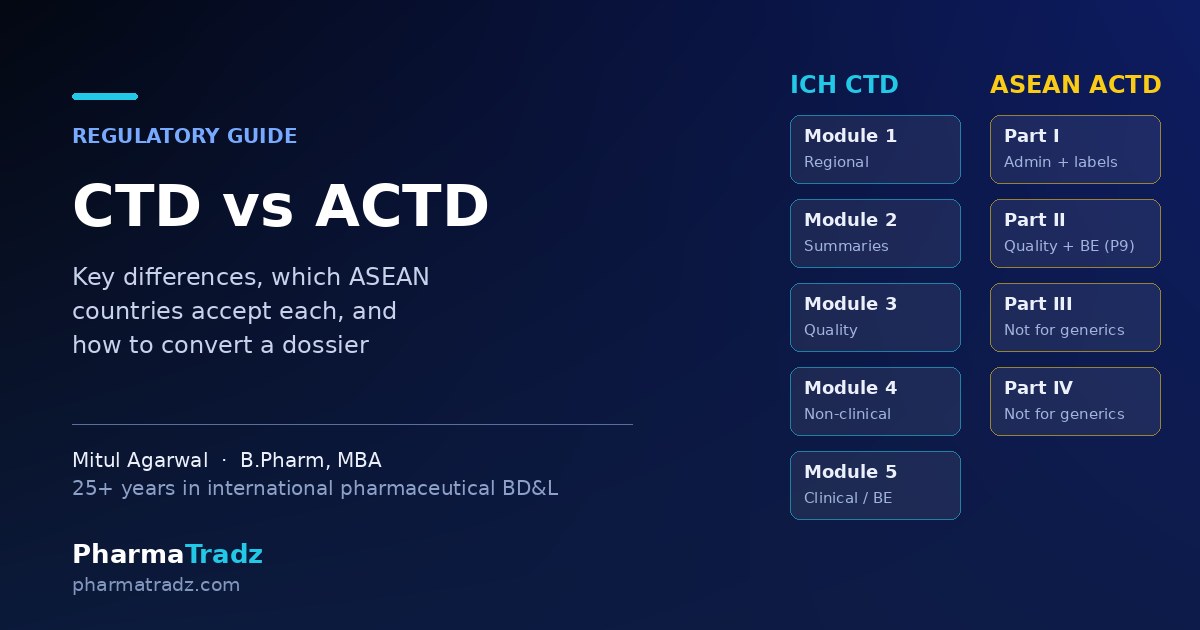
The ICH Common Technical Document (CTD) and the ASEAN Common Technical Dossier (ACTD) hold much the same science, organised differently. The CTD has five modules with a separate summary module; the ACTD has four parts, puts the summaries inside each part, and for generics needs only the administrative and quality parts. Several ASEAN regulators now accept either format, but converting a dossier for ASEAN is rarely just re-filing: stability data, the bioequivalence comparator and process validation usually need attention too.
Why the format matters
A good dossier in the wrong format gets rejected at screening, before anyone reads the data. And a dossier that looks right on the surface can still fail on ASEAN-specific technical requirements. For manufacturers licensing into Southeast Asia, and for regional companies licensing in, knowing the difference saves months. (For the commercial side of licensing, see our guide to out-licensing a generic dossier.)
The ICH CTD in brief
The CTD was agreed through ICH, the International Council for Harmonisation, and became mandatory in the EU and Japan in 2003 and in the US in 2017. It has five modules:
- Module 1: regional administrative information, such as application forms and proposed labelling. Strictly, it isn't part of the harmonised CTD; each region defines its own.
- Module 2: summaries, including the Quality Overall Summary and the non-clinical and clinical overviews.
- Module 3: quality, covering the drug substance (3.2.S), the drug product (3.2.P) and regional information (3.2.R).
- Module 4: non-clinical study reports.
- Module 5: clinical study reports, where a generic's bioequivalence study sits.
Most major regulators now require it electronically, as eCTD. A newer version, eCTD v4.0, is being phased in. The US FDA has accepted it for new applications since September 2024. In the EU it has been optional for new centrally authorised applications since December 2025, with the EMA planning to make it mandatory for them from 2028.
The ASEAN ACTD in brief
ASEAN developed its own harmonised format, the ACTD, together with a set of common technical guidelines known as the ACTR. The current version, ACTD Revision 1, was endorsed in 2019. It has four parts:
- Part I: administrative data and product information, including country-specific forms and labelling.
- Part II: quality, starting with a Quality Overall Summary, followed by the data.
- Part III: non-clinical, starting with its own overview and summaries.
- Part IV: clinical, starting with its own overview and summary.
For generics, the important line is this: Parts III and IV are not required for generic products. A generic ACTD dossier is essentially Part I plus Part II.
CTD vs ACTD: the key differences
| ICH CTD | ASEAN ACTD | |
|---|---|---|
| Structure | 5 modules | 4 parts |
| Summaries | Separate Module 2 | Inside each part (e.g. the QOS opens Part II) |
| Administrative data | Module 1, regional | Part I, country-specific |
| Quality data | Module 3 (3.2.S, 3.2.P, 3.2.R) | Part II (S1–S7, P1–P9); no equivalent of 3.2.R |
| Bioequivalence study | Module 5 | Part II, section P9 "Product interchangeability / equivalence evidence" |
| Non-clinical and clinical parts for generics | Module 4 usually cross-references literature; Module 5 holds the BE study | Parts III and IV not required |
| Electronic format | eCTD widely mandatory | Varies by country |
The one that surprises people is where the bioequivalence study goes. In the CTD it's clinical data in Module 5. In the ACTD it sits in the quality part, as evidence that the product is interchangeable with the reference.
Which ASEAN countries accept which format
ASEAN harmonisation doesn't mean identical rules. As of September 2026, according to each regulator's current guidance:
- Singapore (HSA): accepts either ICH CTD or ACTD, with eCTD available for ICH CTD submissions.
- Malaysia (NPRA): its main drug registration guidance is written around ACTD, with submissions through its online system. For biologics it accepts either format.
- Indonesia (BPOM): its 2025 registration regulation lists both ACTD and ICH CTD.
- Vietnam: since July 2025, dossiers may be prepared in either ACTD or ICH CTD format.
- Philippines (FDA): generics are registered using ACTD. For new drugs on the abridged and verification routes, either format is accepted.
- Thailand (Thai FDA): uses ACTD, and accepts ICH CTD on its collaborative route for products approved by WHO or stringent regulators. Thailand has also moved to eCTD. Check the current requirements with the Thai FDA before filing.
For Cambodia, Laos, Myanmar and Brunei, check directly with the regulator or a local agent.
What really needs to change when you convert
Re-ordering the documents is the easy part. What costs time is meeting ASEAN's technical requirements, which sit behind the format.
1. Re-organise the dossier
- Module 1 is replaced by Part I, using the target country's own forms, labels and product information.
- The Quality Overall Summary (Module 2.3) moves to the start of Part II, using the ACTD template.
- Module 3's drug substance and drug product sections map to Part II's S1–S7 and P1–P8 headings. There's no ACTD home for regional information (3.2.R), so its content has to be placed elsewhere or dropped.
- The bioequivalence study and comparative dissolution data move from Module 5 into Part II, P9.
2. Stability data for Zone IVb
ASEAN's stability guideline requires long-term data at 30°C and 75% relative humidity. For a conventional generic, the minimum at submission is two pilot-scale batches with 6 months' long-term and 6 months' accelerated data. For critical dosage forms or unstable substances it's three batches with 12 months' long-term data. A dossier built for Europe, with long-term data at 25°C/60%, will usually need new stability studies, and that's often the longest lead-time item in the whole conversion.
3. The bioequivalence comparator
ASEAN's bioequivalence guideline prefers the innovator product registered in that country as the comparator. If the study used an innovator batch from elsewhere, the applicant has to justify that it's interchangeable with the locally registered one. Where the innovator can't be identified, the fallbacks are a product approved in an ICH country, then a WHO-prequalified product. The guideline advises agreeing the comparator with the regulator before running a study.
4. Process validation
ASEAN's process validation guideline offers options:
- a full report on three consecutive production batches;
- development data, one pilot batch, a validation scheme and a commitment to complete it;
- reliance on an approval by a reference agency.
Know which one you're filing under, because not every product qualifies for the lighter options. The development-data route isn't recommended for biologics, non-standard processes or specialised dosage forms.
5. Labelling, language and halal
Labels and patient information must follow local language rules, for example Vietnamese in Vietnam, Bahasa Indonesia in Indonesia, and English or Bahasa Malaysia in Malaysia.
Indonesia is phasing in mandatory halal certification for medicines:
- traditional medicines, quasi-drugs and health supplements by 17 October 2026;
- over-the-counter drugs by 17 October 2029;
- prescription drugs, excluding psychotropics, by 17 October 2034.
Manufacturers supplying Indonesia should plan for it now, because it reaches back into excipients and materials.
How long registration takes in ASEAN
Published timelines for generics give a sense of scale:
- Singapore: 240 working days on the abridged route, or 120 on the verification route for products approved by a reference agency (the US FDA, EMA, Health Canada, MHRA, Swissmedic or TGA) within the last two years. Each route has 50 working days of screening first.
- Malaysia: 210 working days for a generic under full evaluation, and 116–136 working days on the abridged route for non-scheduled generics.
- Indonesia: 150 working days for generics on the standard route, with a 90-day reliance route for products already approved in the EU, US, UK, Japan, Canada, Australia or Switzerland.
Approval by a stringent regulator shortens the path in several ASEAN markets, which is one more reason licensees value dossiers with an EU or US approval behind them.
Other regional formats, in one line each
- Gulf states (GCC): ICH eCTD with a GCC-specific Module 1.
- East African Community: an EAC-specific CTD format, usable across partner states.
- ZAZIBONA (Southern Africa collaborative procedure): CTD format, submitted in at least two member countries.
- WHO Prequalification: ICH CTD modular format.
- China: voluntary eCTD since December 2021 for certain categories.
- Brazil: ANVISA signed its e-CTD contract in October 2025, with no implementation date yet.
A conversion checklist
- Confirm which format each target country accepts, and whether eCTD is required.
- Check stability data against 30°C/75% RH, and start new studies early if needed.
- Confirm the bioequivalence comparator is acceptable in each country, or prepare the justification.
- Decide the process validation option you're filing under.
- Re-map Module 3 into Part II headings and move the bioequivalence data into P9.
- Prepare country-specific Part I documents, labels and translations.
- For Indonesia, check the halal timeline for your product category.
Frequently asked questions
What is the difference between CTD and ACTD?
The CTD has five modules, with summaries in a separate Module 2. The ACTD has four parts, with summaries placed inside each part. For generics, the ACTD requires only the administrative and quality parts, and the bioequivalence study sits in the quality part rather than a clinical module.
Do ASEAN countries accept the ICH CTD?
Several do. Singapore, Indonesia and Vietnam accept either format, and the Philippines and Thailand accept ICH CTD on certain routes. Malaysia's generic registration guidance is written around ACTD. Always check the current requirement for the specific country and route.
Can I use EU stability data for ASEAN registration?
Usually not on its own. ASEAN requires long-term stability data at 30°C/75% relative humidity (Zone IVb). EU dossiers often have long-term data at 25°C/60%, so additional studies are usually needed.
Where does the bioequivalence study go in an ACTD dossier?
In Part II, section P9, "Product interchangeability / equivalence evidence", together with comparative dissolution data.
Which comparator should a bioequivalence study use for ASEAN?
Preferably the innovator product registered in the target country. If a different batch was used, the applicant must justify its interchangeability with the local innovator.
Looking for a dossier that's ready for ASEAN, or a partner to register yours? Post your requirement and choose "ACTD dossier required" as the registration need.
Sources
- M4: Organization of the Common Technical Document (ICH / US FDA, October 2017)
- CTD (ICH)
- The CTD triangle (ICH)
- eCTD v4.0 (US FDA)
- eCTD v4.0 in the EU (EMA eSubmission)
- ACTD Rev. 1: organisation of the dossier (ASEAN)
- ACTD Rev. 1: Part II quality (ASEAN)
- ASEAN Common Technical Requirements (ASEAN, December 2016)
- Guidance on therapeutic product registration (HSA Singapore, April 2026)
- Therapeutic product fees and timelines (HSA Singapore)
- Evaluation routes (HSA Singapore)
- Drug Registration Guidance Document, 3rd edition, 12th revision (NPRA Malaysia, July 2026)
- BPOM Regulation No. 23 of 2025 (Indonesia)
- Circular 12/2025/TT-BYT on drug registration (Vietnam, May 2025)
- FDA Circular 2022-004 (FDA Philippines, June 2022)
- Initial registration of prescription generic products (FDA Philippines)
- Marketing authorisation for pharmaceuticals in Thailand (Tilleke & Gibbins, July 2026)
- ASEAN guideline on stability study of drug product, R2 (ASEAN)
- ASEAN guideline for the conduct of bioequivalence studies (ASEAN, March 2015)
- ASEAN guideline on process validation, version 3.1 (via HSA)
- Pharmaceutical industry and mandatory halal certification (BPJPH Indonesia, July 2025)
- GCC Module 1 specifications v1.5 (SFDA)
- The East African Community medicines regulatory harmonisation initiative (PLOS Medicine, 2020)
- The ZAZIBONA collaborative registration procedure (TMDA)
- Full assessment of multisource generic products (WHO Prequalification)
- eCTD implementation in China (NMPA, September 2021)
- ANVISA signs e-CTD contract (ANVISA, October 2025, Portuguese)