Supplying Medicines and Supplements to Indonesia
A practical guide for Indonesian manufacturers, distributors and brand owners who source from abroad, and for manufacturers and exporters worldwide selling into Indonesia.
This page in other languages: English · Bahasa Indonesia
Indonesia has Southeast Asia's largest population, and one of its most protected pharmaceutical markets. Only an Indonesian pharmaceutical manufacturer can register a medicine, and the rules push imports towards local production over time.
For supplements, the date to watch is 17 October 2026. From then, health supplements sold in Indonesia, including imported ones, must be halal-certified. Only products made with non-halal ingredients are exempt, and their labels must say so.
Indonesia at a glance
| Regulator | BPOM (Badan Pengawas Obat dan Makanan), named a WHO-listed authority in December 2025 |
|---|---|
| Who registers | Only an Indonesian pharmaceutical manufacturer. A foreign maker registers through a local manufacturer, usually an affiliate or licensed partner, with written consent |
| When imports are allowed | In set cases, such as special technology or not enough local capacity, with gradual technology transfer towards local production expected |
| Reliance | Reliance on WHO, EMA and ASEAN joint assessments cut BPOM's review from 120 to 90 working days in 2025 |
| Halal deadlines | Health supplements and natural medicines from 17 October 2026, over-the-counter medicines from October 2029, most prescription medicines from October 2034 |
How to supply medicines to Indonesia
- Find a local manufacturer partner. Only an Indonesian pharmaceutical manufacturer can hold the registration. It needs your written consent, unless it is your affiliate.
- Get the plant assessed. BPOM assesses foreign plants by document review, then remote inspection, and on-site inspection if needed. Have your GMP evidence and CoPP ready.
- Register the product. An ACTD dossier, with patient information in Bahasa Indonesia. Marketing authorisations last five years.
- Supply. Public supply for the national health insurance scheme (JKN) runs through the government e-catalogue. Listing needs a marketing authorisation and a contract with a licensed wholesaler (PBF), and local content (TKDN) earns priority.
Unregistered medicines can be imported through the Special Access Scheme, with approval from BPOM or the Ministry of Health. See named-patient and special import and government tender supply.
Supplements
Health supplements (suplemen kesehatan) are registered with BPOM. From 17 October 2026 they must be halal-certified, unless they contain non-halal ingredients, in which case the label must say so. Certificates from foreign halal bodies recognised by Indonesia's halal agency, BPJPH, can be used, so check that your manufacturer's certifier is on its list. We help brands get supplements made under their own label by GMP-certified contract manufacturers: see nutraceutical private label.
What people in Indonesia search for
Semrush data from October 2026 shows that Indonesians search heavily for vitamins: vitamin C and vitamin D get about 110,000 searches a month each, followed by vitamin B complex, B12 and D3. Protein, magnesium, collagen, creatine and gummies follow. Many medicine searches describe a symptom ('obat sakit gigi', 'obat asam urat') rather than a drug.
Indonesians often type supplement names much as they are written in English, but add Indonesian words: “vitamin b complex” gets about 90,500 searches a month, “vitamin d3” 74,000, “magnesium” 40,500 and “vitamin rambut” (hair vitamins) 40,500 (Semrush, October 2026). Medicine searches by generic name are often written in full, as in “chlorphenamine maleate” (about 74,000 a month) and “cefixime trihydrate” (45,900).
How importers and distributors in Indonesia search
The trade uses Indonesian terms: “PBF” (short for pedagang besar farmasi, a pharmaceutical wholesaler) and “obat generik” (generic medicines) each get between 1,000 and 10,000 monthly searches, and the full “pedagang besar farmasi”, “distributor farmasi”, “distributor obat”, “pabrik obat”, “bahan baku obat” and “registrasi obat bpom” between 100 and 1,000 (Google Keyword Planner). For contract manufacturing, “maklon herbal” gets about 390 searches a month and “jasa maklon herbal” about 170, alongside “private label” at about 320 (Semrush, October 2026).
Originator brands searched by name include Voltaren (diclofenac) and Buscopan (hyoscine butylbromide). Brand names are trademarks of their owners and are used only to identify the medicine.
Supplements we can help you make
By generic name, the most searched medicines include chlorphenamine (about 74,000 searches a month), amlodipine, paracetamol, amoxicillin, ambroxol, allopurinol and meloxicam.
Documents to ask your supplier for
- A Certificate of a Pharmaceutical Product (CoPP) in WHO format.
- The plant's GMP evidence, such as a WHO-GMP, EU-GMP or PIC/S certificate, plus any inspection by your regulator.
- The registration dossier (CTD or ACTD), with bioequivalence data for generics where required.
- Stability data for hot climates.
- A Certificate of Analysis for every batch.
Not sure a supplier is genuine? Read how to verify a pharmaceutical supplier. For the neighbouring markets, see our Southeast Asia (ASEAN) import guide.
Sourcing for Indonesia?
Send the product, strength, quantity and the documents your regulator needs. We will match you with GMP-certified manufacturers and suppliers who can serve your market, wherever they are based.
Send your requirement Talk to our teamFrequently asked questions
Articles and guides for Indonesia
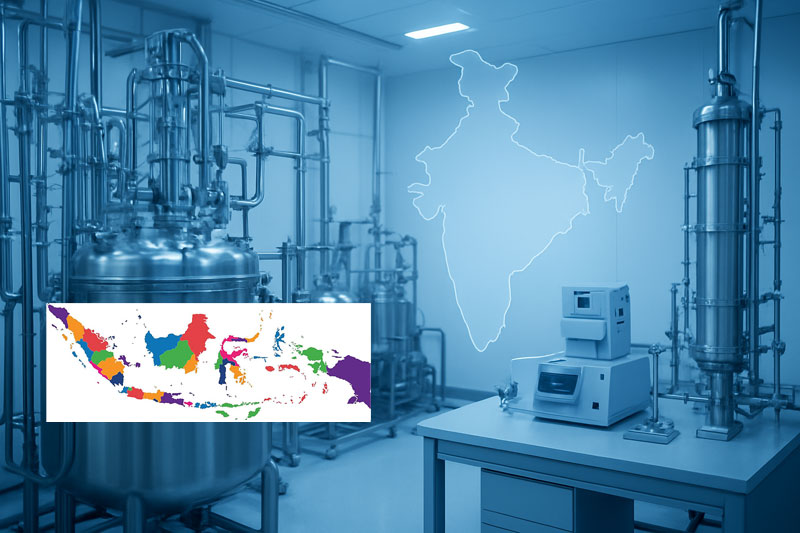
How Companies in Indonesia Can Source Pharma Products & CDMO Services from India
Learn how pharma companies in Indonesia can source medicines, APIs & CDMO services from India. Steps, compliance, docume...
Read Full StoryIndonesia • Source Pharma Products & CDMO Services from India