Supplying Medicines and Supplements to Germany
A practical guide for buyers worldwide sourcing from Germany, and for manufacturers and exporters selling into it.
This page in other languages: English · Deutsch
Germany works inside the EU system. You need a marketing authorisation, through the EMA or the national agencies, and a holder established in the EU or EEA. Imported batches are certified by a qualified person, usually after re-testing. Off-patent supply is shaped by statutory health insurers, which award discount contracts through tenders.
Germany is also a strong place to source from. EU-authorised originator medicines and comparators move through licensed wholesalers, and German API and finished-dose plants are inspected by the regional authorities of each Land. Those same authorities issue export certificates in the WHO format and GMP certificates after inspection.
Germany at a glance
| Regulator | BfArM for most medicines; the Paul-Ehrlich-Institut for vaccines and biomedicines; the EMA for centralised approvals |
|---|---|
| Who holds the licence | An applicant established in the EU or EEA |
| Registration routes | Centralised, decentralised (DCP), mutual recognition (MRP) or national |
| Who imports | A holder of an import authorisation from the competent Land authority, with a qualified person releasing each batch |
| Public buying and reimbursement | Statutory health insurers award discount contracts through tenders; pharmacies dispense the contracted product |
| Unlicensed route | Single import through a German pharmacy when no comparable medicine is available in Germany |
How to supply medicines to Germany
- Find an EU holder and choose the route. The applicant must be established in the EU or EEA. The centralised route is compulsory for biotech medicines and some new active substances; otherwise use the DCP, MRP or a national application to BfArM, or to the Paul-Ehrlich-Institut for vaccines and biomedicines. A generic can be filed once the reference has been authorised for eight years and sold after ten. Our dossier licensing and registration service can help.
- Line up import and batch release. Importing from outside the EU needs an import authorisation from the competent Land authority, and a qualified person certifies each batch, usually after full re-testing unless an MRA covers your country. APIs need a CEP or ASMF, and a written confirmation unless the exporting country is on the Commission's list. See our Europe and Turkey import guide.
- Prepare a German pack. Packs and leaflets must be in German. Prescription medicines carry the EU unique identifier and anti-tampering device, which the QP checks before release. Distributors must follow good distribution practice.
- Win insurer and hospital contracts. Statutory health insurers award discount contracts through EU-wide tenders, sometimes with one supplier per active substance, and pharmacies must dispense the contracted product. Germany's 2023 supply law makes insurers' antibiotic tenders give weight to active-ingredient production in Europe. Our tender supply service can help you bid.
A German pharmacy can import a medicine not authorised in Germany for an individual patient when no comparable medicine, with the same active substance and strength, is available here. From outside the EU and EEA, a doctor's prescription is generally needed. See named-patient and special import and government tender supply.
Sourcing from Germany
- Originator medicines and comparators. Germany offers EU-authorised originator packs with full batch traceability, a common choice for clinical-trial comparators. Each prescription pack carries the EU safety features. Our comparator sourcing guide covers documents, blinding and supply risk.
- APIs and their documents. German API plants are inside the EU, so their substances need no written confirmation for EU use. Ask for a CEP or a DMF, and the plant's GMP certificate. See CEP vs DMF vs ASMF, what to ask about a DMF and our API supplier service.
- Contract manufacturing. German plants are inspected by the regional authorities of each Land. A GMP certificate is issued within 90 days of an inspection that finds no critical or major deficiencies. Read our contract manufacturing guide or ask about white-label manufacturing.
- Export certificates. On request, the competent Land authorities issue export certificates in the WHO format, the German form of the Certificate of a Pharmaceutical Product. The pharmaceutical company, the exporter or the destination country's authority can apply. Collect them in a documentation and quality pack.
Supplements
Food supplements are not approved in Germany. The manufacturer or importer must notify the Federal Office of Consumer Protection and Food Safety (BVL) before first placing a product on the market, with a sample of the label, and the BVL passes the notification to the Länder food authorities. Notification is not an approval, so the business stays responsible for compliance: keep disease claims off the pack. We help brands get supplements made under their own label by GMP-certified contract manufacturers: see nutraceutical private label.
What people in Germany search for
Semrush data from October 2026 shows that people in Germany search most for ashwagandha (about 165,000 searches a month), vitamin D, omega 3 and "kreatin" (creatine, 135,000 each), and vitamin B12 and magnesium (110,000 each).
Germans search for medicines by generic name, in German spelling: "pantoprazol" gets about 88,400 searches a month, "candesartan" 59,600, "atorvastatin" 48,000, "ramipril" 39,500 and "amlodipin" 31,500.
How importers, pharmacies and manufacturers in Germany search
Trade searches centre on private label: "private label mfg" gets about 2,400 searches a month and "private label" 1,000. German phrases for protein powder makers in Europe and the UK (590) and for supplement manufacturers (480) show buyers looking for production partners.
Supplements we can help you make
Often searched medicines include pantoprazole, atorvastatin, rosuvastatin and etoricoxib. Some examples we list:
Auf Deutsch: Arzneimittelimport nach Europa und in die Türkei: Leitfaden nach Ländern (2026)
Documents to ask your supplier for
- A Certificate of a Pharmaceutical Product (CoPP) in WHO format.
- The plant's GMP evidence, such as a WHO-GMP, EU-GMP or PIC/S certificate, plus any inspection by your regulator.
- The registration dossier (CTD or ACTD), with bioequivalence data for generics where required.
- Stability data for hot climates.
- A Certificate of Analysis for every batch.
Not sure a supplier is genuine? Read how to verify a pharmaceutical supplier. For the neighbouring markets, see our Europe and Turkey import guide.
Sourcing for Germany?
Send the product, strength, quantity and the documents your regulator needs. We will match you with GMP-certified manufacturers and suppliers who can serve your market, wherever they are based.
Send your requirement Talk to our teamFrequently asked questions
Articles and guides for Germany
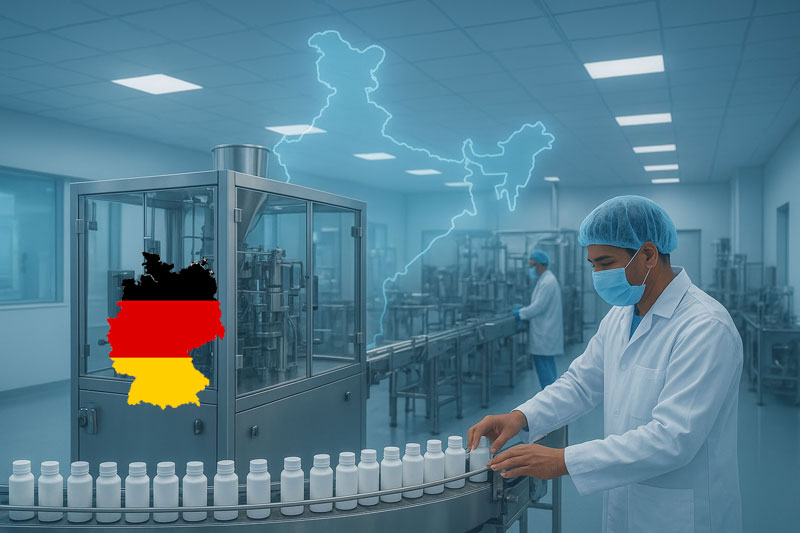
How Companies in Germany Can Source Pharma Products & CDMO Services from India
Learn how German companies can source affordable pharma products, APIs, generic medicines, and CDMO services from India.
Read Full StoryGermany • Source Pharma Products & CDMO Services from India