Supplying Medicines and Supplements to Brazil
A practical guide for Brazilian importers, distributors and hospital buyers who source from abroad, and for manufacturers and exporters worldwide selling into Brazil.
This page in other languages: English · Português
Brazil is Latin America's largest pharmaceutical market, with a strong regulator, ANVISA, and a large local industry. Registration takes time, but a product registered in Brazil is well placed for the rest of the region, including Mexico's new route for ANVISA-approved products.
Two things to plan early: a Brazilian company to import and hold the registration, and the Brazilian GMP certificate (CBPF) for the plant.
Brazil at a glance
| Regulator | ANVISA (Agência Nacional de Vigilância Sanitária) |
|---|---|
| Who holds the registration | A Brazilian company with an ANVISA company authorisation (AFE) that covers importing |
| Plant requirement | A Brazilian GMP certificate (CBPF), valid for two years; since 2025 ANVISA can rely on inspection reports from trusted regulators |
| Timelines | 365 days by law for ordinary registration and 120 for priority cases; ANVISA plans to clear its backlog by the end of 2026 |
| Fast route | Since April 2024, reliance on assessments by WHO, the EMA, FDA, Health Canada, Swissmedic, MHRA and TGA, for identical products |
How to supply medicines to Brazil
- Choose your Brazilian partner. A Brazilian company with an AFE covering imports holds the registration and the import licence.
- Get the plant's CBPF. ANVISA certifies foreign plants for two years. It can rely on trusted regulators' inspection reports and a risk analysis, inspecting where the risk calls for it. Keep your GMP evidence current.
- Register the product. Ordinary registration, priority review for qualifying cases, or the reliance route if the product is identical to one approved by a listed regulator.
- Supply. Private distributors (distribuidoras de medicamentos), pharmacy chains, or public tenders, where foreign companies can bid with a legal representative in Brazil.
Exceptional import of unregistered medicines is reserved for the Ministry of Health and its bodies, for situations such as no alternative on the market. Individual patients can import small quantities for personal use. See named-patient and special import and government tender supply.
Supplements
Food supplements (suplementos alimentares) are regulated by ANVISA under a dedicated framework with lists of permitted ingredients and limits. Labels must be in Portuguese. We help brands get supplements made under their own label by GMP-certified contract manufacturers: see nutraceutical private label.
What people in Brazil search for
Semrush data from October 2026 shows that Brazil is one of the biggest supplement search markets in the world: whey protein and creatine (creatina) get about 550,000 searches a month each, followed by vitamin B12, vitamin D, ashwagandha and omega-3. Among medicines, ibuprofen, prednisone and nimesulide lead.
Brazilians search in Portuguese, though they often borrow English for sports nutrition: “whey protein” and “creatina” get about 550,000 searches a month each, with “vitamina B12” (450,000), “vitamina D” (301,000) and “whey protein isolado” (110,000) close behind (Semrush, October 2026). Medicines are typed by their Portuguese generic name, led by “ibuprofeno” (about 326,300 a month), “prednisona” (315,400), “nimesulida” (283,100) and “dexametasona” (249,000).
How importers and distributors in Brazil search
“private label” gets about 8,100 searches a month and “distribuidora de medicamentos” about 2,900 (Semrush, October 2026). Google Keyword Planner puts “distribuidora de suplementos”, “indústria farmacêutica” and “registro anvisa medicamentos” between 1,000 and 10,000, and “importadora de medicamentos”, “insumos farmacêuticos” and “terceirização de suplementos” (contract manufacturing of supplements) between 100 and 1,000.
Originator brands searched by name include Buscopan (hyoscine butylbromide), Forxiga (dapagliflozin), Mounjaro (tirzepatide) and Ozempic (semaglutide). Brand names are trademarks of their owners and are used only to identify the medicine.
Supplements we can help you make
The most searched medicines include ibuprofen (ibuprofeno, about 326,300 a month), prednisone, nimesulide, dexamethasone, cephalexin and domperidone.
Documents to ask your supplier for
- A Certificate of a Pharmaceutical Product (CoPP) in WHO format.
- The plant's GMP evidence, such as a WHO-GMP, EU-GMP or PIC/S certificate, plus any inspection by your regulator.
- The registration dossier (CTD or ACTD), with bioequivalence data for generics where required.
- Stability data for hot climates.
- A Certificate of Analysis for every batch.
Not sure a supplier is genuine? Read how to verify a pharmaceutical supplier. For the neighbouring markets, see our Latin America and Caribbean import guide.
Sourcing for Brazil?
Send the product, strength, quantity and the documents your regulator needs. We will match you with GMP-certified manufacturers and suppliers who can serve your market, wherever they are based.
Send your requirement Talk to our teamFrequently asked questions
Articles and guides for Brazil
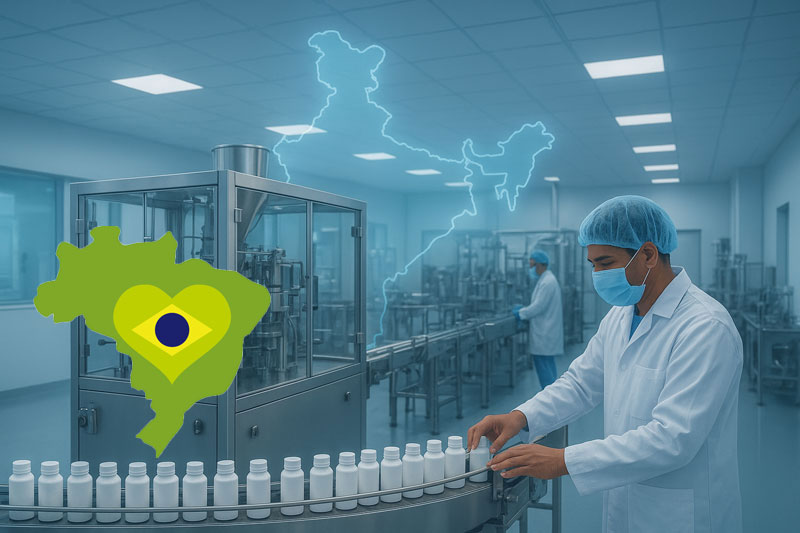
How Brazilian Pharma Companies Can Source Quality CDMO & Pharmaceutical Products from India
Discover how pharmaceutical companies in Brazil can import APIs, formulations, and CDMO services from India. Learn sourc...
Read Full StoryBrazil • Source Pharma Products & CDMO Services from India

Brazil Pharmaceutical Market Overview: Opportunities, Trends, and Challenges
Explore Brazil's pharmaceutical market growth, trends, and regulatory challenges. Learn about opportunities in biologics...
Read Full StoryBrazil • The Pharmaceutical Market