Supplying Medicines and Supplements to Venezuela
A practical guide for Venezuelan importers, distributors and hospital buyers who source from abroad, and for manufacturers and exporters worldwide selling into Venezuela.
This page in other languages: English · Español
People in Venezuela search for medicines in large numbers: metronidazole alone gets about 60,000 searches a month. Registration runs through the INHRR, and every product needs a sponsoring pharmacist.
Two things need care before anything else: banking and payments. US sanctions exempt medicines under a general licence, but each payment route needs its own checks. Agree payment terms and the bank route before you ship.
Venezuela at a glance
| Regulator | Instituto Nacional de Higiene "Rafael Rangel" (INHRR) |
|---|---|
| Who registers | A sponsoring pharmacist registers each product; applications are filed online |
| Registration | A 2024 rule allows registration of products whose innovator isn't registered locally, if they have been on the international market for at least five years; no reliance route |
| Special import | A 2019 resolution lets foreign firms import unregistered medicines through an alliance with a state company or a representative office, under a one-year permit |
| Watch out for | Sanctions and banking: medicines are exempt under a US general licence, but payments need case-by-case checks |
How to supply medicines to Venezuela
- Find a Venezuelan partner. An importer with a sponsoring pharmacist files the registration online with the INHRR.
- Prepare the dossier. A CTD dossier with a CoPP and the plant's GMP evidence.
- Plan the payments. Check the bank route and the sanctions position for each payment before you ship, and agree clear payment terms.
- Supply. Private distributors and pharmacies through your partner. Public supply has run through the PAHO Strategic Fund since 2011.
Under a 2019 resolution, foreign firms without a Venezuelan company can import unregistered medicines through an alliance with a state company or a representative office, under a special one-year permit. Pharmacists' groups said in 2022 that it was still widely used; check its current status before relying on it. See named-patient and special import and government tender supply.
Supplements
Supplements can be registered as foods with the health authority's food service (SACS) or, if they count as medicines, with the INHRR, depending on ingredients and claims. Confirm the route before you print labels. We help brands get supplements made under their own label by GMP-certified contract manufacturers: see nutraceutical private label.
What people in Venezuela search for
Semrush data from October 2026 shows that people in Venezuela search most for vitamin D (about 18,100 searches a month), creatine (14,800), vitamin C and protein (12,100 each). Among medicines, metronidazole, dexamethasone, pregabalin, ciprofloxacin and fluconazole lead.
Venezuelans search in Spanish: “vitamina D” gets about 18,100 searches a month, “creatina” 14,800, “vitamina C” and “proteínas” 12,100 each, and “vitamina B12”, “vitamina D3” and “creatina monohidratada” 8,100 each (Semrush, October 2026). Medicines are typed by their Spanish generic name, led by “metronidazol” (about 60,330 a month), “dexametasona” (36,360), “pregabalina” (29,700) and “ciprofloxacino” (27,010), and “citrato de magnesio” gets about 22,000.
How importers and distributors in Venezuela search
Across ten Spanish-speaking markets combined, Venezuela among them, Google Keyword Planner shows “droguería” between 100,000 and 1 million monthly searches and “distribuidora de medicamentos” and “laboratorio farmacéutico” between 1,000 and 10,000, with “droguerías en Venezuela” and “laboratorios farmacéuticos en Venezuela” between 100 and 1,000. Semrush also picks up “proveedor de laboratorios” and “proveedor médico” locally, at about 30 a month each.
Supplements we can help you make
The most searched medicines include metronidazole (metronidazol, about 60,300 a month), dexamethasone, pregabalin, ciprofloxacin, fluconazole and meloxicam. Some examples we list:
Documents to ask your supplier for
- A Certificate of a Pharmaceutical Product (CoPP) in WHO format.
- The plant's GMP evidence, such as a WHO-GMP, EU-GMP or PIC/S certificate, plus any inspection by your regulator.
- The registration dossier (CTD or ACTD), with bioequivalence data for generics where required.
- Stability data for hot climates.
- A Certificate of Analysis for every batch.
Not sure a supplier is genuine? Read how to verify a pharmaceutical supplier. For the neighbouring markets, see our Latin America and Caribbean import guide.
Sourcing for Venezuela?
Send the product, strength, quantity and the documents your regulator needs. We will match you with GMP-certified manufacturers and suppliers who can serve your market, wherever they are based.
Send your requirement Talk to our teamFrequently asked questions
Articles and guides for Venezuela
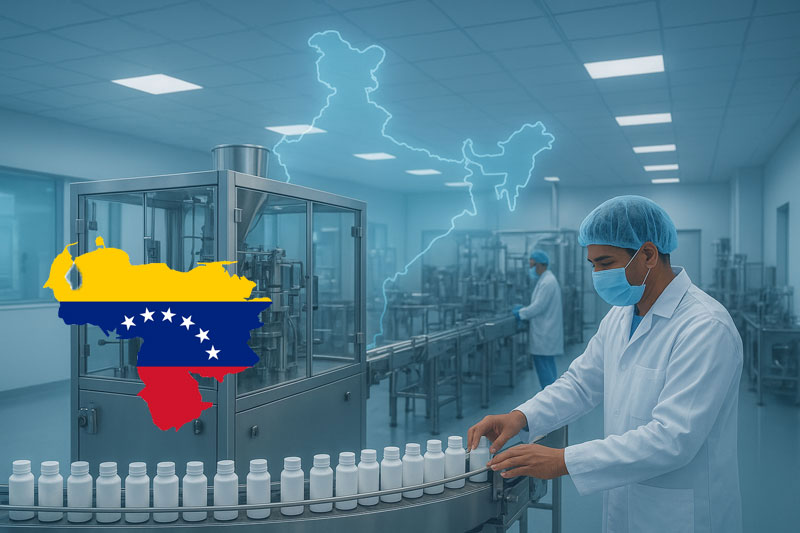
How Venezuelan Companies Can Source Pharma Products & CDMO Services from India
Learn how Venezuelan companies can source affordable pharma products, APIs, generic medicines, and CDMO services from In...
Read Full StoryVenezuela • Source Pharma Products & CDMO Services from India

The State of the Pharmaceutical Market in Venezuela: Opportunities and Challenges
Discover the latest insights into Venezuela’s pharmaceutical market in 2025 — market size, growth, local production tren...
Read Full StoryVenezuela • The Pharmaceutical Market