
By the PharmaTradz BD Team. Updated October 2026.
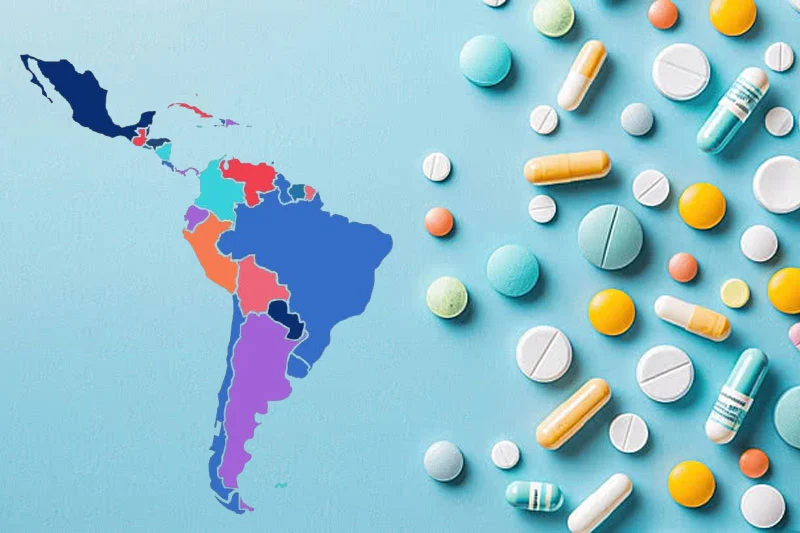
Latin America is not one market. A buyer working across the region deals with many separate regulators, two main languages and a public sector that buys a large share of medicines through tenders. A product that clears registration quickly in one country can take much longer next door.
This guide is for importers, distributors, hospital groups, local manufacturers and tender suppliers who source finished medicines, APIs or contract manufacturing for the region. It covers where supply comes from, how registration and reliance work, how to qualify a supplier, how public procurement runs and what to plan for in logistics.
It is also the hub for our country pages. If you already know your target market, go straight to the country guide directory near the end, or start with our overview of supply to Latin America and the Caribbean.
Where Latin America's medicines come from
The region has real manufacturing depth. Brazil, Mexico, Argentina and Colombia have established domestic industries making generics and branded generics, and some countries also have public laboratories producing vaccines and biologics. Smaller markets in Central America, the Caribbean and the Andes rely more on imports.
- Local and regional manufacturers: strong in oral solids, liquids and many common injectables, and often favoured in tenders that give preference to local production.
- India and China: major sources of generic finished products and of the APIs and intermediates that the region's own formulators depend on.
- Europe and the United States: complex generics, sterile and specialty injectables, biologics, oncology and orphan products, and many of the reference products used for bioequivalence.
- Other producers: other Asian manufacturers for some biosimilars and sterile products, and intra-regional trade between neighbouring countries.
Most buyers end up with a mix. The useful question is rarely which country a product comes from. It is which site makes it, which approvals it holds and whether the dossier will stand up to your regulator.
What buyers in the region typically source
- APIs and intermediates for local formulation, especially cardiovascular, antidiabetic, analgesic, gastrointestinal and antibiotic molecules. See our API supplier network.
- Finished generics for public hospitals, social security systems and retail pharmacy chains.
- Sterile injectables such as IV antibiotics, anaesthetics, oncology products and IV fluids. Our guide to verifying sterile injectable CDMOs covers what to check.
- Biosimilars and biologics, usually under stricter data and cold-chain requirements.
- OTC, vitamins and nutraceuticals for pharmacy chains, often regulated under different rules from medicines.
- Contract manufacturing and private label for tablets, capsules and oral liquids packed in Spanish or Portuguese presentations. See white-label manufacturing.
- Dossiers and licensing for companies that want to hold the registration locally, through dossier licensing and registration support.
Regulators and registration across Latin America
Each country registers medicines through its own authority. In most markets the registration must be held by a local company or legal representative, so decide early who will be the holder.
| Country | Medicines regulator |
|---|---|
| Brazil | ANVISA (Agência Nacional de Vigilância Sanitária) |
| Mexico | COFEPRIS (Comisión Federal para la Protección contra Riesgos Sanitarios) |
| Argentina | ANMAT (Administración Nacional de Medicamentos, Alimentos y Tecnología Médica) |
| Colombia | INVIMA (Instituto Nacional de Vigilancia de Medicamentos y Alimentos) |
| Chile | ISP (Instituto de Salud Pública de Chile) |
| Peru | DIGEMID (Dirección General de Medicamentos, Insumos y Drogas) |
| Ecuador | ARCSA (Agencia de Regulación y Control Sanitario) |
Other markets use agencies such as AGEMED in Bolivia, DINAVISA in Paraguay and DIGEMAPS in the Dominican Republic, or a directorate of the Ministry of Health, as in Costa Rica, Guatemala, Panama and Uruguay.
PAHO reference authorities
PAHO recognises a group of National Regulatory Authorities of Regional Reference (NRAr). In Latin America these are ANMAT, ANVISA, ISP Chile, INVIMA, COFEPRIS and CECMED in Cuba, alongside Health Canada and the US FDA. Smaller regulators often look to their decisions, so an approval from one of them can help a file elsewhere in the region.
Reliance routes
Reliance means a regulator uses another trusted authority's assessment to speed up its own review. It is not automatic approval. The local regulator still reviews the file and makes the decision.
- Brazil: ANVISA's optimised analysis procedure, set out in IN 289/2024, lets it use assessments by Equivalent Foreign Regulatory Authorities (AREE), including EMA, the US FDA, Health Canada, MHRA, Swissmedic, TGA and WHO. It covers registrations and post-approval changes. Brazil-specific data still gets an ordinary review.
- Mexico: since 2025, COFEPRIS has run a reliance route under an agreement published in July 2025. For medicines it can draw on decisions of ICH founding and standing members and WHO-Listed Authorities, and on WHO prequalification for generics, with a stated maximum review of 45 working days. The product must be essentially identical to the one the reference authority approved.
- Elsewhere: several countries offer abbreviated routes for products already approved by reference agencies. Rules change often, so check the country pages below before you commit to a timeline.
The practical point: a supplier whose product already holds a reference approval, with the same formula, site and specifications, can shorten registration noticeably. Ask for that evidence at the first contact.
Harmonisation through Mercosur and PAHO
Mercosur states work on common health rules through Working Subgroup No. 11 (Health), but each country still issues its own registrations. PAHO supports convergence through the Pan American Network for Drug Regulatory Harmonization (PANDRH). Dossiers usually follow the CTD structure, but local administrative modules, bioequivalence rules, labelling and sample requirements differ, and you will need Spanish or Portuguese translations.
How to qualify a supplier
- GMP certificate: check the issuing authority, site address, dosage forms covered and expiry date, and confirm it with the issuer where you can. Some regulators in the region, Brazil among them, issue their own GMP certification for foreign sites, so budget time for an inspection. Our guide on checking a WHO-GMP certificate explains the details.
- COPP: ask for a Certificate of Pharmaceutical Product in WHO format from the exporting country's regulator, showing the product's status in that market.
- CoA: request certificates for several recent batches and compare them with the pharmacopoeia your regulator accepts.
- Stability for the right climatic zone: long-term conditions differ by country, from Zone II to Zone IVb. Confirm the target market's zone and ask for matching data, such as 30°C/65% RH for Zone IVa or 30°C/75% RH for Zone IVb.
- Dossier format: a CTD dossier, API documentation such as a DMF or CEP (and CADIFA in Brazil), and bioequivalence studies against the reference product your regulator accepts.
- Quality agreement: agree on change control, complaints, recalls and pharmacovigilance before the first order.
For a fuller checklist and red flags, read how to verify a pharmaceutical supplier.
Public procurement and tenders
Public buyers drive much of the demand: ministries of health, social security institutes and public hospital networks, often through consolidated national purchases. Most tenders require the product to be registered in the country before bidding, so registration planning and tender planning go together.
The PAHO Strategic Fund is a pooled procurement mechanism for essential medicines and strategic health supplies. Ministries of health and public institutions in PAHO member countries can use it once they sign an agreement. It covers products on the WHO Model List of Essential Medicines, including medicines for communicable and noncommunicable diseases, neglected tropical diseases and diagnostics, and products must meet international quality standards. Vaccines go through PAHO's Revolving Fund. WHO prequalification or a reference approval makes a supplier far more competitive in these channels.
The Global Fund and UNICEF matter mainly for specific programmes in some countries. For live opportunities, see current pharma tenders and our government tender supply service.
Logistics and cold chain into the region
Main sea ports include Santos, Manzanillo, Veracruz, Cartagena, Callao, Buenos Aires, San Antonio, Valparaíso and Guayaquil, with Panama's ports serving as a transshipment hub. Main air gateways include São Paulo-Guarulhos, Mexico City, Bogotá, Lima and Panama City, with Miami often used as a transit point for Central America and the Caribbean.
- Sea freight from Asia: typically 30 to 50 days port to port, longer with transshipment.
- Sea freight from Europe: typically 15 to 30 days, depending on the coast.
- Air freight from Asia or Europe: typically 3 to 7 days to the destination airport, plus customs clearance.
Many countries require an import permit or registration check before goods are released, so missing paperwork is a common cause of delay. For 2 to 8°C products, use validated packaging, data loggers and a forwarder that follows good distribution practice. See our cold chain logistics service and our guide to GDP rules and what to check.
Common problems and practical fixes
| Problem | Practical fix |
|---|---|
| Long registration timelines | Choose products with a reference approval and use reliance routes where they exist. |
| Dossier gaps or wrong format | Run a gap analysis against the target country's requirements before you sign. |
| Stability data for the wrong zone | Confirm the zone first and ask for matching long-term data. |
| Labelling language and format | Share approved Spanish or Portuguese artwork templates early. |
| Foreign GMP inspection backlog | Start the local GMP certification request in parallel with the dossier. |
| Customs holds | Check invoices, certificates of origin, CoAs and import permits before shipment. |
| Payment and currency risk | Use letters of credit or milestone payments, and agree price validity in writing. |
Country guide directory
Choose your market below for local regulators, registration steps and market notes.
- Argentina: Argentina sourcing guide | Argentina pharmaceutical market | Argentina country hub
- Bolivia: Bolivia registration pathway | Bolivia country hub
- Brazil: Brazil sourcing guide | Brazil pharmaceutical market | Brazil country hub
- Chile: Chile sourcing guide | Chile pharmaceutical market | Chile country hub
- Colombia: Colombia sourcing guide | Colombia pharmaceutical market | Colombia country hub
- Costa Rica: Costa Rica registration pathway | Costa Rica country hub
- Dominican Republic: Dominican Republic registration pathway | Dominican Republic country hub
- Ecuador: Ecuador registration pathway | Ecuador country hub
- El Salvador: El Salvador registration pathway | El Salvador country hub
- Guatemala: Guatemala registration pathway | Guatemala country hub
- Honduras: Honduras registration pathway | Honduras pharmaceutical market | Honduras country hub
- Mexico: Mexico sourcing guide | Mexico pharmaceutical market | Mexico country hub
- Nicaragua: Nicaragua registration pathway | Nicaragua country hub
- Panama: Panama registration pathway | Panama country hub
- Paraguay: Paraguay registration pathway | Paraguay country hub
- Peru: Peru pharmaceutical market | Peru country hub
- Uruguay: Uruguay registration pathway | Uruguay country hub
- Venezuela: Venezuela sourcing guide | Venezuela pharmaceutical market | Venezuela country hub
How we can help
PharmaTradz works with GMP-certified manufacturers and CDMOs across Asia, Europe, the Americas and Africa. Tell us the product, strength, target country and volume, and we will match you with suppliers whose documents fit your regulator. Send your RFQ to start.
Frequently Asked Questions(FAQs)
Do I need a local registration holder to import medicines into Latin America?
In most countries, yes. The registration is usually held by a local company or legal representative, who also takes responsibility for pharmacovigilance and recalls. Agree on who holds it before you file.
How does the COFEPRIS reliance route work?
Since 2025, COFEPRIS can rely on decisions of ICH founding and standing members and WHO-Listed Authorities, and on WHO prequalification for generics. The product must be essentially identical to the reference approval, and COFEPRIS still makes the final decision.
What is ANVISA's optimised analysis?
It is a reliance procedure under IN 289/2024. ANVISA uses assessments by designated equivalent foreign authorities, such as EMA, the US FDA and Health Canada, to speed up registrations and post-approval changes, while reviewing Brazil-specific data itself.
Which stability data do Latin American regulators expect?
Long-term data for the climatic zone of the target country. The region ranges from Zone II to Zone IVb, so confirm the zone and ask for matching conditions, such as 30°C/75% RH for Zone IVb.
Can a supplier sell through the PAHO Strategic Fund?
Yes, if its products meet the Fund's quality requirements. The Fund buys essential medicines and health supplies for public institutions in PAHO member countries, and WHO prequalification or a reference approval strengthens a bid.
How long does shipping to Latin America take?
Air freight typically takes 3 to 7 days to the destination airport. Sea freight typically takes 30 to 50 days from Asia and 15 to 30 days from Europe, before customs clearance.