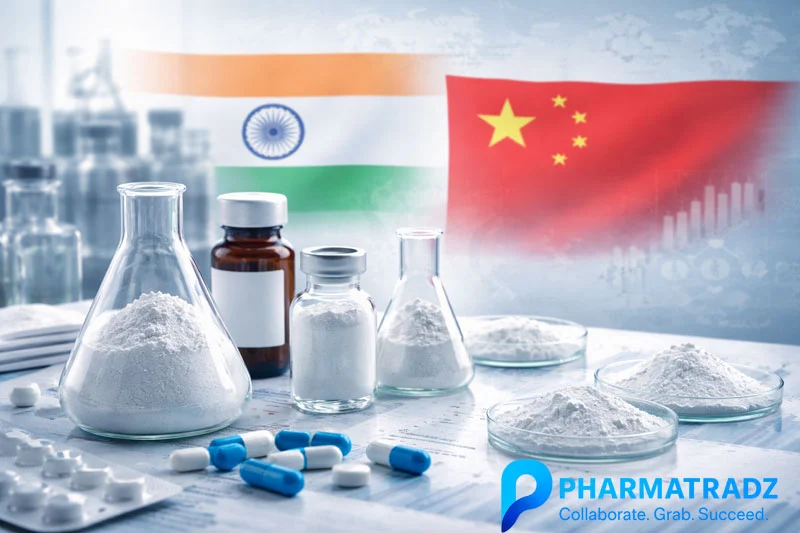
Most of the world's generic APIs are made in India and China. If you buy APIs on cost, you will almost certainly end up comparing suppliers in both. A ranking of company names will not help you much, because the right supplier depends on the molecule, the grade, the documents your market needs and the volume you buy. This guide explains how the two countries differ, where the supply clusters are, and the checks that tell a reliable low-cost supplier from a risky one.
How India and China compare
The two industries are closely linked. Many Indian APIs are made from key starting materials and intermediates produced in China. Each country has its own strengths.
| India | China | |
|---|---|---|
| Main strength | Finished generic APIs with regulated-market documentation | Key starting materials, intermediates, fermentation products and high-volume commodity APIs |
| Regulatory filings | Holds a very large share of US Type II DMFs; many CEPs and ASMFs | Growing numbers of DMFs and CEPs; strongest on volume products |
| Price | Competitive, especially for complex and mid-volume APIs | Often lowest for commodity and fermentation APIs at scale |
| Typical buyers | Formulators supplying the US, EU and other regulated markets | Price-driven buyers, intermediate users, and formulators in less regulated markets |
| Watch-outs | Site-by-site approval differences; dependence on imported starting materials | Documentation depth varies; change control and environmental shutdowns can disrupt supply |
Neither is simply "better". Many buyers deliberately qualify one supplier in each country to protect supply.
Where the clusters are
- India: Hyderabad and Telangana, Visakhapatnam, Gujarat (Ahmedabad, Vadodara, Ankleshwar), Maharashtra, and Himachal Pradesh for formulation-linked API work.
- China: Zhejiang (especially around Taizhou), Jiangsu, Shandong and Hebei, with fermentation-based production spread across several northern provinces.
Clusters matter for two reasons. Suppliers in the same cluster often share upstream sources, so a disruption can hit several of them at once. And local environmental or safety inspections can pause a whole area for weeks.
What drives API cost
- Route of synthesis and the number of steps.
- Raw material and starting-material prices, which can swing sharply.
- Scale: volume APIs are priced very differently from niche ones.
- Documentation: an API with a US DMF, a CEP and a full regulatory package costs more than "technical grade" material, and it should.
- Containment for high-potency and cytotoxic APIs.
- Freight, duties and payment terms. Generic APIs are currently outside the new US tariff on patented medicines. Our tariff guide explains what is covered.
An offer far below the market with no explanation is a warning, not a bargain. It often means a missing filing, a different grade or a supplier who is not the actual manufacturer.
Qualifying a supplier: the checks that matter
| Check | What to look for |
|---|---|
| Is it the manufacturer? | The name and address on the GMP certificate and DMF match the supplier, or the trader shows a manufacturer's authorisation |
| Regulatory file | US DMF with letter of access, CEP, or EU ASMF, as your market requires; open part available for local filings |
| EU written confirmation | For APIs imported into the EU from most non-EU countries, a written confirmation from the exporting country's regulator |
| Inspection history | Recent FDA and EU inspections, any warning letters, import alerts or non-compliance reports, and how they were closed |
| Starting materials | Where key starting materials come from, and whether a second source is qualified |
| Impurities | Nitrosamine risk assessment, residual solvents, elemental impurities and genotoxic impurity controls |
| Change control | A written commitment to notify you before any change to route, site or key materials |
| Commercial terms | MOQ, lead time, samples, stability data, and a realistic forecast commitment |
Our article on nitrosamines and what to ask for in a dossier covers the impurity questions in more depth.
Practical tips for cost-sensitive buyers
- Buy the documents you need, not more. If your market does not require a US DMF, a well-documented supplier without one can be a sensible choice — as long as the GMP status is sound.
- Give a forecast. Suppliers price against expected annual volume, not the first order.
- Test before you commit. Ask for samples from a commercial batch, not a lab batch, and test them against your specification.
- Audit early. A virtual audit before the first order and a physical audit before a long-term agreement are normal practice.
- Keep a second source warm. A small, regular order from a second qualified supplier is cheap insurance.
How we can help
We match buyers with GMP-compliant API manufacturers in India, China, Europe and other producing regions, and we check site certificates and filing status before an offer reaches you. Tell us the API, grade, quantity, target market and the regulatory file you need through our API enquiry form. You can also browse our API sourcing service, our list of specialty and high-potency APIs, or read a balanced comparison of API manufacturing in China and India.
Frequently Asked Questions(FAQs)
Are Chinese APIs cheaper than Indian APIs?
Often for commodity, fermentation-based and high-volume APIs. For complex APIs with full regulated-market documentation, Indian suppliers are frequently competitive or cheaper. Compare offers on the same grade and the same documents, not on price alone.
How do I confirm a supplier's US FDA or EU approval?
Ask for the GMP certificate and the DMF or CEP number for the specific site, then check the FDA's DMF list and inspection records, the EDQM certificate database and EudraGMDP. The names and addresses must match the supplier.
What is an EU written confirmation for APIs?
APIs imported into the EU from most non-EU countries need a written confirmation from the exporting country's regulator stating that the site follows GMP equivalent to EU standards. Without it, the API cannot be used in medicines for the EU market.
What are typical MOQs and lead times for generic APIs?
They vary by molecule. Volume APIs often ship from stock within weeks, while niche or high-potency APIs may be made to order with lead times of two to four months. A realistic annual forecast usually improves both price and priority.
Should I qualify suppliers in both India and China?
For important molecules, many buyers do. Qualifying one supplier in each country spreads the risk of regulatory action, plant shutdowns or starting-material shortages in one location.