How Companies in the United States Can Source Pharma Products & CDMO Services (2026 Guide)
United States • Source Pharma Products & CDMO Services

Introduction
The United States is the largest pharmaceutical market in the world, and it depends heavily on imported APIs and finished generics. US generic companies, virtual pharma firms, repackagers and hospital groups all source abroad, and many use contract manufacturers for development, clinical supply and commercial production.
The US Food and Drug Administration (FDA) applies the same standards to foreign and domestic plants. A supplier that cannot support an FDA application, pass an inspection and clear import screening is not a real option, whatever its price.
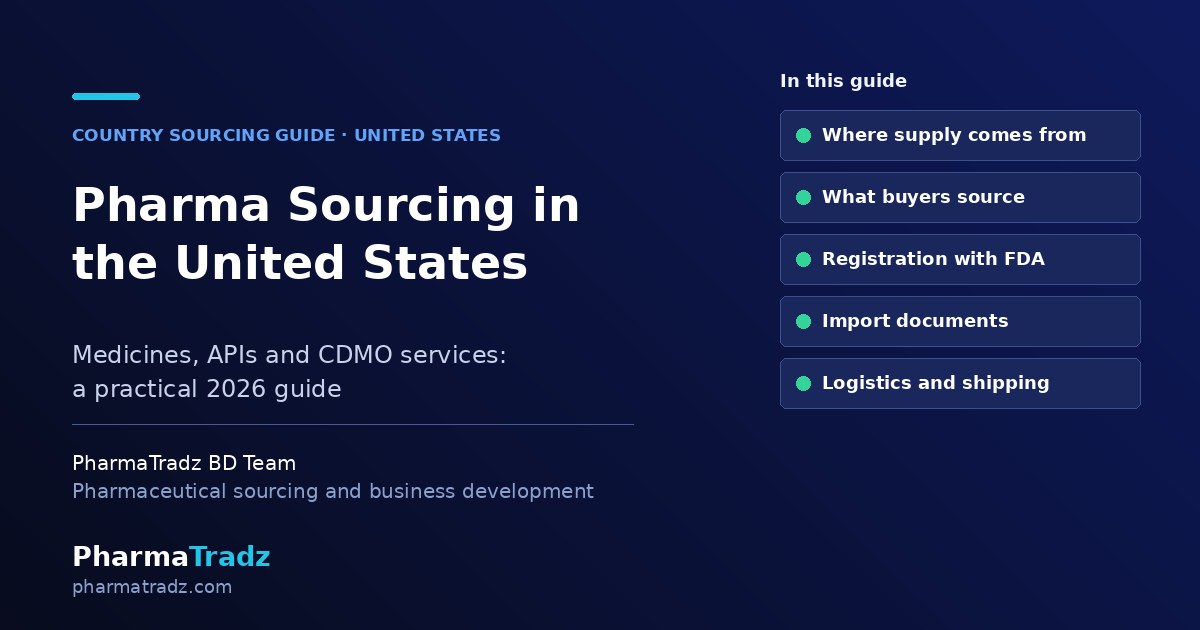
This guide covers where US supply comes from, what buyers typically source, how to qualify a manufacturer or CDMO, the documents needed at entry, logistics, and the regulatory and trade points that most often cause problems, including the 2026 Section 232 tariff on patented medicines.
Where supply comes from
US buyers draw on several supply bases, each with different strengths:
- India and China supply a large share of generic APIs, and many FDA-inspected plants in both countries make finished generics for the US market.
- Europe and Switzerland are major sources of branded medicines, biologics, sterile injectables and specialty APIs.
- Domestic and nearby sites in the US, Puerto Rico, Canada and Mexico are used for shorter supply chains, shortage-sensitive products and controlled substances.
- South Korea, Japan and Singapore host significant biologics and API capacity.
For most buyers the deciding factor is not geography but the site's FDA record: inspection outcomes, warning letters, import alerts and how well it supports filings. Check the latest drug shortage information if you are sourcing for supply-constrained products.
Pharma categories supply
| Category | What US buyers typically source |
|---|---|
| APIs | Generic APIs backed by a Type II Drug Master File |
| Finished generics | Oral solids and liquids made under an ANDA held by the buyer or the manufacturer |
| Sterile injectables | Hospital and shortage-prone injectables, prefilled syringes, lyophilised products |
| Development and clinical supply | Formulation, scale-up and clinical batches for NDA, 505(b)(2) or BLA programmes |
| OTC products | Monograph products such as analgesics, antacids and topical items |
| Packaging and labelling | Contract packaging, serialisation and US-market artwork |
Buyers planning new generic launches often start from patent and exclusivity dates. Our generic entry tracker helps with that timing.
How to source pharma products
1. Fix the regulatory route
Decide whether the product will be marketed under an ANDA, NDA, 505(b)(2), BLA or an OTC monograph. This sets the data package, the inspection exposure and what the supplier must provide.
2. Screen the site's FDA history
Confirm the establishment's registration and listing, then review inspection results, Form 483 observations, warning letters and import alerts. See our guide on how to verify a pharmaceutical supplier.
3. Check the API and DMF position
For APIs, ask whether a Type II DMF is on file, whether it has passed the FDA completeness assessment for ANDA reference, and whether the holder will issue a letter of authorisation.
4. Audit and review data
Run an on-site or remote audit focused on data integrity, change control and investigations. Review batch Certificates of Analysis and ICH stability data at Zone II conditions.
5. Contract carefully
Sign a quality agreement that sets out cGMP responsibilities, change notification and FDA inspection support, alongside a supply agreement covering price, MOQ, lead time and tariff allocation. You can request quotes from several GMP-certified manufacturers through the PharmaTradz RFQ.
Required documents for import
Regulatory basis
- Approved application (ANDA, NDA or BLA) or compliance with an OTC monograph
- Current FDA establishment registration and drug listing for every foreign site involved
- Named US agent for each foreign establishment
- National Drug Code (NDC) listed for the product
- DMF letter of authorisation where the API is referenced in an application
For each entry
- Commercial invoice, packing list and bill of lading or air waybill
- Entry filed through a customs broker in ACE with the FDA data elements
- Batch Certificate of Analysis and release documentation
- Temperature records for cold-chain cargo
- DEA import permit or declaration for controlled substances
Logistics and shipping
Main gateways
Sea freight from Asia usually lands at Los Angeles and Long Beach, while cargo from Europe often arrives at New York and New Jersey, Savannah, Charleston or Houston. Pharmaceutical air cargo commonly moves through JFK, Chicago O'Hare, Miami, Memphis and Louisville.
Indicative transit times
| Origin | Sea freight | Air freight |
|---|---|---|
| Asia to the West Coast | Typically 3 to 5 weeks | Typically 3 to 6 days |
| Asia to the East Coast | Typically 5 to 7 weeks | Typically 3 to 6 days |
| Europe to the East Coast | Typically 2 to 3 weeks | Typically 1 to 3 days |
Cold chain, Incoterms and entry review
Biologics and vaccines need validated packaging and GDP-trained handlers. Many US importers buy FCA or EXW and manage freight themselves; buyers with less experience prefer CIP or DAP. At entry, FDA screens each line electronically. The shipment may proceed, be examined or sampled, or be detained, and products that appear adulterated, misbranded or unapproved can be refused admission. Accurate product codes, registration numbers and NDCs reduce holds.
Legal and regulatory overview
Approval and GMP
Prescription drugs need FDA approval before marketing, and every site must follow cGMP. Applications and DMFs are filed in eCTD format, and FDA may inspect foreign plants before approval. Labelling must be in English and match the approved label.
Import alerts and limits
Import alerts let FDA detain products from listed firms without physical examination, so a site on an alert can block supply until it is removed. Commercial imports of unapproved drugs are generally not allowed. Limited exceptions include investigational use under an IND, import for further processing or export, temporary importation during shortages at FDA's discretion, and state importation programmes under Section 804. FDA's personal importation policy, which is generally limited to small, personal-use quantities such as a 90-day supply, is not a commercial route.
Supply chain security
The Drug Supply Chain Security Act requires product identifiers on packages and electronic tracing between licensed trading partners.
Section 232 tariff
From 31 July 2026, a Section 232 tariff applies to imported patented medicines and their APIs. Generics and biosimilars are exempt, and rates vary by country of origin and by company agreements. Confirm the classification of each product with your customs broker.
Common challenges and practical solutions
| Challenge | Practical solution |
|---|---|
| Site lands on an import alert | Screen alerts and warning letters before qualifying, and keep a second qualified site. |
| DMF not ready for reference | Confirm completeness assessment status and get the letter of authorisation before filing. |
| Entry holds | Check registration, listing and NDC data before every shipment. |
| Data integrity findings | Audit raw data, audit trails and investigations, not just summary reports. |
| Tariff exposure on patented products | Map each SKU's patent status and origin, and set tariff allocation in the contract. |
| Single-source risk | Qualify a second API or finished-product site for critical lines. |
Most supply failures can be traced to weak qualification. Time spent on audit and document review before the first order is rarely wasted.
Conclusion
US buyers can source well from Asia, Europe and the Americas, provided each supplier can support FDA filings and inspections. Match the product to the right supply base, screen FDA compliance history, lock down DMF and quality agreements, and plan for trade measures such as the 2026 Section 232 tariff.
PharmaTradz works with GMP-certified manufacturers and CDMOs across Asia, Europe, the Americas and Africa, and can help you compare options for APIs, generics and contract manufacturing. More resources are on our United States hub.
Frequently Asked Questions
Do foreign manufacturers need to register with the FDA?
Yes. Foreign sites making drugs for the US must register, list their products and name a US agent. Registration does not mean FDA has approved the site or the product.
What is a Drug Master File and when is it needed?
A DMF is a confidential file a manufacturer submits to FDA. API makers usually file a Type II DMF so that ANDA and NDA applicants can reference it through a letter of authorisation.
What happens to a shipment at a US port of entry?
FDA screens the entry and may release it, examine or sample it, or detain it. Products that appear adulterated, misbranded or unapproved can be refused admission.
What is an FDA import alert?
It lets FDA detain products from listed firms without physical examination until the firm shows it has fixed the problem.
Can unapproved drugs be imported into the United States?
Generally not for commercial sale. Exceptions include investigational use, import for further processing or export, and temporary importation during shortages at FDA's discretion.
Does the 2026 Section 232 tariff apply to generics?
No. The tariff covers patented medicines and their APIs, while generics and biosimilars are exempt.
Source Pharma Products & CDMO Services — other markets
Planning to register or source in United States?
Tell us the molecule, dosage form and target market. We will come back on the regulatory pathway and whether the project is realistic before you commit anything.
Submit a Requirement Ask a questionIf you already hold WHO-GMP, EU-GMP, USFDA or PIC/S approval, you are closer to supplying United States than you probably think.
United States's regulator publishes a register of authorised products. Look up any supplier's claims yourself — including ours.