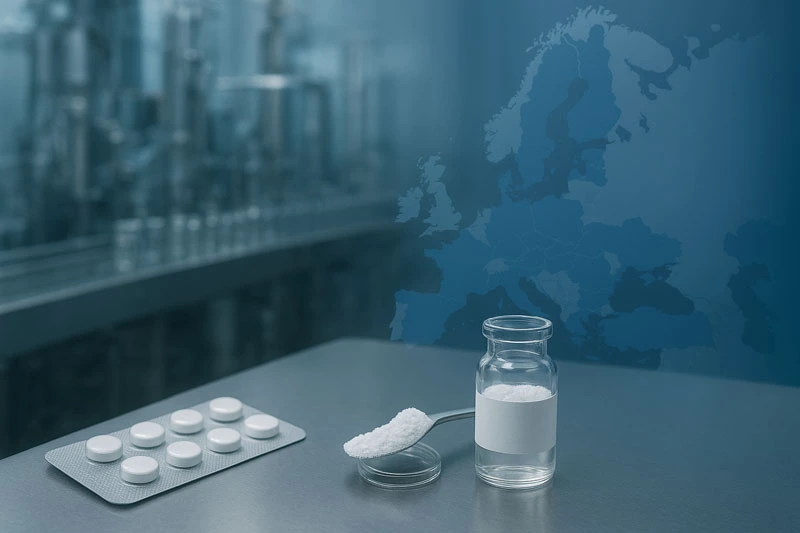
Europe is not usually the cheapest place to buy an API. It is often the safest, and for some molecules it is the only realistic choice. Complex chemistry, high-potency compounds, peptides, sterile APIs and controlled substances are areas where European manufacturers have long experience and strong regulatory files. This guide explains where Europe's strengths lie, which countries specialise in what, the documents you should expect, and when paying a European price makes commercial sense.
Why buyers choose European API manufacturers
- Regulatory depth. EU sites are inspected by national competent authorities under EU GMP for APIs (ICH Q7). Most suppliers hold a CEP, an EU ASMF and often a US DMF, with full validation, impurity and stability data.
- Complex chemistry. Multi-step synthesis, chiral chemistry, high-potency containment, peptides and fermentation are long-standing specialisms.
- Change control and traceability. Buyers usually get clear notice of changes to raw materials, routes or sites, which protects their own filings.
- No written confirmation needed for the EU. APIs made in the EU do not need the written confirmation that most non-EU imports require.
- Supply security. Shorter supply chains and diversified sources reduce the risk of a single-country disruption.
Who makes what, by country
| Country or region | Typical strengths |
|---|---|
| Italy | One of Europe's largest API producers: generic APIs, steroids and hormones, fermentation products, custom synthesis |
| Spain | Generic APIs, oncology and complex small molecules, export-oriented API plants |
| Switzerland | High-potency APIs, peptides, complex synthesis and development services |
| Germany | Complex intermediates, custom synthesis, sterile and biologic drug substances |
| France and Belgium | Chiral and complex chemistry, purification technologies, sterile APIs |
| Ireland and the United Kingdom | Innovator API production and advanced development work |
| Central and Eastern Europe | Competitively priced generic APIs and intermediates, often with CEPs |
| Nordic countries | Peptides, enzymes and fermentation-based products |
As with any region, approvals and capabilities belong to individual sites. Check the specific plant, not the country or the company name.
Specialisations where Europe stands out
- High-potency and cytotoxic APIs. Many plants run OEB 4–5 containment for oncology molecules and ADC payloads.
- Peptides. Solid-phase and hybrid synthesis at clinical and commercial scale.
- Sterile APIs. Aseptically produced or terminally sterilised drug substances for injectables.
- Fermentation and semi-synthesis. Antibiotics, statins, immunosuppressants and steroid-based products.
- Controlled substances. Licensed production and handling of narcotic and psychotropic APIs.
For many of these molecules, see our list of specialty and high-potency APIs.
The documents to expect
| Document | What it does |
|---|---|
| CEP (EDQM certificate of suitability) | Confirms the API meets the European Pharmacopoeia monograph; accepted in the EU and many other markets |
| EU ASMF (active substance master file) | Supports EU filings where there is no CEP, with an open and a restricted part |
| US DMF (Type II) and letter of access | Supports US ANDA and NDA filings |
| GMP certificate | Issued by the national authority; searchable in EudraGMDP |
| Impurity, nitrosamine and stability data | Needed for your own registration and for regulators' questions |
When does paying more make sense?
A European API can cost noticeably more than an Asian equivalent. It tends to be worth it when:
- the chemistry, containment or sterility requirements narrow the field to a few qualified plants anyway;
- your finished product goes to the EU, US, Japan or other markets where a weak file costs months;
- supply continuity matters more than unit price, as with hospital and critical medicines;
- the API is a small part of the finished product's cost, so the premium barely changes your margin;
- US tariffs apply. For patented medicines, EU-origin products currently pay a combined 15% US tariff, against 100% for many other origins. See our US tariff guide.
Policy is moving the same way. The EU's proposed Critical Medicines Act aims to strengthen European production of essential medicines and their ingredients, which may favour European supply in public tenders over time.
Questions to ask a European API supplier
- Which site makes the API, and when was it last inspected?
- Which filings exist — CEP, ASMF, US DMF — and are letters of access available?
- Where do the key starting materials come from, and is there a second source?
- What are the MOQ, lead time and price breaks at your forecast volume?
- Can you receive commercial-batch samples and stability data before contracting?
- What notice will they give before any change to the process or site?
How we can help
We work with API manufacturers across Europe as well as in Asia and the Americas, and we check site certificates and filings before an offer reaches you. Send your requirement — API, grade, quantity, target market and the regulatory file you need — through our API enquiry form, or read about our API sourcing service. To compare lower-cost options, see our guide to qualifying generic API suppliers in India and China.
Frequently Asked Questions(FAQs)
Why are European APIs more expensive?
Higher labour, energy and compliance costs, smaller batch sizes for niche products, and investment in containment and documentation. For complex, high-potency or sterile APIs the gap narrows, because only a few qualified plants exist anywhere.
What is a CEP and why does it matter?
A certificate of suitability from EDQM confirms that an API meets the European Pharmacopoeia monograph. It simplifies registration in the EU and is accepted by many regulators elsewhere.
Do APIs made in the EU need a written confirmation?
No. Written confirmation applies to APIs imported into the EU from most non-EU countries. APIs manufactured in the EU are covered by EU GMP inspections directly.
Which European countries produce the most APIs?
Italy and Spain are among the largest producers of generic APIs in Europe. Switzerland, Germany and France are strong in complex, high-potency and specialty chemistry, and Central and Eastern Europe offers competitively priced generic APIs.
Are European APIs affected by the US pharma tariffs?
Generic APIs are currently exempt. For patented medicines and their APIs, EU-origin goods pay a combined 15% US tariff, compared with 100% for many other origins.