
Objective
This blog explains why GMP compliance has become harder for pharma exporters targeting the US market, why companies are bringing in consultants much earlier in the process, and what you need to know to avoid the mistakes that cause FDA inspection failures.
Key Takeaways
- FDA GMP inspections remain detailed and risk-based, especially for facilities supplying the US market.
- Many GMP audit failures are linked to issues that can be reduced through better documentation, training, data integrity controls, and quality-system oversight.
- Hiring a pharmaceutical regulatory consultant early saves time, money, and market access.
- Documentation gaps, data integrity issues, weak CAPA systems, and training failures are common themes seen in many GMP inspection findings.
- Preparing for FDA GMP inspections is not a one-time task, it is an ongoing process.
Table of Contents
- Why GMP Compliance Is a Bigger Deal Than Ever
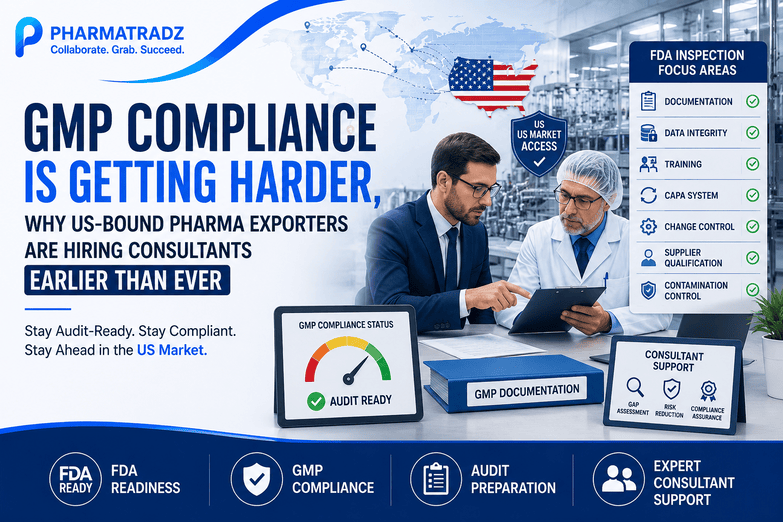
- What the FDA Actually Looks For During Inspections
- Why Pharmaceutical Companies Fail GMP Audits
- The Real Cost of Non-Compliance
- Why Exporters Are Calling Consultants Earlier
- How to Prepare for FDA GMP Inspections
- What Good Pre-Inspection Preparation Looks Like
- GMP Compliance Challenges for Pharmaceutical Companies
- What the Numbers Say
- Final Thoughts
- FAQs
1. Why GMP Compliance Is a Bigger Deal Than Ever
Selling pharmaceuticals in the US is one of the most lucrative things a pharma company can do. It is also one of the most regulated.
The FDA expects facilities supplying the US market to meet applicable CGMP requirements. A company’s history, facility appearance, or success in other markets does not replace documented CGMP compliance. If a facility does not meet FDA expectations, the company may face inspection observations, warning letters, import restrictions, or other regulatory action, depending on the severity.
FDA continues to inspect both domestic and foreign facilities using a risk-based approach. Several overseas manufacturers have faced warning letters, import alerts, or other compliance actions when FDA identified serious CGMP concerns. Regulatory expectations remain high, and companies must keep their systems current with FDA guidance and inspection priorities.
Exporters who used to prepare for inspections a few months in advance are now finding that it is not nearly enough. The ones who are actually passing, and keeping their US market access, started preparing much earlier. And most of them did not do it alone.
2. What the FDA Actually Looks For During Inspections
FDA inspectors do not just walk through your facility and check if things look clean. FDA inspections can involve detailed review of systems, records, procedures, staff practices, and quality controls.
They review batch records. They check how deviations are handled. They look at your out-of-specification investigation process. They interview your staff, not management, but the people actually working on the floor. They check if what your SOPs say is what your employees actually do.
They also look at your data integrity. This has become a major focus area. Any sign that records have been altered, backdated, or selectively reported is a serious red flag. It does not matter if the product itself is fine. Data integrity issues alone are enough to trigger a warning letter.
A qualified pharmaceutical regulatory consultant who has worked directly with FDA processes knows exactly what inspectors are trained to look for, and can identify gaps in your system before the inspector walks through the door.
3. Why Pharmaceutical Companies Fail GMP Audits
This is the question every exporter should be asking before they start the inspection process.
Poor documentation. This is the number one reason. SOPs that are outdated, incomplete, or not followed. Batch records with missing entries. Change control logs that are incomplete. FDA expects records to be complete, accurate, traceable, and consistent with actual manufacturing and quality activities.
Data integrity failures. Deleted entries, overwritten records, shared login credentials, and unofficial spreadsheets running alongside official systems. These patterns raise immediate red flags during inspections.
Undertrained staff. Many companies invest in systems but not in people. Floor-level employees cannot explain the SOPs they are supposed to follow. This can raise serious concerns about whether procedures are understood and followed in daily operations.
Inadequate CAPA systems. Finding a problem is one thing. Fixing it properly and preventing it from happening again is another. Weak corrective and preventive action processes are a recurring inspection failure point.
Contamination control gaps. Environmental monitoring that is infrequent or poorly documented. Cross-contamination risks that have not been for mally assessed. Equipment cleaning validation exists only on paper.
Many exporters reduce supplier qualification risks by working with a US FDA approved pharma manufacturer that already operates under established quality systems, inspection readiness programs, and documented compliance procedures.
4. The Real Cost of Non-Compliance
An FDA warning letter can lead to major operational, financial, and regulatory consequences.
Companies that have gone through this describe the process as exhausting and expensive. The cost of remediation after a warning letter is almost always far higher than the cost of getting compliance right before an inspection.
5. Why Exporters Are Calling Consultants Earlier
Five years ago, many pharma exporters brought in a consultant two or three months before an expected FDA inspection. That model has quietly stopped working.
Here is why. The FDA does not always announce inspections far in advance. Surveillance inspections can come with shorter notice than companies expect. And even when there is lead time, two months is not enough to fix systemic gaps in documentation, training, or quality systems.
Companies with known compliance gaps often benefit from starting preparation many months before expected US market entry or inspection activity. They engaged consultants not to do a last-minute check but to rebuild their compliance infrastructure from the ground up.
A good consultant does not just prepare you for the inspection. They help you build a system that can pass inspection on any given day, not just when you know someone is coming.
6. How to Prepare for FDA GMP Inspections
Preparation for FDA GMP inspections is not a checklist activity. It is a culture shift. But there are specific things that must happen.
Start with a gap assessment. Before anything else, understand where you currently stand versus where FDA expectations sit. This means an honest internal audit, or better, an external one that replicates what an FDA inspector would do.
Fix your documentation system first. Every SOP must be current, approved, and accessible to the people using it. Every record must be complete, legible, and traceable. There are no partial credits here.
Make data integrity a non-negotiable. Audit trails must be active. Electronic systems must be validated. Paper records must be controlled. Any gaps in data integrity will be found, and they will cost you.
Train your staff, then train them again. Training is not a one-time onboarding exercise. It must be regular, documented, and role-specific. Every person working in a GMP environment must be able to explain what they do and why.
Run mock inspections. A mock FDA inspection, conducted by someone who knows how real inspections run, is one of the most valuable things you can do before the real one. It surfaces problems you did not know existed.
Build your CAPA system properly. Every deviation, complaint, and out-of-specification result must flow through a documented, effective CAPA process. This is one of the first things FDA inspectors evaluate.
7. What Good Pre-Inspection Preparation Looks Like
A company that is genuinely ready for an FDA inspection does not scramble when the inspector arrives. Their staff is calm. Their documents are in order. Their quality team can answer questions without hesitation.
That state does not happen in two months. It is built over time through consistent work on systems, people, and culture. The facility that passes an unannounced inspection is the one that is prepared as if every day could be inspection day.
8. GMP Compliance Challenges for Pharmaceutical Companies
The challenges are real, and they are not limited to small or less experienced companies.
Keeping up with regulatory updates. FDA guidance documents change. ICH guidelines evolve. Companies that do not actively track these updates find their systems falling behind without realising it.
Managing multi-site compliance. For companies with multiple manufacturing locations, maintaining consistent GMP standards across all sites is genuinely difficult. What works at one plant does not automatically transfer to another.
Technology transitions. Moving from paper-based to electronic quality management systems is a major compliance challenge. Many companies underestimate the validation requirements and staff retraining involved.
Supply chain complexity. More suppliers, more raw material sources, and more contract manufacturers mean more compliance exposure. Each link in the supply chain is a potential inspection finding.
Retention of qualified people. Experienced quality assurance professionals are in high demand. Companies that cannot retain them often see their compliance standards erode without visible warning signs.
9. What the Numbers Say
As per the research done by Pharmatradz Global Ventures Pvt Ltd, pharma exporters who engaged regulatory consultants at least 12 months before a planned US market entry had a significantly lower rate of first-inspection failures compared to those who began preparation in the final quarter.
A case study conducted by Pharmatradz Global Ventures Pvt Ltd found that a mid-size Indian pharmaceutical exporter reduced its FDA observation count from eleven in a previous inspection to two in the following cycle, after a structured 14-month compliance rebuild supported by an external consultant team. The changes were not cosmetic. They were systematic, covering documentation, data integrity, staff training, and supplier qualification.
Early preparation, done properly, changes inspection results.
10. Final Thoughts
GMP compliance for US-bound pharma exports has never been more demanding. The FDA is not getting easier to satisfy. The companies that are succeeding are the ones treating compliance as a business-critical investment, not a regulatory burden to manage at the last minute.
Another area that often affects inspection outcomes is supplier qualification and API supplier verification. Companies that depend on external API sources should ensure those suppliers meet the same quality and documentation standards expected during regulatory inspections.
Early consultant support can help companies identify gaps before they become inspection findings. It is a smart business decision. It means you find the gaps before the inspector does. It can reduce the risk of avoidable compliance issues that may affect market access. It means your team builds the knowledge and habits that keep you compliant long after the consultant leaves.
If you are planning to enter or maintain your presence in the US market, preparation should begin before inspection notice, especially when documentation, training, or quality-system gaps already exist.
Frequently Asked Questions(FAQs)
Q1. How often does the FDA inspect overseas pharma manufacturers?
The frequency varies. The FDA conducts both scheduled and unannounced inspections. Facilities supplying the US market can expect to be inspected every one to three years, though this depends on the product risk profile and past inspection history.
Q2. What are the most common GMP compliance challenges for pharmaceutical companies?
Documentation gaps, data integrity failures, undertrained staff, weak CAPA systems, and inadequate supplier qualification are the most frequently cited issues in FDA warning letters.
Q3. Why do pharmaceutical companies fail GMP audits?
Most failures come down to poor documentation practices, data integrity problems, and staff who cannot demonstrate that they understand and follow the procedures they are supposed to follow.
Q4. How early should a pharma company start preparing for an FDA GMP inspection?
Industry experience and regulatory data consistently point to 12 to 18 months as the appropriate preparation window for companies with known compliance gaps.
Q5. What does a pharmaceutical regulatory consultant actually do?
They assess your current compliance status, identify gaps against FDA expectations, help rebuild quality systems, conduct mock inspections, train your staff, and prepare your documentation. Some also support you during the actual inspection.
Q6. What happens if a company fails an FDA GMP inspection?
Depending on the severity, outcomes range from a Form 483 with observations to a formal warning letter, import alert, or consent decree. Each step up the scale brings greater operational and financial consequences.
Q7. Can a company recover from an FDA warning letter?
Yes, but it takes time. Companies typically need to submit a comprehensive corrective action response, implement changes, and, in many cases, undergo a re-inspection before restrictions are lifted. The process often takes 12 to 36 months