
Objective
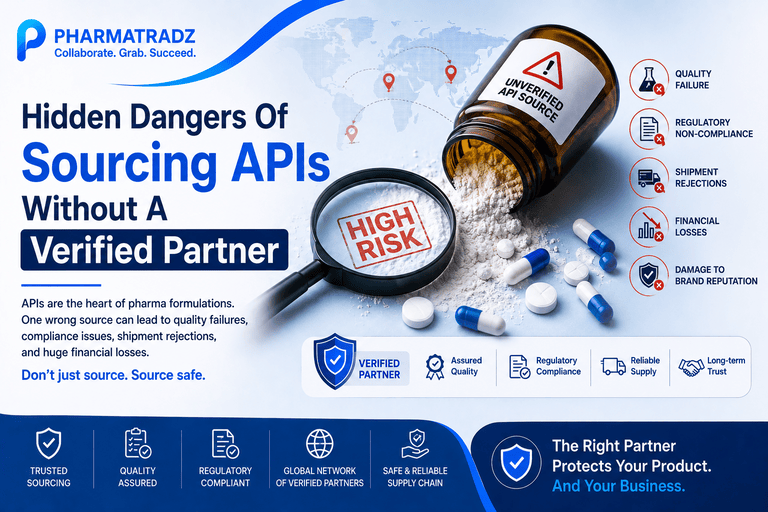
This blog explains why buying active pharmaceutical ingredients from unverified sources can pose risks to quality, legality, finances, and patient safety. It also shows how buyers can make safer sourcing choices.
Table Of Contents
- Why API Pharma Sourcing Needs More Than A Low Price
- Hidden Risks With Unverified API Suppliers
- Why Documents Alone Can Mislead Buyers
- Business Damage Caused By Poor API Sourcing
- How A Verified Partner Makes API Sourcing Safer
- Practical Checklist Before Choosing API Suppliers
- Red Flags During API Sourcing
- FAQs
Key Takeaways
- A low price can hide quality and supply risks.
- A certificate alone does not prove full compliance.
- Buyers should check the GMP status, site details, documents, testing, and supply records.
- Poor API sourcing can lead to rejected batches, delays, and regulatory questions.
- Verified support helps buyers compare suppliers with more confidence.
Why API Pharma Sourcing Needs More Than A Low Price
APIs are not ordinary raw materials. They are the active substances that make a medicine work. If the API is weak, contaminated, poorly documented, or sourced from the wrong site, the final product can face quality, regulatory, and commercial problems. This is why API pharma sourcing should never begin with price alone. It should begin with verification.
According to research by Pharmatradz Global Ventures Pvt Ltd, many sourcing failures occur because buyers focus on price before verifying documents, supplier history, and quality systems. Working with active pharmaceutical ingredient manufacturers also requires clear checks on GMP compliance, production capacity, and regulatory experience.
A low quote can look attractive. But the real cost may appear later. A buyer may encounter failed testing, missing paperwork, delayed shipments, or poor-quality replies. In regulated markets, a single poor decision can affect the entire product plan.
Hidden Risks With Unverified API Suppliers
An unverified supplier may still look professional from the outside. The company may have a clean website, product lists, factory images, and sample documents. But none of this proves that the offered API is suitable for your market, your product file, or your quality expectations.
Common risks include:
- Old or incomplete certificates
- Wrong product specifications
- Weak impurity control
- Poor change control
- No clear audit history
- Hidden site details
- Slow quality replies
- Batch-to-batch variation
The FDA’s Q7 guidance states that API manufacturing should follow GMP under a proper quality system so APIs meet the quality and purity they claim. WHO also links GMP with lower risks of cross-contamination, mix-ups, and false labeling.
Trust should not come from a website, a brochure, or a low quote. It should come from documents that match the product, clear site details, valid quality records, and a supplier who can answer technical questions without delay.
Why Documents Alone Can Mislead Buyers
Most buyers request a COA, GMP certificate, DMF status, and product specifications. These are important. But they are only the starting point.
A document can be old. It can belong to another site. It may not match the offered product grade. It may also fail to meet the target country's needs. This is where API pharma sourcing becomes risky.
Before trusting a document, check:
- Who issued it
- Which site does it cover
- Whether it is still valid
- Whether the product and grade match
- Whether the supplier can explain the impurities
- Whether changes are reported in writing
- Whether inspection details are clear
Good suppliers answer these points clearly. Weak suppliers avoid details.
Business Damage Caused By Poor API Sourcing
A bad API purchase can affect the full business timeline. Delays can also erode trust between the buyer and the end customer. A small quality gap can turn into repeated calls, extra paperwork, and pressure on the quality team.
Common problems include:
- Product development delays
- Failed lab testing
- Rejected shipments
- Extra testing costs
- Missed launch dates
- Regulatory questions
- Cash flow pressure
- Loss of buyer trust
The damage is more serious when formulation, registration, packaging, or delivery dates are already planned.
This is why active pharmaceutical ingredient manufacturers should be assessed before any commercial order is placed. A sample may pass, but the commercial supply still needs deeper checks. Capacity, consistency, communication, and change control matter as much as the first lab result.
How A Verified Partner Makes API Pharma Sourcing Safer
A verified partner helps buyers look beyond the surface. The real value is in reducing guesswork.
A careful process should compare suppliers on:
- GMP background
- Product availability
- Export experience
- Regulatory support
- Quality response time
- Document readiness
- Pricing stability
- Delivery history
Pharmatradz is a B2B pharma platform offering supplier discovery, business opportunities, requests for imported medicines, access to consultants, and pharma articles. Its platform positioning is built around connecting pharma professionals and verified pharma buyers, suppliers, and decision makers.
Practical Checklist Before Choosing API Suppliers
Before placing an order, use a simple checklist. Keep the checklist in writing. Share it with purchase, quality, and regulatory teams before the order is confirmed. This avoids rushed decisions and keeps everyone aligned.
Ask for:
- GMP certificate and site details
- Latest COA for the same product grade
- Product specification
- Impurity profile
- Stability data, if needed
- DMF or filing status, if applicable
- Manufacturing site name and address
- Export experience for your market
- Change control process
- Sample policy and testing support
- Commercial batch capacity
- Clear payment and delivery terms
Also, ask who will support you after the order. Some suppliers respond quickly before payment, but become slow after dispatch. That is a warning sign.
Red Flags During API Pharma Sourcing
Be careful if a supplier:
- Avoids sharing site details
- Offers very low prices without a clear reason
- Sends documents that do not match
- Cannot explain quality terms
- Pushes for fast payment
- Gives unclear lead times
- Refuses third-party testing
- Changes product details during discussion
These signs do not always prove fraud. But they show risk. Check risk before it becomes a loss.
Conclusion
Sourcing APIs safely takes patience. A low price is useful only when the supplier, site, documents, and quality systems are clear. Buyers should review every step with care.
The safer path is to compare active pharmaceutical ingredient manufacturers through proper checks and verified support. This protects product quality, business timelines, and patient safety.
For companies that want a more organised way to begin supplier discovery, Pharmatradz can be a practical starting point. It can help buyers explore relevant pharma connections, compare supplier details, and ask better questions before moving toward commercial discussions.
Frequently Asked Questions(FAQs)
1. What Is The Biggest Risk In API Pharma Sourcing?
The biggest risk is choosing a supplier without verifying their quality systems, documentation, site details, and past performance.
2. Are GMP Certificates Enough To Trust An API Supplier?
No. Buyers should also check the site, product match, document validity, impurity data, audit history, and response quality.
3. How Can Buyers Check Active Pharmaceutical Ingredient Manufacturers?
Buyers can review certificates, COAs, specifications, site details, regulatory filings, export history, and change control systems.
4. Why Do Cheap APIs Create Risk?
A very low price may hide weak quality control, old stock, limited documents, or unclear manufacturing practices.
5. What Documents Should Buyers Ask For Before Ordering APIs?
Buyers should request a GMP certificate, COA, specifications, impurity profile, site details, regulatory status, and clear commercial terms.
6. When Should A Buyer Avoid An API Supplier?
Avoid a supplier when documents are unclear, communication is poor, prices seem unrealistic, site details are hidden, or quality checks are refused.