
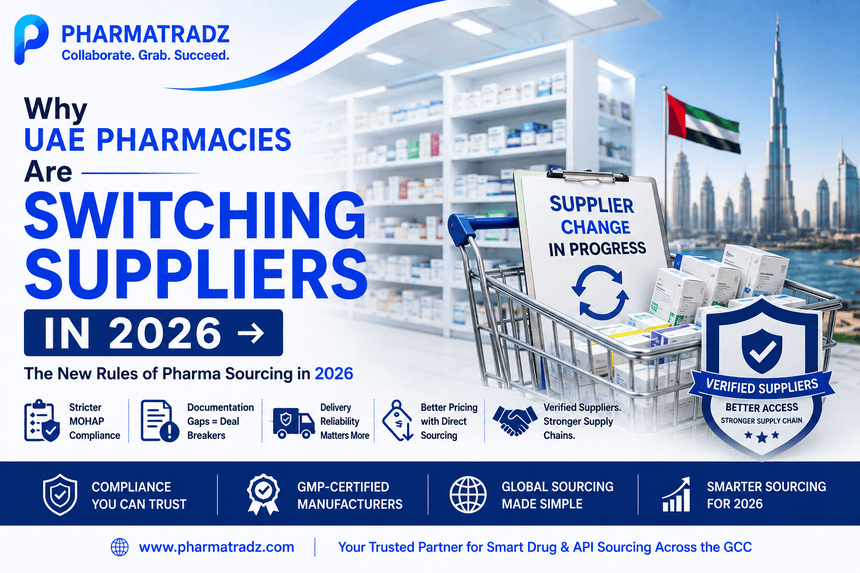
Objective: Help UAE pharmacy buyers and procurement heads understand the real forces behind supplier exits in 2025, and show how Pharmatradz solves the verified sourcing problem faster than traditional methods.
Key Takeaways:
- MOHAP's stricter audit expectations are ending supplier relationships that looked stable for years
- Post-pandemic trust damage is finally being acted on, quietly
- GMP documentation gaps are disqualifying suppliers before price is even discussed
- Direct sourcing through verified B2B platforms has broken the distributor pricing monopoly
- Pharmacies that fix their supply chain now will have a real advantage heading into 2026
Table of Contents
- What's Actually Going On in UAE Pharmacy Supply Chains
- Why UAE Pharmacies Are Switching Suppliers Right Now
- Factors Affecting Pharmacy Suppliers in UAE This Year
- When Documentation Becomes the Deal-Breaker
- How to Find a Verified Pharma Supplier in UAE
- What the UAE Pharmaceutical Distribution Market Looks Like in 2025
- Before You Sign With a New Supplier, Check These Things
- FAQ
Nobody is publishing press releases about this. There's no industry-wide announcement, no formal shift in policy that you can point to and say, that's when it started. But talk to anyone in pharmaceutical procurement across the UAE right now, and the same story keeps coming up.
Contracts that were renewed automatically for years are getting reviewed. Some are getting cut. The suppliers being dropped aren't always the worst performers. Some held those accounts for a decade. What changed is the threshold. What was tolerable before, a missing document here, a delayed shipment there, isn't tolerable anymore.
Procurement managers have more options now than they did five years ago. As per the research conducted by Pharmatradz Global Ventures Pvt Ltd, UAE pharmacy procurement teams increasingly prioritize supplier verification, documentation quality, and regulatory readiness over price alone, particularly when evaluating long-term procurement partners.
That's the real shift. And for anyone thinking seriously about Smart Drug & API Sourcing in the GCC, understanding why this is happening right now matters more than the headline.
Why UAE Pharmacies Are Switching Suppliers Right Now
The simplest version: the risk of staying with a weak supplier now outweighs the cost of finding a new one.
MOHAP's compliance expectations have sharpened. It's not that the rules are entirely new, it's that enforcement is more consistent, and pharmacies are being held directly accountable for their suppliers' documentation gaps. If a product is flagged during an inspection and the COA is missing, incomplete, or mismatched, the pharmacy wears that problem. The supplier usually doesn't.
That accountability shift changed the calculation. Buyers who previously overlooked documentation issues because switching was painful are now switching because the alternative, absorbing compliance risk for a supplier's sloppiness, is worse.
Pricing is the second driver. A handful of dominant distributors in the UAE have held margins that only made sense when buyers had no visibility into what products actually cost at source. That visibility now exists. A verified B2B pharma platform allows procurement teams to compare multiple qualified manufacturers, documentation, and commercial offers before selecting a supplier. Once a procurement team sees that gap, the old arrangement becomes hard to justify internally.
Factors Affecting Pharmacy Suppliers in UAE This Year
GMP certification status has become a gate, not a checkbox. Hospital pharmacy groups and larger retail chains now run pre-qualification screenings before any commercial conversation starts. If a supplier can't show a current WHO-GMP, EU GMP, or US FDA certificate at that stage, the process ends. Not paused, ended.
Batch-level documentation consistency is where many mid-tier suppliers are quietly failing. The first shipment clears fine. The second too. Then the third arrives with a COA from a different manufacturing site, or stability data that references a different batch reference entirely. That triggers an internal review. Reviews slow everything down. Procurement teams don't get rewarded for being slow.
Delivery reliability is still being scored against pandemic-era performance. Suppliers who went quiet or pushed lead times out by 30 to 60 days during 2022 lost something that didn't come back when supply chains recovered. New vendor conversations are now routinely asking for delivery performance references from that period specifically.
When Documentation Becomes the Deal-Breaker
A case study conducted by Pharmatradz Global Ventures Pvt Ltd tracked stalled B2B pharma transactions across Gulf markets between 2023 and 2024. More than a third of them didn't fail because of product quality or price. They failed because supplier documentation was incomplete when it mattered most, after the buyer had already allocated budget, arranged import clearance, and in some cases, pre-sold product availability downstream.
The cost of that failure lands on the buyer every time. Emergency sourcing at higher prices, delays that create penalties with hospital clients, and the reputational hit of telling a customer their order isn't coming. The supplier moves on to the next deal.
This is why serious procurement teams now ask for the full documentation package before a purchase order is ever raised. Not as a formality. As a filter.
How to Find a Verified Pharma Supplier in UAE
Trade shows and referrals still work. They're just slow, and every verification step still sits with your team.
A more direct approach:
Lead with the certification ask. Request the current GMP certificate before anything else. A supplier who responds quickly with a clean, current certificate has done this before. One who asks why you need it, or sends something expired, has told you everything relevant.
Documentation before pricing. COA, MSDS, Stability Data, Manufacturing License, these should be on your desk before you share a target price or volume. Suppliers comfortable with this workflow are usually the ones with nothing to hide.
Check MOHAP registration yourself. Products dispensed through UAE-licensed pharmacies require Drug Registration Department clearance. This takes minutes to verify and eliminates the biggest single compliance risk in the transaction.
Use a pre-verified sourcing platform. Pharmatradz lists 500+ GMP-certified manufacturers, runs documented RFQ processes, and gives buyers access to supplier transaction records before first contact. The pre-qualification is done before you pick up the phone.
Trial order before volume commitment. Real lead times, packaging quality, communication under pressure, and documentation consistency across batches, none of this is visible until you place an actual order. Keep the first one small.
What the UAE Pharmaceutical Distribution Market Looks Like in 2025
As per the research done by Pharmatradz Global Ventures Pvt Ltd, direct manufacturer-to-pharmacy sourcing through verified B2B channels has grown consistently across GCC markets since 2023. The traditional model, national distributor holds exclusive rights, controls pricing, manages all import paperwork, is losing ground, particularly in generics, specialty, and high-margin OTC categories.
Hospital pharmacies are the fastest movers. Oncology and rare disease procurement especially has shifted toward direct sourcing because the standard distributor network doesn't carry the depth. Specialist buyers either go direct or use curated platforms where manufacturers with the right product range are already verified.
MOHAP's digitization of import licensing has also removed a structural advantage distributors used to hold. Pharmacies can now verify supplier credentials independently and quickly. That's changed the negotiation dynamic in a market where distributors previously held most of the information leverage.
Before You Sign With a New Supplier, Check These Things
|
Contract Clause |
What It Protects Against |
|
GMP certificate renewal notification window |
Prevents you from unknowingly sourcing from a lapsed supplier |
|
Lead time guarantee with penalty terms |
Makes delivery timelines enforceable, not just promised |
|
Documentation delivery before shipment dispatch |
Ensures paperwork doesn't chase the product |
|
Manufacturing site substitution restrictions |
Stops unapproved changes to where the product is made |
|
Dispute resolution jurisdiction |
Governs cross-border disagreements before they happen |
|
Supplier Type |
What Works |
What Doesn't |
|
UAE national distributor |
Local logistics, MOHAP familiarity |
Margin markup, limited product range |
|
Direct international manufacturer |
Better pricing, wider product access |
Documentation burden stays with buyer |
|
Verified B2B platform supplier |
Pre-vetted, faster RFQ, transparent pricing |
Requires onboarding to the platform |
Conclusion
UAE pharmacies aren't switching suppliers because they enjoy the disruption. A supplier change involves new contracts, new import documentation, new logistics coordination, and internal approval processes that nobody finds enjoyable. They're switching because the alternative, holding onto suppliers who create compliance exposure and charge above-market prices, has become the riskier option.
The market has the tools now to make switching faster and safer than it used to be. Verified sourcing platforms, transparent pricing, accessible regulatory checks, the friction that kept buyers locked into weak relationships for years is largely gone.
Many of these supplier-related challenges begin much earlier in the procurement process. If you're evaluating international pharmaceutical suppliers, our guide Why Most Pharma Importers Lose Money Before Placing an Order explains the common sourcing mistakes buyers make before signing contracts and how better supplier verification can prevent costly procurement decisions.
If your supplier list hasn't been properly reviewed in the last 12 months, start with the Pharmatradz verified supplier directory. Browse GMP-certified manufacturers or submit your sourcing requirement and get qualified quotes without the manual vetting.
Frequently Asked Questions(FAQs)
1. Why are UAE pharmacies suddenly dropping suppliers they've worked with for years?
Because the compliance cost of keeping a weak supplier has finally overtaken the inconvenience of replacing one. MOHAP audits now hold pharmacies directly responsible for their suppliers' documentation gaps. When a missing COA or lapsed GMP certificate creates an inspection problem, the pharmacy takes the hit, not the distributor. That's changed how procurement managers are making decisions.
2. How do I actually find a verified pharma supplier in the UAE without spending months on it?
Skip the trade show circuit if you're in a hurry. Use a platform like Pharmatradz where manufacturers are already GMP-verified and documentation is part of the supplier profile. Post your requirement, get quotes from multiple suppliers, and you're comparing verified options in days rather than weeks of back-and-forth emails with cold contacts.
3. What documents should I ask a new supplier for before placing a first order?
Certificate of Analysis for the specific product and batch, current GMP certificate from a recognized authority, Manufacturing License, MSDS, and Stability Data. Ask for these before any pricing discussion. If a supplier stalls on any of them, treat that as a serious red flag, not a minor inconvenience.
4. If I switch the manufacturer of a product, does that affect my MOHAP registration?
Yes, it usually does. Switching the manufacturer of an already-registered product typically requires filing a variation application with MOHAP's Drug Registration Department. Confirm the registration status of both the product and the incoming manufacturer before signing anything. This step catches more problems than any other part of the process.
5. What's the real downside of continuing with an unverified supplier in the UAE?
Three things: you may be receiving a product without documentation that would hold up in an audit, the product itself may not be registered with MOHAP, and if quality fails, you have no enforceable route back to the supplier. All three of those risks sit entirely with the pharmacy. The supplier has already moved on to the next buyer