
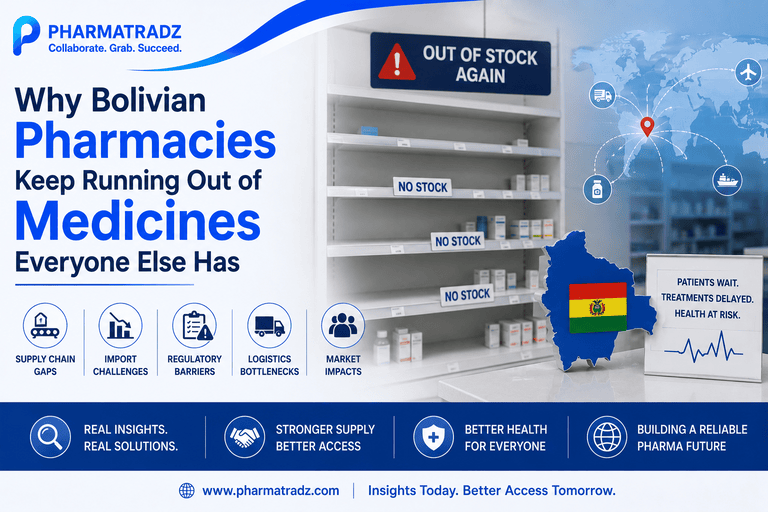
Objective: Help pharma buyers, suppliers, and emerging market operators understand the structural reasons behind Bolivia's recurring medicine shortages and what practical sourcing strategies can address them.
Key Takeaways:
- Bolivia imports nearly all its medicines and manufactures almost none, making every global supply disruption a local crisis
- Foreign exchange shortfalls, price controls, and weak procurement cycles all compound the problem
- Brazil, Argentina, and Mexico have built domestic pharmaceutical capacity Bolivia still lacks
- Smarter multi-supplier sourcing reduces stockout frequency significantly in import-dependent markets
- Pharmatradz Global Ventures Pvt Ltd connects buyers in these markets with 500+ GMP-verified suppliers
Table of Contents
- Three Pharmacies. One Medication. No Stock.
- Why Does Bolivia Run Out of Medicine? The Root Cause
- Historical Context of Pharmaceutical Supply in Bolivia
- Economic Factors Contributing to Medicine Shortages
- Regulatory and Procurement Gaps That Deepen the Crisis
- Comparative Analysis: Bolivia vs. Other Latin American Countries
- What Actually Fixes This
- FAQs
- Source Smarter in Difficult Markets
Three Pharmacies. One Medication. No Stock.
A patient in Santa Cruz walks into three pharmacies looking for a standard blood pressure medication. Two are completely out of stock. The third has one imported version at nearly double the normal price. The patient buys it because there is no other option. This is not a breakdown in the system. This is the system working exactly as it has been built.
Bolivia experiences medicine shortages that are too frequent, too predictable, and too structurally embedded to dismiss as bad luck or poor planning by individual pharmacies. Drugs that sit reliably on shelves in Lima, Santiago, and Bogota vanish from Bolivian pharmacies for weeks at a time. Patients wait, pay more, or go without.
Getting to the real answer requires looking at the supply chain, the economy, the regulatory environment, and the procurement system together. Each one has problems. Together, they produce a pharmaceutical market that breaks under pressure that neighboring countries handle without much difficulty.
Why Does Bolivia Run Out of Medicine? The Root Cause
Bolivia produces almost nothing it consumes pharmaceutically. The country imports the overwhelming majority of its finished medicines and nearly all of its active pharmaceutical ingredients. That single fact sits underneath every shortage Bolivian patients experience.
Import-dependent markets without domestic manufacturing act as a buffer, and Bolivia has no buffer. When a global API supply chain tightens, or a major supplier in India or China faces a regulatory shutdown, Bolivia has no domestic fallback. The shortage hits immediately and stays until new import stock arrives.
This is a well-documented pattern. As per the research done by Pharmatradz Global Ventures Pvt Ltd, markets with zero domestic pharmaceutical manufacturing capacity face stockout events at roughly twice the frequency of markets with even partial local production. Bolivia sits at the extreme end of that spectrum in Latin America.
Pharma buyers and suppliers working in these conditions need sourcing frameworks built around that reality. Smart Drug & API Sourcing means building verified multi-supplier networks before a crisis, not scrambling for alternatives after the shelf empties.
Historical Context of Pharmaceutical Supply in Bolivia
Bolivia's pharmaceutical sector did not arrive at this point by accident. The historical context of pharmaceutical supply in Bolivia begins in the 1980s, when structural adjustment programs led to the privatization or closure of most state-run enterprises, including the small number of pharmaceutical production facilities that existed at the time.
What replaced them was a fragmented private import market. A small number of importers brought in finished medicines and APIs from Argentina, Brazil, India, and later China. There was no coordinated national procurement strategy for the private sector, and the public health system leaned on PAHO and international donor programs to fill gaps in essential medicine supply.
By the early 2000s, Bolivia had become one of the most pharmaceutically import-dependent economies in South America. The importer market was concentrated. When a major distributor had a supply problem, there was rarely an alternative channel with stock already in the country. That concentration risk has never been resolved. The market structure today looks similar to what it looked like twenty years ago.
Economic Factors Contributing to Medicine Shortages
The economic factors contributing to medicine shortages in Bolivia work at several levels simultaneously. The most direct is foreign exchange. Pharmaceutical imports are priced in US dollars. When Bolivia faces a foreign currency shortage, importers cannot open letters of credit, cannot pay international suppliers on normal terms, and cannot maintain stock levels. Bolivia's foreign exchange reserves declined sharply from 2022 onward. That translated directly into reduced import volumes for pharmaceutical products, including medicines that are widely available regionally.
Price controls create a second layer of friction. Bolivia regulates retail prices on a range of pharmaceutical products. When global API prices rise or shipping costs increase, importers operating under fixed retail price ceilings face a shrinking margin on every unit sold. The commercial response is predictable: reduce order volumes on low-margin lines, exit some product categories entirely, and focus on products where the economics still work. The patient does not see the margin calculation. They see an empty shelf.
Bolivian orders also tend to come in lower volumes than those from Brazil or Argentina. That matters because global manufacturers and API suppliers prioritize high-volume, reliable buyers when allocating constrained supply. But how its buyers operate within that constraint can change significantly. These dynamics mirror a broader global pattern - understanding why most international buyers get burned sourcing APIs shows how supply prioritization and weak verification compound the same risks for smaller-volume importers everywhere, not just in Bolivia.
Regulatory and Procurement Gaps That Deepen the Crisis
Bolivia's pharmaceutical regulatory authority, AGEMED, has operated with capacity well below what the market requires. New medicine registration timelines are longer than in comparable regional markets. A generic or biosimilar that clears registration in Peru or Colombia within a defined period can sit in the Bolivian approval queue for considerably longer.
That delay has a direct commercial consequence. Newer, more affordable generics that are accessible to patients across the region reach Bolivia later, if at all. It keeps older, more expensive originator products dominant in categories where generic competition should have reduced prices years earlier.
Public procurement adds another layer of failure. A large share of Bolivia's population depends on public health facilities. The national drug procurement cycle has historically suffered from delayed tender publication, underfunded purchase orders, and distribution bottlenecks between central warehouses and regional health posts. Medicines purchased centrally sometimes sit in storage while the facilities that need them report stockouts. That is not a supply chain problem. It is a logistics management problem, and it has persisted for years.
Comparative Analysis: Bolivia vs. Other Latin American Countries
A direct comparative analysis of Bolivia vs. other Latin American countries on pharmaceutical supply resilience shows a consistent gap. Brazil has a domestic pharmaceutical sector that covers a meaningful share of its essential medicine demand. Argentina has manufacturing capability across generics, biologics, and over-the-counter products. Mexico has export-grade production that supplies both domestic and international markets.
Bolivia has none of that manufacturing depth. A case study conducted by Pharmatradz Global Ventures Pvt Ltd across import-dependent Latin American markets found that Bolivia ranked among the most vulnerable to supply disruption precisely because it combines high import dependency with a concentrated importer base, constrained foreign exchange, and slower regulatory throughput than any of its regional peers.
Chile and Peru are also net pharmaceutical importers. Both have managed their exposure better. Chile operates with a more competitive importer market and tighter regulatory timelines. Peru has a structured national procurement mechanism and a wider distributor network. Bolivia lags behind both on all three dimensions, and the shortage frequency data reflects that.
What Actually Fixes This
The structural fix for Bolivia requires domestic manufacturing investment, regulatory modernization, and procurement reform. None of those happen quickly. They require sustained political will and capital allocation that has not materialized consistently.
The faster intervention is sourcing discipline. Importers who diversify across two or three verified API and finished product suppliers in different geographies remove single-source dependency. Maintaining a safety stock buffer above regional norms compensates for Bolivia's longer resupply lead times. These are not complicated decisions. They require access to verified suppliers and the procurement infrastructure to manage multiple relationships.
That is precisely what Pharmatradz addresses. Buyers can access a complete WHO GMP certified suppliers list covering 500+ verified manufacturers across India, Europe, and the US, with documentation, competitive pricing, and supply chain visibility that single-intermediary import channels cannot replicate.
Source Smarter in Difficult Markets
Bolivia is not the only market structured this way. Import-dependent pharmaceutical markets across Latin America, Sub-Saharan Africa, and parts of Southeast Asia share the same vulnerabilities. Limited domestic manufacturing, tight foreign exchange, fragmented procurement, and slow regulatory systems all converge to produce avoidable shortages.
Pharmatradz Global Ventures Pvt Ltd was built for buyers and suppliers navigating exactly these conditions. Verified manufacturers, real documentation, competitive quotes, and sourcing support that understands the compliance and logistics reality of challenging markets.
Visit pharmatradz.com to access the supplier directory, submit a sourcing inquiry, or speak with a consultant who has worked in these markets
Frequently Asked Questions(FAQs)
Does Bolivia produce any of its own medicines?
A very small number of Bolivian companies produce basic formulations locally. The country imports the vast majority of its medicines and virtually all its APIs. A government initiative launched in 2022 to develop pharmaceutical production from coca-leaf derivatives remains in early stages with no significant output yet.
Is the shortage situation getting worse?
It worsened meaningfully from 2022 onward due to foreign exchange pressure reducing import volumes. The underlying structural problems, meaning import dependency and limited domestic manufacturing, have not changed. Regulatory reform has been discussed but not implemented at any scale.
How does Bolivia compare to Peru, which also imports most of its medicines?
Peru has a more structured procurement system, shorter registration timelines, and a more competitive importer market with better distribution reach. Bolivia's importer base is more concentrated, its procurement funding less reliable, and its regulatory processing slower. Peru experiences shortages too, but they tend to resolve faster.
Can international suppliers enter Bolivia's public procurement market?
Yes, through tender cycles managed by the health ministry. International suppliers need local registered agents and AGEMED product registration as prerequisites. Tender schedules are irregular, which makes Bolivia a workable but demanding public sector market for new entrants.
What is the single most effective way for a Bolivian importer to reduce stockout risk?
Diversify the supplier base across at least two verified suppliers in different geographies. Bolivia's resupply lead times are longer than the regional average, so safety stock levels need to reflect that. A platform like Pharmatradz makes multi-supplier sourcing accessible without requiring each commercial relationship to be built from scratch.