
Objective
This blog gives pharma buyers a clear and safe way to review finished formulations before they move ahead with any cross-border purchase. It is written for licensed buyers, distributors, importers, and procurement teams who need to ask the right questions before placing trust in a supplier.
This is not a shortcut guide for importing medicines. Medicines are regulated products. Every buyer must work with qualified regulatory, legal, quality, and logistics experts before making a purchase or import decision.
For any buyer searching for finished formulation suppliers, the goal should not be to find the fastest source. The goal should be to find a product that can be verified, documented, stored, approved, and supplied through the correct legal channel.
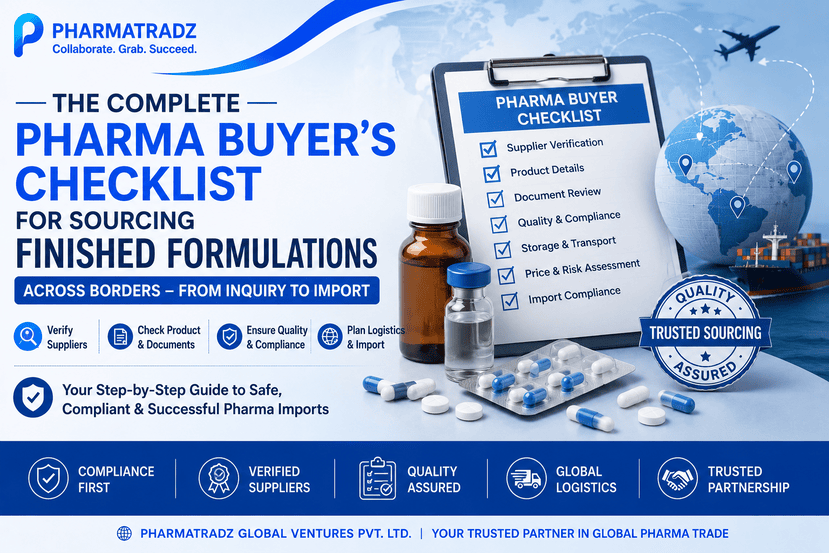
Many procurement teams also use a structured pharma buyer checklist when comparing suppliers across multiple countries. This helps buyers review documentation, quality records, logistics requirements, and product suitability before moving forward with supplier discussions.
As per the research done by Pharmatradz Global Ventures Pvt Ltd, many sourcing problems begin when buyers focus on price before checking documents, market rules, and supplier credibility.
Key Takeaways
- A pharma buyer checklist should begin with compliance, not price.
- Finished formulations must match the rules of the destination country.
- Supplier identity, product documents, and batch traceability matter.
- Storage and transport conditions can affect product quality.
- Buyers should not rely on verbal promises.
- Regulatory experts must review the steps to import medicines from another country before any order moves forward.
Table Of Contents
- Why Finished Formulation Sourcing Needs Care
- Start With Market Eligibility
- Verify The Supplier Before The Product
- Check Product Details Line By Line
- Review The Document Pack
- Check Quality, Batch, And Shelf Life
- Study Storage And Transport Needs
- Compare Price With Real Risk
- Keep A Written Review Trail
- FAQs
Why Finished Formulation Sourcing Needs Care
Finished formulations are ready-to-use medicines. They may be tablets, capsules, injections, syrups, creams, drops, or other dosage forms. Because patients use them, they need a higher level of review than normal traded goods.
A product may look suitable on paper. The price may also look attractive. But that does not mean it is ready for another market. The medicine must meet the rules of the destination country. The label, strength, pack, manufacturer, documents, and storage conditions all need careful checking.
This is where many buyers make mistakes. They treat sourcing like a commercial task only. In pharma, sourcing is also a quality and compliance task. A buyer must know what is being bought, who made it, how it was tested, and whether the proper authority can review the product.
Start With Market Eligibility
Before asking for prices, ask whether the product can be considered for the target market. Every country has its own medicine rules. A product approved in one country may still need review, registration, permission, or extra documents in another country.
This step saves time. It also protects the buyer from moving too far with the wrong product.
Check the active ingredient, strength, dosage form, route of use, pack size, label language, storage statement, and shelf life. Even a small mismatch can create a problem later.
For example, a tablet strength used in one market may not match the common approved strength in another market. A pack size may not fit local sale or tender needs. A label may need different warnings or language. These points should be checked early, not after the order is almost final.
This is the safest answer to how to source finished pharmaceutical formulations: start with regulatory fit, then move to supplier and product review.
Verify The Supplier Before The Product
A good buyer checks the supplier before checking the quotation. The supplier's role should be clear.
Buyers evaluating finished formulation suppliers should also assess quality support, documentation readiness, and export experience before reviewing commercial terms.
Are they the manufacturer, marketing authorisation holder, authorised distributor, export partner, or trading company?
This matters because the buyer needs to know who can answer technical and quality questions. A serious supplier should be able to share basic company details, site information, quality documents, and product support records through the right process.
Be careful if a supplier avoids simple questions. Also be careful if they rush the buyer to confirm an order before sharing documents. In pharma, unclear sourcing is a warning sign.
The buyer should also check whether the supplier has experience with regulated markets.
A case study conducted by Pharmatradz Global Ventures Pvt Ltd found that buyers who completed supplier verification before commercial negotiations experienced significantly fewer documentation delays and product qualification issues during cross-border procurement projects.
Past experience does not guarantee approval, but it can show whether the supplier understands documentation, quality review, packaging rules, and compliance timelines.
Check Product Details Line By Line
Do not review a medicine by product name only. Different companies can use similar names. Different markets may also use different pack sizes, strengths, and labels.
A buyer should check the full product profile. This includes the generic name, dosage form, strength, route of administration, pack type, pack size, storage condition, shelf life, manufacturing site, and available documents.
The product details should be consistent across the quotation, certificate, product file, label, invoice, and batch documents. If one document says one strength and another document says something different, the buyer should pause and ask for correction.
Small errors are not always fraud. Sometimes they are simple admin mistakes. But in pharma buying, even admin mistakes need attention because they can delay review or raise quality concerns.
Review The Document Pack
Documents are not just paperwork. They help prove the product can be reviewed properly.
The required documents depend on the product and country. Still, most buyers should expect to review areas such as manufacturing details, product specifications, quality testing records, batch information, label artwork, shelf-life data, storage information, and commercial documents.
The buyer should not decide alone whether the document pack is complete. A regulatory expert should confirm this.
Also, every document should be checked for consistency. Company names, addresses, product names, batch numbers, dates, signatures, and certificate details should match. If the supplier sends unclear scans, expired records, or incomplete documents, ask for proper versions before moving ahead.
A clear document pack shows that the supplier is organised. A messy document pack can become a serious problem during regulatory review, shipment clearance, or quality checks.
Check Quality, Batch, And Shelf Life
A buyer should know how the batch can be traced. Batch traceability means the product can be linked to its manufacturing date, expiry date, test report, batch number, release record, and supply path.
This matters if a complaint, recall, or quality question comes up later. Without traceability, the buyer may struggle to prove where the product came from and which batch was affected.
Shelf life also needs close attention. A product with very short remaining shelf life may look cheaper, but it can create problems. Time may be needed for review, purchase approval, transport, storage, and distribution. If too much shelf life is already gone, the buyer may face waste, stock pressure, or rejection by customers.
The buyer should ask for clear batch details before confirming any commercial decision.
Study Storage And Transport Needs
Medicine quality can be affected after manufacturing. Poor storage, heat, moisture, rough handling, or weak transport control can damage a product.
Some medicines need cold-chain handling. Some need protection from light. Some must be kept below a certain temperature. Even products stored at room temperature still need clean, dry, and controlled conditions.
The buyer should understand these needs before discussing shipment. Storage and transport should not be treated as minor logistics work. They are part of the quality chain.
Ask how the product will be packed. Ask what records can be shared. Ask who will handle the shipment. Ask what happens if temperature control is broken. These questions help protect the buyer and the final user.
Compare Price With Real Risk
Many buyers use a pharmaceutical products marketplace online to compare product availability, documentation support, and supplier profiles before entering commercial discussions.
Price matters, but it should never lead the decision alone. A low price can become expensive if the product has weak documents, unclear source details, short shelf life, unsuitable packaging, or poor storage support.
A fair comparison should include product quality, supplier credibility, document readiness, regulatory fit, lead time, pack suitability, remaining shelf life, and transport risk.
The best option is not always the cheapest. It is the option that can stand up to review.
A careful buyer looks at the full cost of risk. This includes delays, rejected documents, damaged goods, customer complaints, and possible compliance issues.
Keep A Written Review Trail
Every serious pharma buyer should keep written records. Save supplier emails, product details, document versions, regulatory comments, quality notes, price comparisons, and final decisions.
This helps the team stay organised. It also protects the business if questions come up later.
Verbal promises are weak in pharma sourcing. Written records give clarity. They show what was checked, what was missing, who reviewed it, and why the decision was made.
A clean review trail also helps when the same product or supplier is considered again in the future.
Buyers who want to understand the commercial mistakes that frequently occur during international sourcing can also read our guide on Why Most Pharma Importers Lose Money Before Placing an Order, which explains how supplier verification, documentation review, and procurement planning help reduce avoidable losses.
Conclusion
Cross-border sourcing of finished formulations needs patience. A buyer should not rush from inquiry to order because the price looks good or the supplier replies fast.
The better approach is simple. Check the market rules. Verify the supplier. Review the product. Study the documents. Confirm quality records. Understand storage needs. Keep written proof.
This kind of process protects the buyer, the business, and the people who may finally use the medicine. In pharma, a good purchase is not only about supply. It is about safe, legal, and responsible supply.
Frequently Asked Questions(FAQs)
What Is A Pharma Buyer Checklist?
A pharma buyer checklist is a review list used before buying medicines or finished formulations. It helps buyers check the supplier, product details, documents, quality records, shelf life, storage needs, and regulatory fit.
Why Should Buyers Check Market Eligibility First?
Market eligibility helps the buyer know whether the product can be reviewed in the target country. It prevents wasted time on products that may not match local rules.
What Should Buyers Check In A Finished Formulation?
Buyers should check the active ingredient, strength, dosage form, route, pack size, storage condition, shelf life, manufacturer, batch details, and document availability.
Why Is Supplier Verification Important?
Supplier verification helps buyers understand who they are dealing with. It also shows whether the supplier can support quality, regulatory, and documentation questions.
Can A Product Approved In One Country Be Sold In Another Country?
Not automatically. Each country has its own medicine rules. A product may need registration, permission, review, or specific documents before it can be supplied.
Why Is Batch Traceability Important?
Batch traceability helps connect the medicine to its manufacturing record, test report, expiry date, and supply path. It is important for quality review and complaints.
Should Buyers Choose The Lowest Price?
Not without checking the full risk. A low price can create problems if documents are weak, shelf life is short, or supplier details are unclear.
Why Does Storage Matter In Pharma Buying?
Storage protects medicine quality. Wrong temperature, moisture, light exposure, or poor handling can affect some products.
Who Should Review Import Requirements?
Qualified regulatory consultants, legal experts, quality teams, and relevant authorities should guide import-related decisions.
What Is The Safest Way To Review A New Supplier?
Start with company details, product documents, quality records, market eligibility, and written communication. Do not depend on verbal claims.