
By Mitul Agarwal, B.Pharm, MBA. Published 2 October 2026. Covers buyer requests received from 1 July to 30 September 2026.
Every week, importers, hospitals, distributors and tender buyers send PharmaTradz requests for medicines they cannot find easily. This quarterly report shares what they asked for, where they wrote from, and what we learned. It is based only on our own enquiry data, anonymised. We publish it so manufacturers can see real demand and so buyers know they are not the only ones looking.
The quarter in numbers
- 90 buyer requests in the quarter: 81 enquiries on product pages and 9 sourcing requests (RFQ and named-patient forms).
- Monthly trend: 34 in July, 18 in August and 38 in September. September was the busiest month.
- 16 of the 90 requests were for controlled medicines such as opioids and benzodiazepines. We only handle these with valid import and export permits, so they are left out of the product analysis below.
- That leaves 74 requests for the analysis. Where the buyer's country could be identified (45 of the 74), requests came from 19 countries.
Where requests came from
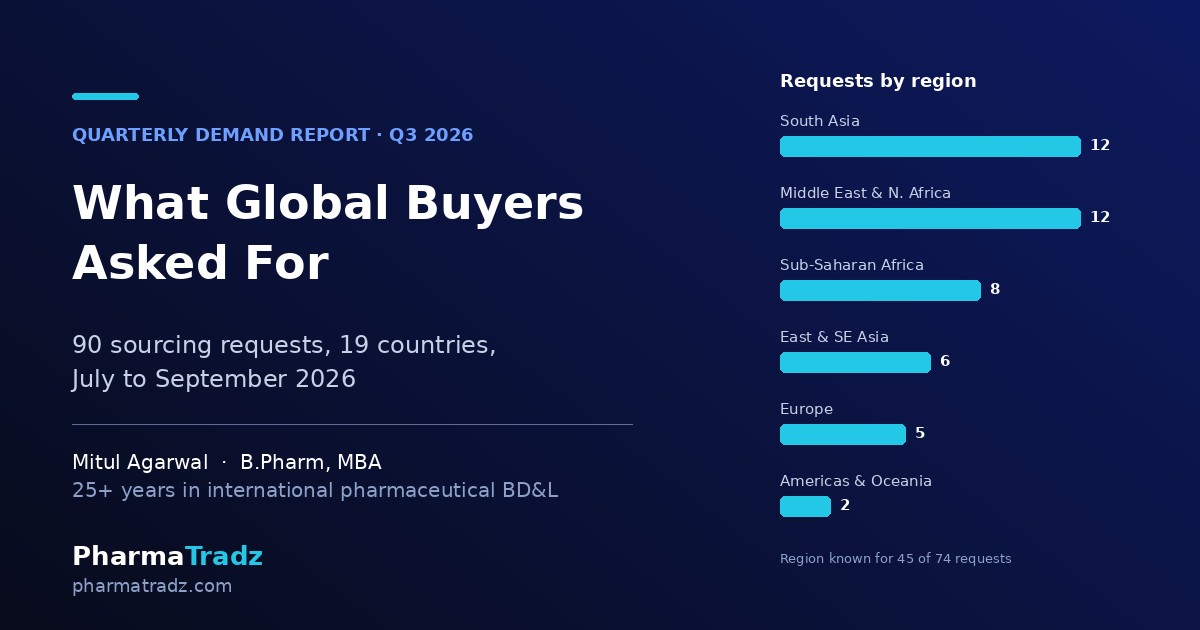
Country is taken from the RFQ form, or from the dialling code of the phone number on a product-page enquiry. 29 requests had no usable country and are not counted here.
| Region | Requests | Countries |
|---|---|---|
| South Asia | 12 | India (9), Pakistan (2), Bangladesh (1) |
| Middle East and North Africa | 12 | Egypt (7), UAE (4), Israel (1) |
| Sub-Saharan Africa | 8 | Zambia (3), Kenya (2), Nigeria, Ghana, Côte d'Ivoire (1 each) |
| East and South-East Asia | 6 | Philippines (4), China (2) |
| Europe | 5 | UK (2), Germany, Ireland, Lithuania (1 each) |
| Americas and Oceania | 2 | United States, Australia (1 each) |
Two things stand out. First, demand is spread across emerging markets rather than concentrated in one region: South Asia and the Middle East are level, with Africa close behind. Second, Egypt was the most active country after India, driven almost entirely by cardiometabolic and liver medicines: five of the six resmetirom requests came from Egypt.
What buyers asked for
By therapy area, the most requested categories on product pages were women's health (9), gastrointestinal (6), oncology (5), orphan drugs (4), critical care (4) and OTC (4). Looking at individual products, four patterns were clear.
1. New medicines that are not yet registered locally
The single most requested product of the quarter was resmetirom (6 requests), the first medicine approved for MASH (metabolic dysfunction-associated steatohepatitis), approved in the US in 2024 as Rezdiffra. Close behind were erdafitinib for bladder cancer (3), tesamorelin (3), and three different cystic fibrosis modulators, including the newest triple combination with vanzacaftor. We also received a named-patient request from Lithuania for inavolisib, a breast cancer medicine approved in 2024.
These are patented medicines with no generic. Buyers asking for them usually need a named-patient or special-import route because the product is not yet registered in their country. That is a growing share of what we do.
2. Old medicines that have become hard to find
The opposite problem showed up just as often: older products that few manufacturers still make. Requests included succimer for lead poisoning (3), amyl nitrite for cyanide antidote kits (3), the inhaled anaesthetic halothane (3), methylergometrine injection for postpartum bleeding (2), methacholine for asthma testing (from Côte d'Ivoire) and tetanus toxoid vaccine (from Pakistan). For buyers, the challenge here is not price but finding any GMP source with valid documents.
3. Women's health and fertility
Estradiol transdermal patches (4) and hCG and hMG fertility injections (3) were the most requested women's health products. Combined with methylergometrine, women's health was the largest therapy area of the quarter.
4. Diabetes, weight and metabolic medicines
GLP-1 interest continued: tirzepatide (2) and an RFQ from an Indian buyer for semaglutide injection, as generic semaglutide launched in India this year. There were also requests for pioglitazone, bempedoic acid and rosuvastatin. Tirzepatide remains patented, so it can only be supplied through authorised routes.
Requests by type
- Product-page enquiries (81): most buyers still start by finding a product page and asking about it directly.
- Sourcing RFQs (7): buyers describing what they need, including quantity, destination and documents. Destinations were India, the US, the Philippines, Ghana, Côte d'Ivoire and Pakistan.
- Named-patient requests (1): for a medicine not registered in the buyer's country.
- Manufacturer partnership (1): an Indian API exporter looking for buyers.
Excipient requests also appeared: cyclodextrins (2), used to improve the solubility of poorly soluble medicines.
What this means
For manufacturers and exporters: the gaps are clear. Older critical-care and antidote products (succimer, halothane, amyl nitrite, methylergometrine) have steady demand and very few suppliers. If you make any of them, or hold a dossier, list it with us.
For importers and hospitals: if you are struggling to find a product, you are probably not alone. Send an RFQ with the product, quantity and destination. We usually reply within 48 hours with matched manufacturers, indicative prices and document status.
How we counted
- The data covers all product-page enquiries and sourcing forms received from 1 July to 30 September 2026.
- Test entries and requests hidden from public view were removed. Repeat requests for the same product are counted separately.
- No buyer names, companies or contact details are shown or used in this report.
- The sample is modest, so read these as demand signals rather than market sizes. We will publish this report every quarter so trends become clearer over time.
Next report: January 2027, covering October to December 2026.