
Objective
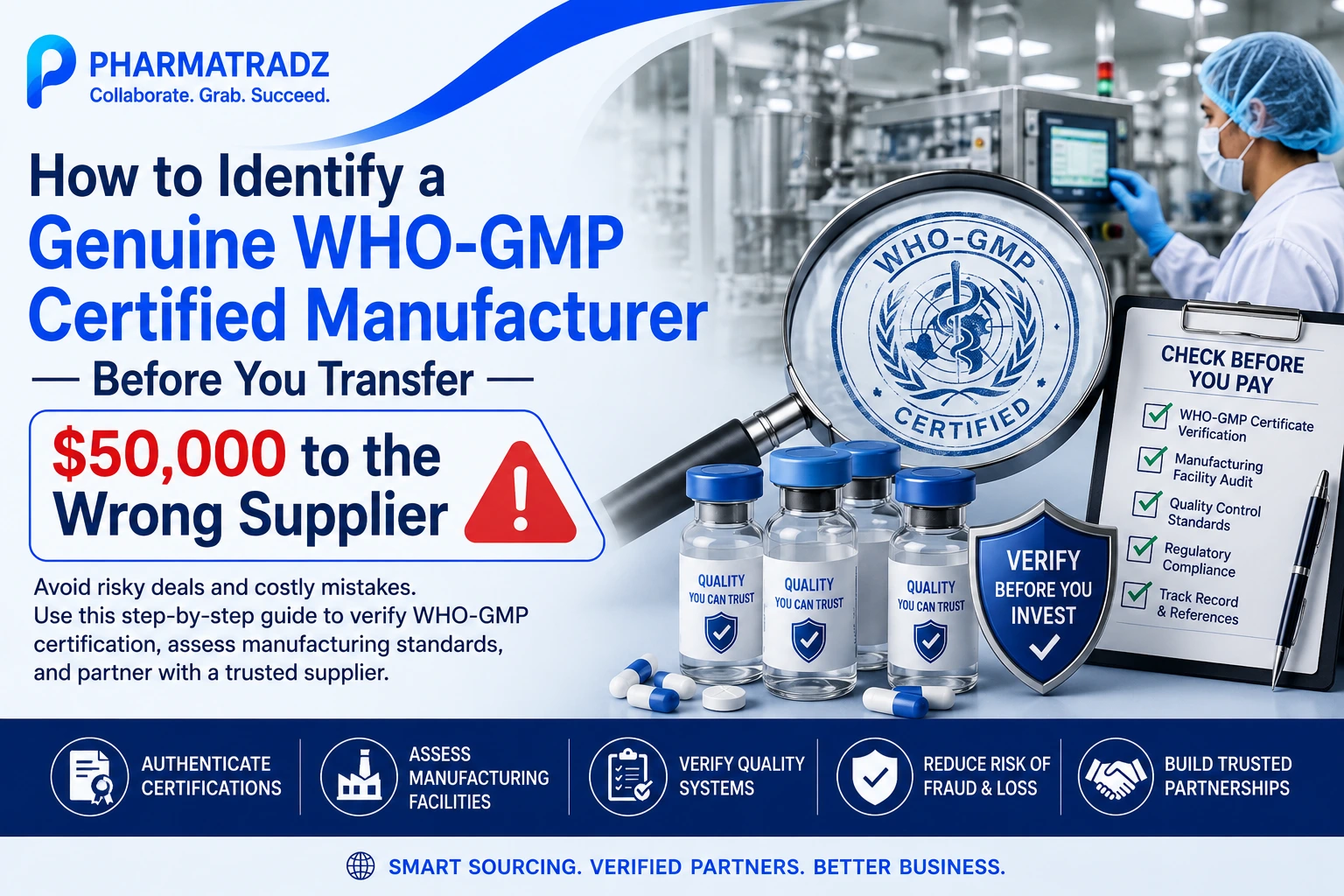
This guide helps pharma buyers check a manufacturer before sending a large advance payment. It explains what WHO-GMP means, what documents to ask for, and what warning signs to notice before importing medicines. The goal is to help buyers avoid fake suppliers, weak documents, and expensive sourcing mistakes.
Key Takeaways
- Do not trust a WHO-GMP certificate without checking the details.
- The company name, factory address, license, and bank details must match.
- A certificate must cover the right dosage form and product category.
- A trader may sell the product, but the manufacturing site still needs verification.
- Product approval is just as important as factory approval.
- A WHO GMP-certified suppliers list can help, but it should not be your only proof.
- Every buyer should learn how to verify a drug manufacturer before importing.
Table Of Contents
- Why This Check Matters Before Payment
- What WHO-GMP Means In Simple Words
- Why Many Buyers Get Misled
- How To Read A WHO-GMP Certificate Properly
- How To Use A WHO GMP Certified Suppliers List
- Documents To Ask For Before You Pay
- How To Verify A Drug Manufacturer Before Importing
- Red Flags You Should Not Ignore
- FAQs
Why This Check Matters Before Payment
A pharma supplier can look genuine from the outside. The website may look clean. The product list may be long. The sales team may reply quickly. Still, none of this proves that the supplier can legally make or export the medicine you want.
Many buyers search for verified pharma exporters because they want a safer starting point. Pharmatradz Global Ventures Pvt Ltd can use this type of verification approach to help buyers focus on one clear rule: check the factory, not just the seller.
This matters when the advance payment is large. A $50,000 transfer is not a small trial order. If the supplier is fake, unlicensed, or using another company’s documents, recovery can be difficult.
In pharma trade, a wrong supplier is not only a money problem. It can also lead to shipment rejection, customs delay, product registration issues, and legal trouble in the importing country.
What WHO-GMP Means In Simple Words
WHO-GMP means World Health Organization Good Manufacturing Practices. It is a system used to make sure medicines are produced and controlled in a proper way.
GMP covers things like clean production areas, trained staff, written records, quality checks, storage, testing, and control of raw materials.
A genuine WHO-GMP certificate shows that a manufacturing site has been assessed for certain manufacturing practices. It does not mean every product made by that company is automatically approved for export to every country.
This is where many buyers make a mistake. They see the word “WHO-GMP” and stop asking questions. That is not enough.
The real check is simple. Does this exact factory have approval for this exact product type, in this exact dosage form, for the market you want to import into?
Why Many Buyers Get Misled
Fake or weak suppliers do not always look suspicious at first. Some use professional emails, edited certificates, copied product lists, and low prices to build trust quickly.
A buyer may ask, “Are you WHO-GMP certified?” The supplier may answer, “Yes,” and send a certificate. But the certificate may belong to another unit, another company, another product line, or an expired approval.
Some sellers are traders. A trader can be genuine, but the role must be clear. If a trader is supplying the product, the buyer still needs to know the actual manufacturing site.
Do not assume that the company sending the invoice is the company making the medicine. Ask directly. Who is the manufacturer? Where is the plant? Which license covers this product? Which company owns the bank account?
These questions may feel basic, but they prevent serious mistakes.
How To Read A WHO-GMP Certificate Properly
A WHO-GMP certificate should be checked slowly. Do not accept it as proof just because it has a stamp.
Check these details first:
- Legal company name
- Full manufacturing site address
- Certificate number
- Issue date
- Expiry date
- Issuing authority
- Dosage form covered
- Product category covered
- Signature and seal
- Any conditions or limitations
The factory address is very important. A sales office address does not prove manufacturing approval. The certificate should show the plant where the medicine will be made.
The dosage form also matters. Tablets, capsules, syrups, injections, creams, ointments, and APIs are not the same. A factory approved for tablets may not be approved for sterile injections. This distinction is especially critical when sourcing from active pharmaceutical ingredient manufacturers - API production facilities require entirely separate GMP approvals from finished dosage form plants, and the two should never be treated as interchangeable.
If the supplier cannot explain the certificate scope clearly, pause the deal.
How To Use A WHO GMP Certified Suppliers List
A WHO GMP certified suppliers list can help you shortlist manufacturers. It may show approved manufacturing units, states, addresses, and certificate-related information.
But no list should be treated as final proof. Lists can become old. A company may renew its certificate, lose approval, change its site, or stop making a certain product.
Use the list as a starting point only.
When checking a supplier from a list, match the name and address exactly. Then ask for the latest certificate and product documents. After that, verify the details with the issuing authority or through official channels where possible.
If the supplier’s name appears on a list but the factory address is different, ask for clarification. If the company name is slightly different, ask for legal proof of the relationship.
Small spelling differences may be harmless. Different legal entities are not harmless.
Documents To Ask For Before You Pay
A serious pharma supplier should not get upset when you ask for documents. Documentation is part of pharma business.
Ask for these before payment:
- Valid WHO-GMP certificate
- Manufacturing license
- Product approval or product permission
- Certificate of Pharmaceutical Product, if required
- Free sale certificate, if required
- Certificate of analysis
- Product composition
- Batch size details, when needed
- Stability data summary, when required
- Product label and pack insert
- Export registration details
- Business registration proof
- Proforma invoice
- Bank details in the legal company name
The exact document list depends on the product and importing country. Some markets need product registration before import. Some need extra legalization or embassy attestation. This applies not only to finished medicines but also to raw material suppliers - for example, when sourcing from pharmaceutical excipients suppliers, buyers should request separate GMP documentation specific to excipient-grade manufacturing, not general pharmaceutical production approvals.
Do not leave this check until the shipment is ready. By then, your money may already be with the wrong supplier.
How To Verify A Drug Manufacturer Before Importing
If you want to know how to verify a drug manufacturer before importing, follow a simple order.
First, match the company name. The name on the certificate, license, invoice, email, and bank account should make sense together.
Second, match the plant address. The manufacturing address should be the same across the certificate and license.
Third, check the certificate validity. Do not accept expired documents unless the authority confirms renewal.
Fourth, check product scope. The approval must cover the product type you plan to buy.
Fifth, ask for product-specific documents. A factory certificate alone is not enough.
Sixth, review the payment account. The bank account should belong to the legal company. Avoid personal accounts and unrelated company accounts.
Seventh, consider third-party inspection for a large order. A factory audit can confirm whether the site exists, operates, and matches the documents.
Red Flags You Should Not Ignore
Some signs should make you stop before paying.
Be careful if:
- The supplier offers a price far below the market.
- The supplier keeps pushing urgent payment.
- The certificate is blurred or cropped.
- The company refuses to share a license.
- The bank account name does not match.
- The factory address changes during discussion.
- The supplier avoids video calls.
- The product is outside the certificate scope.
- The invoice comes from a different company.
- The supplier refuses inspection or audit.
One red flag may have a reason. Several red flags together are a strong warning. If you are still unsure about how to read and compare different certification standards across markets, a detailed breakdown of which certifications actually matter when choosing a supplier covers the key differences between GMP, WHO-GMP, US-FDA, and EU-GMP - and how each one applies to your specific sourcing decision.
Conclusion
A WHO-GMP certificate is important, but it is not enough by itself. The buyer must check the company, factory, product scope, license, documents, and payment details.
The safest buyers slow down before they pay. They ask direct questions. They match every document. They verify the manufacturer before trusting the deal.
A careful review before payment can save your money, protect your import process, and prevent a serious pharma sourcing mistake.
Frequently Asked Questions(FAQs)
What Is A WHO-GMP Certified Manufacturer?
A WHO-GMP certified manufacturer is a company whose manufacturing site follows Good Manufacturing Practices for approved product categories and dosage forms.
Is WHO-GMP Certification Enough For Import?
No. Import may also need product registration, import permission, a Certificate of Pharmaceutical Product, a free sale certificate, and local regulatory approval.
How Can I Check A WHO GMP Certified Suppliers List?
Check the supplier’s exact name, plant address, certificate number, validity, issuing authority, dosage form, and product category. Then verify the latest documents.
How Do I Know If A Supplier Is A Manufacturer Or Trader?
Ask for the manufacturing license and plant address. If another company makes the product, ask for documents that show the relationship clearly.
Why Does Product Scope Matter?
Product scope tells you what the factory is approved to make. Approval for tablets does not automatically cover injections, syrups, creams, or APIs.
Should I Pay Before Verification?
No. Do not send a large advance before checking the certificate, license, product documents, invoice, and bank account details.
What Is The Biggest Warning Sign?
The biggest warning sign is pressure for fast payment without proper documents. A genuine supplier should allow reasonable verification.
Should I Ask For A Factory Audit?
Yes, especially for large orders. A third-party audit can reduce risk before you transfer a major payment