
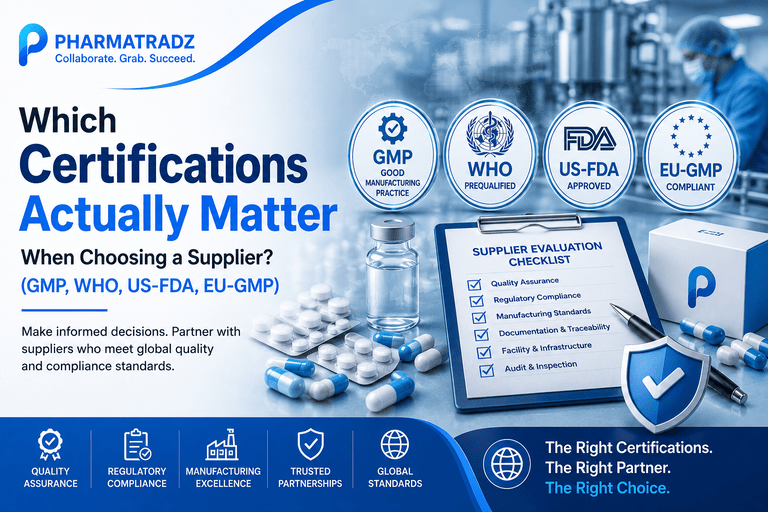
Choosing a pharmaceutical supplier is not just about pricing or product range. For most buyers, the real concern starts with understanding what GMP certification in pharma is and whether it truly guarantees quality and compliance. With so many certifications listed by suppliers, it can be difficult to know which ones actually carry weight.
Many businesses today look for verified GMP pharma suppliers to reduce uncertainty and ensure consistency in sourcing. This is where platforms like Pharma Tradz are often explored to gain better clarity on supplier credentials and global standards.
As per the research done by the Pharmatradz Global Ventures Pvt Ltd, confusion around certifications is one of the main reasons buyers make the wrong supplier choices, especially when entering new markets.
Key Takeaways
- Not all certifications carry the same value across markets
- GMP is a baseline, but higher standards exist for regulated regions
- Choosing the right certification depends on your target market
- Verification is as important as the certification itself
- Supplier reliability goes beyond certificates
Why Certifications Are Important in Pharmaceutical Sourcing
Certifications play a major role in ensuring product quality, safety, and compliance. They are often the first filter buyers use when evaluating suppliers, which is why understanding pharma supplier certifications becomes essential during the sourcing process.
- They do ensure that manufacturing standards are met.
- They assist in fulfilling regulatory needs in target markets.
- They create trust between the suppliers and buyers.
- They minimize the chance of compliance problems.
However, relying only on certificates without deeper checks can lead to problems later.
What is the actual meaning of GMP
GMP stands for Good Manufacturing Practices. It is a system that ensures products are consistently produced and controlled according to quality standards.
At its core, GMP covers areas such as:
- Clean production environments.
- Good documentation and record keeping.
- Quality check at all levels.
- Hygiene and staff training.
While GMP is considered essential, it is important to understand that not all GMP certifications are the same.
A Simple Comparison of GMP, WHO-GMP, US-FDA, and EU-GMP Standards
Understanding the differences between certifications helps in making better sourcing decisions.
|
Certification |
Scope |
Strictness |
Applicable Markets |
|
GMP |
Basic standard |
Moderate |
Local and regional distribution |
|
WHO-GMP |
Global guideline |
Moderate |
Semi-regulated and developing markets |
|
US-FDA |
Highly regulated |
Very strict |
United States market |
|
EU-GMP |
Highly regulated |
Very strict |
European Union countries |
This comparison also highlights the difference between WHO GMP and US FDA approval, which is often misunderstood by buyers.
Which Certification Is Important for Your Market?
The importance of certifications depends on where you plan to sell or distribute products.
- For the US market, working with a US FDA-approved manufacturer is essential
- In the case of Europe, suppliers must fulfill the requirements of the EU GMO on suppliers.
- For global or semi-regulated markets, WHO-GMP may be acceptable
- For local distribution, basic GMP may be sufficient
Understanding the meaning of EU GMP certification and other regional standards helps avoid compliance issues later.
How to Choose the Right Certified Supplier Without Getting Confused
With the knowledge of various certifications, the ultimate decision is a problem to many buyers. The reason is that several suppliers might be having similar certifications yet they might be highly unreliable.
To make a better decision, it is better to consider a combination of the factors rather than consider certificates alone:
- Check if the certification matches your target market requirements
- Review the supplier’s past performance and client history
- Find consistency in product quality between batches.
- Assess the level of transparency of the supplier with documentation.
- Confirm their ability to handle long-term supply commitments
By focusing on both certifications and real-world performance, businesses can avoid confusion and select suppliers that align better with their sourcing goals.
Common Mistakes Buyers Make When Checking Certifications
Most sourcing problems occur due to false assumptions.
- Assuming all GMP certifications are equal
- Not checking the validity or expiry of certificates
- Ignoring audit history or inspection reports
- Only concentrating on the documents rather than on the processes.
- Overlooking consistency in supply
Such errors usually result in inappropriate selection of suppliers and long-term difficulties. To understand how these mistakes compound at the sourcing stage, it is worth reading about why most international buyers get burned sourcing APIs - many of the same certification oversights apply directly to ingredient-level procurement decisions.
How to Check Certifications of a Supplier
Verification is another important aspect and this should not be overlooked.
- Regulatory websites of check officials should be authentic.
- Order recent audit and inspection reports.
- Validity of the issued certificate and the issuing authority.
- Review product-specific approvals
- Compare the information with the regulatory authorities.
The importance of knowing how to check the credentials of the pharma suppliers will reduce the sourcing risks, and enhance decision-making.
Are Certifications Enough to Guarantee Real Pharmaceutical Quality?
The certifications are essential, yet not the only quality signifier.
- There is more to product performance than there is to certificate.
- Good documentation practices imply reliability.
- Effective communication enhances long-term relationships.
- Regular audits and updates show accountability.
Most customers are no longer interested in simple pharmaceutical quality certification to determine the overall performance of the supplier.
How Digital Platforms Help Verify Suppliers Faster
Online platforms are transforming the manner in which customers consider their suppliers. They also give access to trusted data and thus they can easily compare alternatives and know what the suppliers can deliver.
Pharma Tradz is one such platform that helps businesses explore supplier information, certifications, and global connections in one place. This saves time that is spent on manual checks, and enhances visibility.
Key Factors to Consider Beyond Certifications
Certifications are just a single component in the decision-making process.
- Pricing consistency across orders
- On-time delivery and logistics.
- Variety of products available.
- Responsiveness and communication
- Long-term reliability
Focusing on compliance alongside these factors helps create more stable sourcing strategies. This is particularly important when working with active pharmaceutical ingredient manufacturers, where quality consistency at the raw material level directly impacts the safety and efficacy of your final product.
Conclusion
Selecting the appropriate supplier goes beyond just a list of certifications. While GMP, WHO-GMP, US-FDA, and EU-GMP all play important roles, their relevance depends on your target market and business goals.
Understanding the differences and verifying supplier credentials carefully can help avoid compliance issues and improve sourcing outcomes. Platforms like Pharma Tradz can support businesses in exploring supplier options and gaining better visibility into certification standards across regions.
If you are looking to simplify your supplier search and make more confident decisions, it may be worth exploring Pharma Tradz to discover verified partners, compare certifications, and move forward with greater clarity in your sourcing journey.
Frequently Asked Questions(FAQs)
1. What is the GMP certification in pharma?
It is a system that promotes the production of pharmaceutical products of controlled quality standards.
2. Does WHO-GMO suffice to meet global markets?
In certain markets it might pass, but in more strict areas such as the US and the EU it has to be higher.
3. What is the difference between WHO-GMP and US-FDA?
WHO-GMP is a global guideline, while US-FDA involves stricter regulatory inspections and approvals.
4. What to do to check a pharma supplier?
You will be able to access official databases, order audit reports, and verify certification information.
5. What is the most significant certification?
It will be based on your target market and regulatory needs