By the PharmaTradz BD Team. Published November 2026.
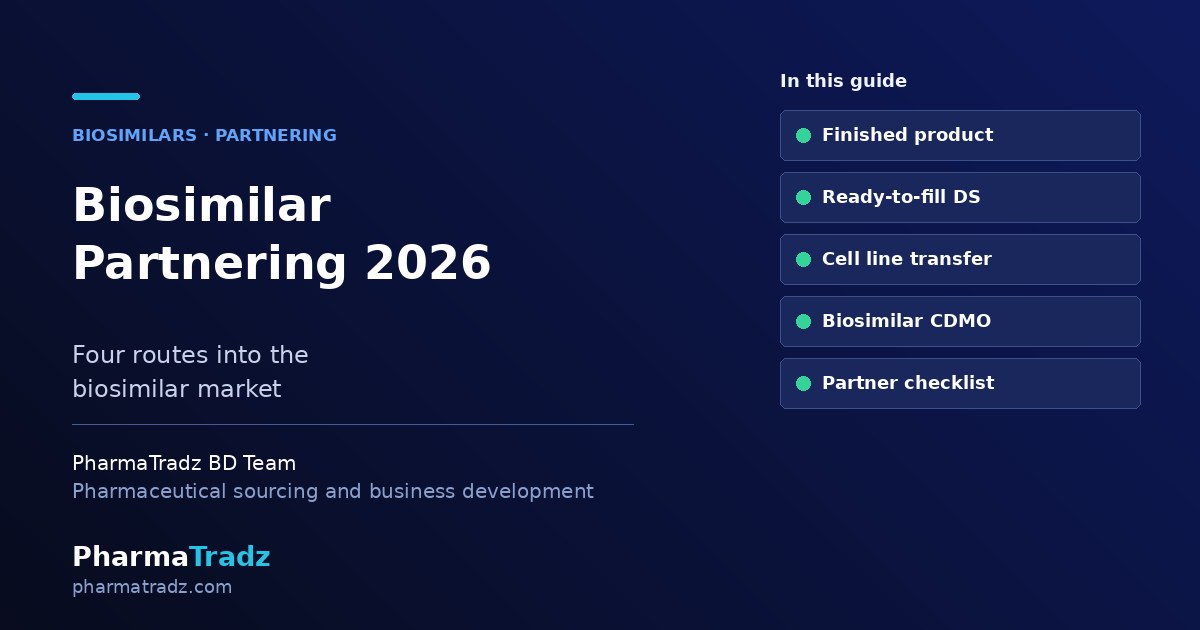
A few years ago, entering the biosimilar market meant one thing: spend close to a decade and a large budget developing a molecule from scratch. That is no longer the only way in. Today a pharmaceutical company in Latin America, the Middle East, Africa or Asia can import finished biosimilars, fill and finish ready-made drug substance locally, take over a proven cell line and process, or have a contract manufacturer develop a product for it. Each route has its own cost, timeline and level of control.
This guide explains the four routes, what has changed in regulation during 2025 and 2026, and what to check before you sign with a partner.
Why 2026 is a good time to enter
Three trends are working in favour of new entrants.
- More molecules are open. According to a mid-2026 industry market report, the FDA had approved 92 biosimilars covering 20 reference biologics, and 67 of them were on the US market. Many more originator biologics lose protection between now and 2030, including several large oncology and immunology antibodies.
- Development is getting cheaper. In October 2025 the FDA published draft guidance saying that, for most well-characterised biosimilars, a comparative efficacy trial is generally no longer needed when analytical and pharmacokinetic data show similarity. In March 2026 the EMA's CHMP adopted a reflection paper taking the same tailored approach for the majority of biosimilar candidates. The FDA has also said switching studies are not required for interchangeability.
- Prices are falling fast. Ustekinumab and denosumab biosimilars in the US now sell at deep discounts to the originator. Health systems everywhere expect the same savings, which favours suppliers with an efficient cost base.
Lower development cost does not mean lower quality expectations. Regulators are relying more on analytical comparability, so the quality of the cell line, the process and the analytical package matters more than ever.
Route 1: Finished product (in-licensing and distribution)
The fastest route. You license or distribute a biosimilar that is already approved, usually by the EMA, FDA or another stringent authority, and register it in your markets using the partner's dossier.
- Best for: distributors and regional companies that want revenue within 12 to 24 months.
- What you get: a registration dossier, finished packs, product samples for registration, and pharmacovigilance support.
- Watch for: territory exclusivity, minimum purchase commitments, supply priority in shortages, and who holds the marketing authorisation in your country.
Route 2: Ready-to-fill drug substance
Here you buy the purified bulk drug substance (DS) from the developer and carry out the formulation, filling, labelling and release in your own sterile facility or at a local fill-finish partner. Many governments favour this model because it brings part of the value chain into the country and often counts as local manufacturing in public tenders.
- Best for: companies with an aseptic filling line for vials or prefilled syringes, and markets that reward local production.
- What you need: a supply and quality agreement for the DS, a technology transfer for the drug product process, comparability data between the partner's finished product and yours, and a registration strategy that names your fill site.
- Watch for: DS shelf life and frozen shipping, the release specification and certificate for each DS batch, and who is responsible for stability studies on the locally filled product.
Route 3: Clone, cell line and process technology transfer
The deepest form of partnership. The developer transfers a characterised production clone, the cell bank (master and working cell banks), the upstream and downstream process and the analytical methods, so that you can make the drug substance yourself.
- Best for: companies building national biologics capacity, or those planning several molecules over the next decade.
- What you need: a GMP biologics plant or one under construction, a team in cell culture, purification and analytics, and usually two to four years before your first commercial batch.
- Watch for: the clone's history and documentation, freedom to operate in each territory, process patents, how many molecules are included, royalties versus upfront fees, and how much on-site support the transferor provides.
A good technology transfer package is more than a vial of cells. Ask for the cell bank characterisation and testing records, the process description and development reports, the analytical similarity data against the reference product, and the regulatory history of any approvals already granted with the same process.
Route 4: Contract development and manufacturing (biosimilar CDMO)
If you own the commercial rights but not the facilities, a CDMO can develop and manufacture the biosimilar for you, from cell line development through clinical supply to commercial batches.
- Best for: companies with market access and funding but no biologics plant.
- What you need: a clear target product profile, the reference product sourced from the right markets for comparability work, and a regulatory plan agreed early.
- Watch for: who owns the cell line and process at the end, slot availability, cost per gram at commercial scale, and the CDMO's inspection record with the authorities you will file with.
Comparing the four routes
| Route | Time to market | Investment | Control |
|---|---|---|---|
| Finished product | Shortest | Low | Low |
| Ready-to-fill DS | Medium | Medium (fill-finish line) | Medium |
| Cell line and process transfer | Longest | High (biologics plant) | High |
| CDMO development | Long | High, but no plant needed | High, by contract |
Many companies combine routes: they start with finished product to build the market and the brand, then move to local fill-finish, and later to full technology transfer once volumes justify a plant.
Checks that apply to every route
- Reference product. Which reference product was used for comparability, and will your regulator accept it? Some authorities require local or bridged comparator data.
- Approval history. Approval by a stringent authority or WHO prequalification makes registration elsewhere much easier.
- GMP status of every site in the chain: DS, drug product, testing and packaging.
- Immunogenicity and pharmacovigilance. Who runs safety reporting in your market, and how are batches traced to patients?
- Cold chain. Most biosimilars need 2 to 8 °C storage. Frozen DS needs validated shipping and a plan for temperature excursions.
- Supply continuity. Capacity reserved for you, safety stock, and what happens if the partner changes its process.
How PharmaTradz helps
We connect pharmaceutical companies with biosimilar partners for finished product, ready-to-fill drug substance, clone and cell line technology transfer, and CDMO development. Tell us the molecule, your target markets and the model you prefer, and we will introduce partners with the right approvals and documentation.
- Browse biosimilar products and partners.
- Looking for a registration dossier to license? See dossiers for licensing.
- Need development or manufacturing capacity? Check CDMO capacity.
- Have a biosimilar or technology to offer? Partner with us.
- Ready to start? Send your requirement.
For the regulatory background in Europe, see our article on the EU pharma package and what it changes for generic and biosimilar companies.
The bottom line
Biosimilars are no longer only for companies with a decade and a large budget to spare. With simpler clinical requirements and more molecules coming off patent, the real question is which entry route fits your capabilities: finished product for speed, ready-to-fill drug substance for local value, technology transfer for long-term control, or a CDMO when you have the market but not the plant.
This article is general business information, not legal or regulatory advice. Requirements differ by country and change over time; check the current position with the relevant authority or a qualified adviser.
Frequently Asked Questions(FAQs)
What is ready-to-fill drug substance?
Purified bulk biologic, supplied to a partner who formulates, fills, labels and releases the finished product in its own sterile facility. It lets a company manufacture locally without running cell culture.
What is included in a biosimilar technology transfer?
Usually the production clone and cell banks, the upstream and downstream process, analytical methods, development reports, comparability data against the reference product, and on-site training support.
Do biosimilars still need comparative efficacy trials?
Less often. FDA draft guidance from October 2025 and an EMA reflection paper adopted in March 2026 say that, for most well-characterised biosimilars, analytical and pharmacokinetic data can replace a comparative efficacy study.
Which route is fastest?
In-licensing an approved finished product. Registration with an existing dossier typically takes one to two years, compared with several years for technology transfer or new development.
Who owns the cell line when a CDMO develops a biosimilar?
It depends on the contract. Agree ownership of the cell line, process and data before work starts, together with the right to move manufacturing to another site.