
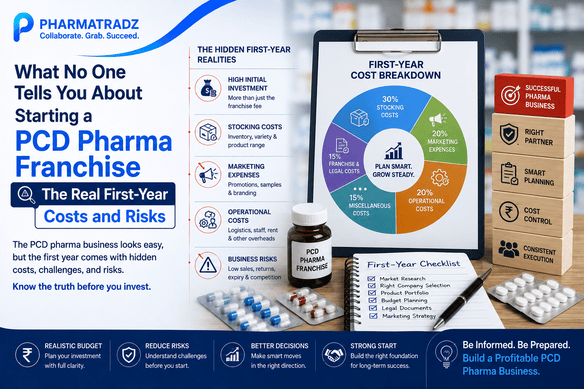
Objective: To give anyone considering a PCD pharma franchise an honest, ground-level picture of what the first year actually costs, what risks are rarely talked about, and what you need to know before signing any agreement.
Key Takeaways
- The real cost of starting a PCD pharma franchise is almost always higher than the initial investment figure you are quoted.
- Most first-year losses come from costs that nobody mentions upfront, storage, logistics, samples, and slow-moving stock.
- Pharma franchise profit margin looks good on paper. The actual margin in your pocket depends heavily on territory, product mix, and how fast doctors start prescribing.
- Risks of starting a pharma franchise are manageable, but only if you go in knowing what they are.
- The first six months are the hardest. Most people who quit do so in this window, not because the business model failed, but because they ran out of working capital.
- Choosing the right company matters as much as choosing the right products.
Table of Contents
- Why Most People Underestimate the First Year
- The Real Cost of Starting a PCD Pharma Franchise, What the Numbers Actually Look Like
- Hidden Costs Nobody Warns You About
- Understanding Pharma Franchise Profit Margin, What Is Real and What Is Marketing
- The Biggest Risks of Starting a Pharma Franchise
- How Long Before You Actually Break Even
- What to Check Before You Sign Anything
- FAQs
1. Why Most People Underestimate the First Year
Starting a PCD pharma franchise looks straightforward from the outside. You get a territory. You get a product range. You pay an initial amount, place orders, and sell to doctors and chemists. The company handles manufacturing. You handle sales.
That picture is mostly accurate. But it leaves out a lot.
The first year of a pharma franchise business is a period of building doctor relationships, building chemist networks, and building a local reputation for reliability. None of that happens immediately. And during that building phase, money keeps going out while income comes in slowly.
Based on internal market observations by Pharmatradz Global Ventures Pvt Ltd, many new PCD franchise owners underestimate their first-year operating costs, especially working capital, stock rotation, travel, and credit delays.
If you are seriously exploring pharma franchise opportunities, the most useful thing you can do before committing is map out every cost, not just the obvious ones.
2. The Real Cost of Starting a PCD Pharma Franchise, What the Numbers Actually Look Like
Let us go through this honestly, category by category. These figures reflect typical first-year costs for a single-territory PCD franchise in India. They will vary by state, product category, and company, but the structure applies broadly.
Initial Stock Investment
Most companies require a minimum first order, typically between ₹20,000 and ₹1,00,000, depending on the product range and company size. This is the number most people focus on. It is also the smallest part of the total first-year cost.
Recurring Monthly Stock Orders
To keep products available at chemists and maintain supply when doctors start prescribing, you need to reorder regularly. Budget ₹15,000 to ₹40,000 per month, depending on your territory size and the range you are working with.
Promotional and Visual Aid Materials
Visiting cards, doctor bags, product literature, visual aids, notepads, and branded items for doctor visits, these are either provided by the company or charged to you. Even when provided, replacement and additional materials come at a cost. Budget ₹5,000 to ₹15,000 for the first year across this category.
Travel and Field Expenses
Doctor visits, chemist calls, and area coverage all require transport. Whether you use a two-wheeler, car, or hire someone, this cost is real and recurring. Expect ₹3,000 to ₹10,000 per month, depending on how much ground your territory covers.
Drug License and GST Registration
These are one-time costs but are necessary from day one. Drug licence costs and requirements vary by state and business structure. New franchise owners should confirm the current fee, premises requirements, and documentation rules with their State Drug Control Department or a qualified compliance consultant.
Storage and Handling
Pharma products need proper storage, cool, dry, away from direct sunlight. If you do not have a dedicated space at home that meets basic requirements, you may need to rent a small storage room or pay for temperature-controlled storage for certain product categories. This is a cost most new franchisees do not think about until their first consignment arrives.
These figures are not fixed costs. They are practical first-year estimates. The actual amount depends on the territory, product range, company terms, credit cycle, and how actively the franchise owner works in the field.
|
Cost Category |
What It Covers |
Estimated First-Year Cost |
|
Initial Stock Investment |
First product order, starter range, basic product availability |
₹20,000 – ₹1,00,000 |
|
Recurring Stock Orders |
Monthly reorders to keep products available in the territory |
₹1,80,000 – ₹4,80,000 |
|
Promotional Material |
Visual aids, product literature, doctor bags, visiting cards, samples, and printed support material |
₹5,000 – ₹25,000 |
|
Travel And Field Expenses |
Doctor visits, chemist calls, local travel, fuel, and area coverage |
₹36,000 – ₹1,20,000 |
|
Drug Licence And GST Support |
State drug licence process, documentation, consultant or CA support where needed |
₹10,000 – ₹30,000 |
|
Storage And Handling |
Safe storage space, basic shelving, temperature care where required, and product handling |
₹0 – ₹60,000 |
|
Samples And Free Goods |
Doctor samples, trial packs, replacement stock, and promotional supply support |
₹10,000 – ₹50,000 |
|
Slow-Moving Or Expired Stock Buffer |
Losses from products that do not move quickly or expire before sale |
₹15,000 – ₹60,000 |
|
Working Capital Reserve |
Cash kept aside for credit cycles, delayed chemist payments, emergency stock, and monthly running costs |
₹50,000 – ₹1,50,000 |
|
Total Estimated First-Year Cost |
Indicative total for a small to mid-level single-territory PCD pharma franchise |
₹3,26,000 – ₹10,75,000 |
The wide range reflects how differently territories, product categories, and working styles affect total spend. The lower end assumes a very lean operation in a smaller territory. The upper end reflects an active franchise covering a mid-size city with a broad product range.
3. Hidden Costs Nobody Warns You About
These are the costs that do not appear in any franchise brochure but show up in real life consistently.
Samples and Free Goods
Doctors expect samples when you visit. Some companies provide them. Most provide a limited quantity and expect you to manage the rest. Giving samples speeds up prescription generation, but it comes at a cost that comes directly off your margin.
Expired and Slow-Moving Stock
Not every product in your range will sell at the same rate. Some will sit. Products that cross their expiry date can become a direct loss if the company does not offer a clear replacement or return policy. Always get the expiry, damage, and slow-moving stock policy in writing before signing. Plan for 5 to 10 percent of your stock spend in year one to be absorbed this way.
Chemist Credit and Collection Delays
Most chemists operate on 30 to 60-day credit. You pay the company upfront or on short credit. Chemists pay you later. That gap in cash flow is a hidden cost in the sense that it ties up your working capital continuously. As your business grows, this gap grows with it.
Replacing Underperforming Products
You may discover after three or four months that certain products in your range are not gaining traction. Swapping them out or adding new ones often requires a new minimum order. That is an additional cost that was not in your original plan.
4. Understanding Pharma Franchise Profit Margin, What Is Real and What Is Marketing
Pharma franchise profit margin is one of the most discussed, and most misunderstood, aspects of this business.
The headline numbers look attractive. Companies quote MRP-to-franchise price ratios that imply margins of 30 to 60 percent or more. On paper, if you buy a product at ₹100 and sell it at the MRP of ₹160, you have made ₹60.
Here is what that number does not account for:
- Chemist margin, typically, 15 to 20 percent of MRP comes off the top for the chemist.
- Doctor samples, free goods reduce the effective margin on units sold
- Stockist discount, if you work through a stockist, another 8 to 12 percent goes there
- Damaged or expired stock, absorbed by you, not the company
- Your own travel, time, and operating costs, often not factored in when people calculate margin
After chemist margins, samples, travel, credit delays, expiry risk, and operating costs, many new franchise owners may see a much lower net margin than the headline figure. The actual margin depends on territory, product mix, prescription volume, and collection discipline.
5. The Biggest Risks of Starting a Pharma Franchise
The risks of starting a pharma franchise fall into three broad categories.
Business Risk
- Doctors take time to trust a new product range and start prescribing it consistently. There is no shortcut.
- Competitor franchisees in your territory, or overlapping territories from the same company, can undercut your pricing.
- Product quality issues from the manufacturer damage your reputation locally, even though you had no control over manufacturing.
Financial Risk
- Running out of working capital before the territory starts generating consistent income.
- Overinvesting in a product range that does not gain traction in your specific market.
- Being stuck with expired stock that cannot be returned.
Company Risk
- The company you sign with discontinues products without notice.
- They appoint another franchisee in or near your territory.
- They change pricing, MOQ (minimum order quantity), or credit terms mid-contract.
- The company's drug license or manufacturing approvals lapse, rare, but it happens.
None of these risks makes the business unviable. But they are real, and they need to be planned for.
6. How Long Before You Actually Break Even
For most PCD pharma franchise operators, genuine break-even, where monthly income consistently exceeds monthly costs, happens somewhere between month 9 and month 18.
The variables that affect this most are:
- How quickly you build a core group of prescribing doctors (typically 15 to 25 doctors writing regularly makes a significant difference)
- How well the product range fits the therapeutic needs of your territory
- Whether you have enough working capital to sustain operations through the slow early months without making desperate decisions
The franchisees who fail in year one almost always run out of working capital, not out of opportunity. The opportunity may be there, but success depends on planning, compliance, field effort, product quality, and cash flow management.
A practical rule: have at least six months of operating costs in reserve before you start. Do not fund this with money you cannot afford to lose.
7. What to Check Before You Sign Anything
Before committing to any PCD pharma franchise agreement, verify these things directly, not from the brochure:
- Exclusivity clause: Does the agreement guarantee you an exclusive territory, or can the company appoint others nearby?
- Minimum order quantity, What is the minimum per order and per month? Can you see it realistically?
- Return policy: What happens to expired or damaged stock? Get this in writing.
- Company credentials: Check whether the company or its manufacturing partner has valid licences, relevant certifications, and current product documentation. If the products are manufactured by a third party, ask for those manufacturing details in writing.
- Product registration: Product approvals and licences: Check whether the products are manufactured and supplied under valid drug licences, required approvals, and applicable regulatory compliance. Ask for current documentation instead of relying only on catalogue claims.
- Track record: Talk to existing franchisees in other territories. Not references the company gives you, find them independently.
- Pricing stability: Ask directly how often they revise MRP and franchise pricing.
Taking two or three weeks to verify these things before signing saves months of problems after.
Conclusion
A PCD pharma franchise is a real business opportunity. The model works. People build successful, sustainable businesses through it every year.
But going in with an accurate picture of the real cost of starting a PCD pharma franchise, and a clear-eyed view of the risks, is what separates the franchisees who make it through year one from those who do not.
The first year costs more than the brochure says. It takes longer than the sales pitch suggests. And the margin looks better on paper than it does in your bank account for the first several months.
Know that going in. Plan for it financially. And choose your company with the same scrutiny you would apply to any significant business decision.
"The franchisees who succeed are not always the most experienced. They are the ones who went in knowing the full picture, and had enough runway to reach the other side of the difficult first year."
Frequently Asked Questions(FAQs)
1. How Much Money Do I Need To Start A PCD Pharma Franchise?
You should keep more than just the stock amount ready. A safe starting range is usually ₹3,00,000 to ₹6,00,000, depending on your area and product range. This gives you enough room for stock, travel, credit cycles, and basic running costs.
2. Can I Run A PCD Pharma Franchise Part-Time?
It is possible, but not easy. The first few months need regular doctor visits, chemist follow-ups, and field work. If you cannot give enough time, you may need to hire a medical representative. That can help, but it also increases your cost.
3. How Is A PCD Pharma Franchise Different From Pharma Distribution?
A PCD pharma franchise is more sales-focused. You promote the company's products in your area and build demand through doctors and chemists. A distribution business is mainly about supplying stock. PCD usually needs more effort, but it can also offer better margins.
4. How Can I Check If A Pharma Company Is Genuine?
Check the company's manufacturing license, GST details, product approvals, and certifications. Do not depend only on what the company shares. Speak to existing franchise partners and check if the company has any serious complaints, recalls, or regulatory issues.
5. Why Do Many First-Year Pharma Franchisees Fail?
Most fail because of cash flow problems. Chemists may ask for credit, but stock reorders still need payment. Another reason is slow doctor adoption. Prescriptions take time. A good product range helps, but regular follow-up and proper planning matter more