
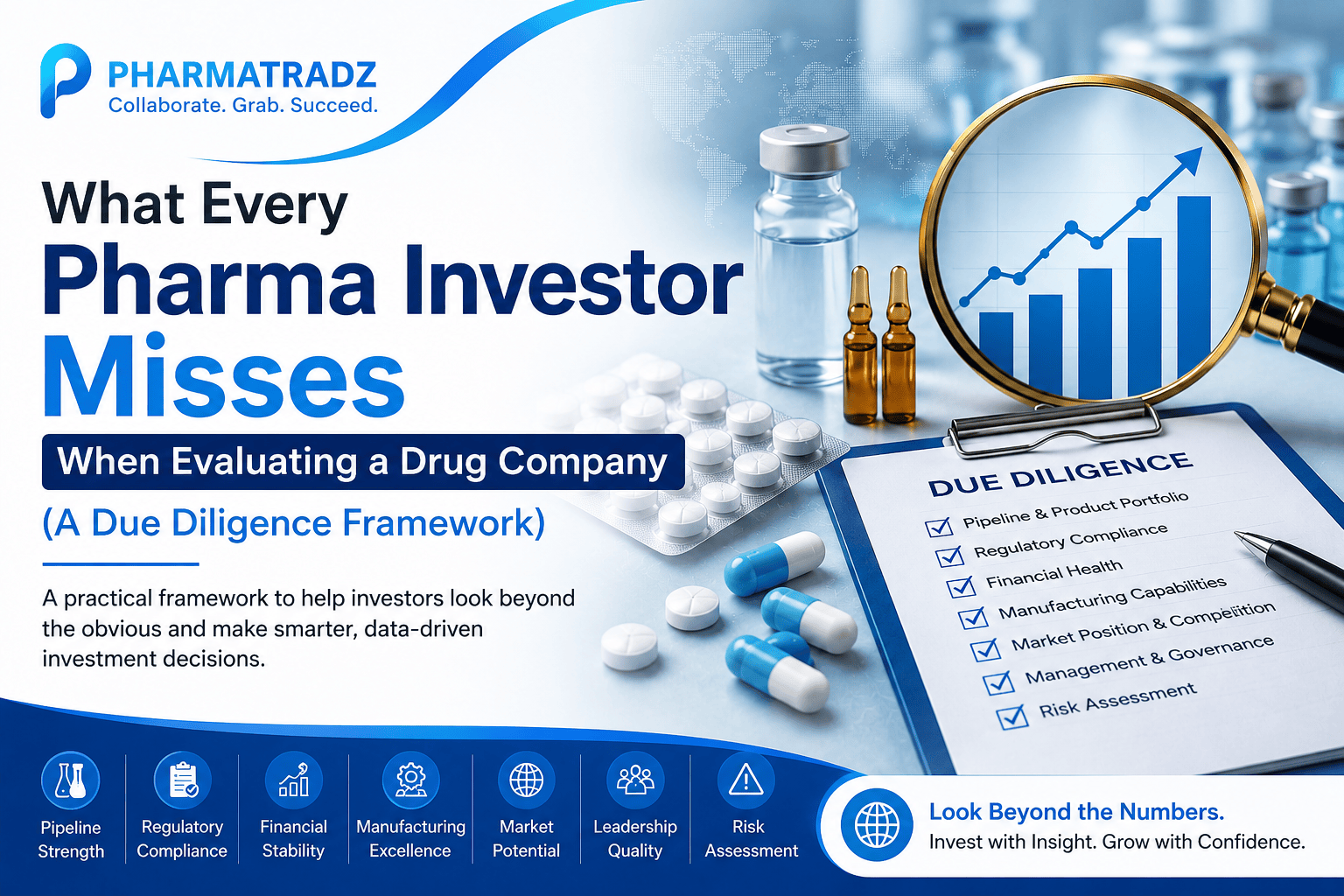
Investing in pharmaceutical companies often looks promising on the surface. Strong pipelines, growing demand, and global expansion make the sector attractive to investors. However, many investors struggle with how to evaluate a pharmaceutical company for investment beyond basic numbers, which leads to unexpected risks later.
While financial reports and product portfolios are easy to review, deeper issues often remain hidden. This is where many investors exploring pharma investment opportunities fail to see the full picture before making decisions. After initial research, many also explore platforms like Pharma Tradz to understand better how companies operate across supply chains and markets.
As per the research done by the Pharmatradz Global Ventures Pvt Ltd, a large number of failed investments are linked to gaps in due diligence rather than incorrect market assumptions.
Key Takeaways
- Pharma investment requires more than reviewing revenue and product pipelines
- Regulatory and compliance risks often impact timelines and returns
- Supply chain dependencies can affect long-term stability
- Execution capability is as important as scientific innovation
- A structured due diligence framework helps reduce investment risk
Why Traditional Pharma Investment Analysis Falls Short
Financial metrics and market potential are the initial two financial metrics that most investors begin with. These are important but do not portray a full picture.
A typical pharma company financial analysis may include revenue growth, profit margins, and pipeline value. However, these numbers do not always reflect operational challenges. Delays in approvals, problems with suppliers and gaps in compliance may have a considerable effect.
This gap between financial data and real-world execution is where many investment decisions go wrong.
The Hidden Risks Most Pharma Investors Overlook
Although companies perform well, they may have risks that are not readily apparent.
- Delays in the regulations that influence the timing of launching products.
- Dependence on a limited number of suppliers or manufacturers
- Quality and compliance issues that may lead to recalls
- Limited diversification in the product portfolio
- Weak distribution or market access
These pharmaceutical company regulatory risk factors often remain unnoticed until they start affecting revenue and growth.
A Practical Due Diligence Framework for Pharma Investments
A structured evaluation helps investors understand both visible and hidden risks.
1. Regulatory and Approval status
Ensure that products are either approved, under review, or delayed. The regulatory schedule has a direct impact on the revenue forecasts.
2. Manufacturing and Supply Chain
Determine the place and mode of production of goods. Seek alternative suppliers and production options. Investors should also assess whether the company works with established pharma contract manufacturing partners, as this directly affects production reliability, scalability, and cost efficiency over time."
3. Product Portfolio Strength
Assess the reliance that the company has on a limited number of products or whether the company has a diversified pipeline.
4. Compliance and Certifications
Check on quality standards including GMP and other regulatory approvals.
5. Commercial Readiness
Determine the accessibility of products within the market. Distribution strength is also very important in generating revenue.
6. Financial Stability
Check financial flow, investment, and sustainability in the long run.
This framework helps investors better understand how to evaluate a pharmaceutical company for investment beyond surface-level data.
Key Questions Every Pharma Investor Should Ask
Prior to investing, it is always good to ask the right questions to identify the risks early.
- Is the company dependent on a single product or supplier?
- Are regulatory approvals achievable or not?
- Is the company able to scale the production in case demand is greater?
- Are profit margins sustainable over time?
- What are the dangers of slow product launch?
These questions help build a clearer picture of the company’s future.
Real Reasons Pharma Investments Fail
Many investments fail not because of poor science, but due to execution challenges.
- Delays in regulatory approvals
- Poor partner selection
- Slow market entry
- Lack of alignment between forecasts and actual performance.
- Disruption of manufacturing or supply chain a risk that extends beyond the company itself. Understanding why most international buyers get burned sourcing APIs highlights how supply chain vulnerabilities at the ingredient level can cascade into production delays and revenue loss for the entire investment.
These issues often appear after investment decisions have already been made.
Red Flags to Watch Before Investing
Early detection of warning signs may lead to minimized risk.
- Unrealistic growth projections
- Lack of transparency in operations
- Lack of compliance data or obsolete data.
- Too much reliance on one market or product.
- Delay in product development processes.
Spotting these signs early helps avoid costly mistakes.
Simple Pharma Investment Evaluation Checklist
|
Area |
What to Check |
|
Regulatory |
Approval status and timelines |
|
Manufacturing |
Supplier reliability and capacity |
|
Product |
Pipeline diversity |
|
Financial |
Revenue and cash flow stability |
|
Compliance |
Certifications and audit history |
Using a checklist like this helps maintain consistency in evaluation.
How Digital Platforms Are Changing Due Diligence
The availability of valid information has increased over the past years. Investors can now explore company details, supplier networks, and compliance records more easily.
Pharma Tradz is one such platform that allows businesses and investors to understand supply chains, explore partners, and gain better visibility into how pharmaceutical companies operate. This assists to minimize uncertainty in the evaluation.
What Most Investors Miss
The largest disconnect in pharma investing is the emphasis on theory, not execution.
A strong pipeline does not guarantee success if approvals are delayed. High revenue projections may not materialise if supply chains are weak. Similarly, good financials may not reflect compliance risks.
These gaps need to be understood to make more effective investment decisions.
Conclusion
Pharma investing offers strong opportunities, but it also comes with risks that are often overlooked. Financial information and pipelines of the product present only one side of the coin. The real issues typically are in the regulatory procedures, reliability of manufacturing, and capacity of execution.
A well-developed due diligence framework assists them to go beyond the superficial data and detect any potential risks at an early stage. Platforms like Pharma Tradz can support this process by providing better visibility into supply chains, partners, and operational details.
If you are serious about making smarter pharma investments, now is the time to go deeper. Explore Pharma Tradz to uncover verified partners, gain clearer insights, and make decisions backed by real data, not assumptions. The difference between a missed opportunity and a successful investment often comes down to the information you act on today.
Frequently Asked Questions(FAQs)
1. How to evaluate a pharmaceutical company for investment?
It includes the analysis of financials, regulatory position, supply chain, product pipeline and compliance considerations.
2. What is the reason why pharma investments do not succeed?
Some common failures include regulatory delays, supply chain failures, and execution failures.
3. What are the main risks of pharma companies?
The key risks are regulatory approvals, a dependency on manufacturing, and compliance.
4. Do financial analysis suffice in pharma investment?
No, financial information does not represent the operation and regulatory issues alone.
5. What can investors do to minimize pharma investment risk?
Risk can be mitigated by using a structured due diligence framework and reviewing both financial and operational aspects.