
Objective
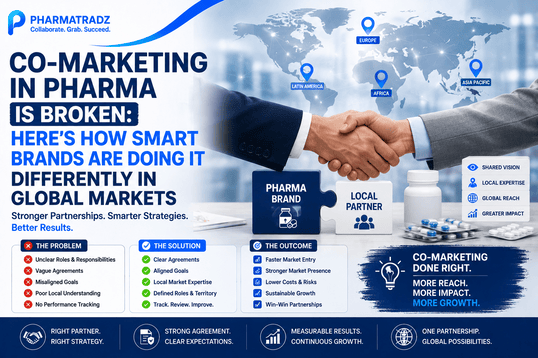
This blog breaks down why pharma co-marketing fails so often, and what companies that are actually succeeding are doing differently. If your brand is planning to grow in global markets through co-marketing, this is worth reading carefully.
Key Takeaways
- Most pharma co-marketing deals fail because of poor planning, not poor products.
- A clear and detailed pharma co-marketing agreement is non-negotiable.
- Global expansion needs local knowledge, not just a local partner.
- Smart brands align goals, define roles, and track results from day one.
- Co-marketing, when done right, cuts costs and accelerates market entry.
Table of Contents
- What Co-Marketing in Pharma Actually Means
- Why So Many Co-Marketing Deals Fall Apart
- The Hidden Costs Nobody Talks About
- What Smart Pharma Brands Are Doing Differently
- Building a Co-Marketing Agreement That Actually Works
- Going Global, What the Successful Ones Do First
- The Real Benefits of Pharma Co-Marketing
- What the Data Shows
- Final Thoughts
- FAQs
1. What Co-Marketing in Pharma Actually Means
Let's start simple.
Co-marketing in pharma means two companies promote the same drug in the same market, but under different brand names. Each company keeps its own identity. Each runs its own sales team. But the product is the same.
This is different from co-promotion, where both partners promote under one shared brand.
Co-marketing is popular in global pharma because it makes practical sense. A company might have a strong product but no distribution in a new country. A local partner already has the network, the relationships, and the regulatory experience. So they team up.
The model looks simple on paper, but it becomes difficult when roles, targets, compliance duties, and local execution are not clearly managed.
2. Why So Many Co-Marketing Deals Fall Apart
Nobody signs a co-marketing deal expecting it to fail. But many do. And usually for the same reasons.
Roles are never clearly defined. Who covers which area? Who owns the relationship with hospitals? Who sets the price? These questions seem obvious before the deal. After signing, they become the source of endless conflict.
The agreement is too vague. Some deals are built on trust and goodwill. When targets, territories, and responsibilities are not written down clearly, problems are just a matter of time.
The goals don't match. One partner wants quick sales. The other wants slow, careful brand building. These two goals pull in opposite directions. Without alignment upfront, the partnership becomes a constant negotiation.
Cultural differences are underestimated. A sales strategy that works in Germany will not automatically work in Indonesia or Nigeria. Healthcare systems are different. The doctor's behaviour is different. Regulatory rules are different. Ignoring this is one of the most expensive mistakes in global pharma.
Nobody tracks the numbers. Many co-marketing deals run on gut feel. There are no shared dashboards, no monthly reviews, no performance benchmarks. So problems stay hidden until they become too big to fix quietly.
3. The Hidden Costs Nobody Talks About
A failed co-marketing deal does not just waste the deal itself. It creates ripple effects.
|
What Goes Wrong |
What It Actually Costs |
|
Two partners targeting the same doctors |
Both partners may end up targeting the same doctors, which can reduce sales efficiency and create internal competition. |
|
Different brand messages in the same market |
Doctors get confused and disengage |
|
Regulatory filing mix-ups |
Fines, product pulls, market bans |
|
Partner dispute escalates |
Legal fees, delayed launches, lost years |
|
Brand reputation takes a hit |
Trust lost in that market, hard to rebuild |
These problems can happen when the agreement does not clearly define territory, messaging, compliance duties, and partner responsibilities. And the recovery is always slower and more expensive than the deal itself.
4. What Smart Pharma Brands Are Doing Differently
The companies getting co-marketing right are not doing something exotic. They are just more disciplined about the basics.
They slow down before they speed up. Before approaching any partner, they spend real time studying the target market. Who are the key prescribers? What do doctors care about? What does the competitive landscape look like? This upfront work saves months of wasted effort later.
They pick partners based on evidence, not impression. A good pitch from a potential partner is not enough. Smart brands check track records, distribution reach, compliance history, and financial health. They ask for references. They visit the partner's office. They look at past deals.
They protect everything in writing. This is where a solid pharma co-marketing agreement becomes the most important document in the entire deal. Every territory, every target, every brand rule, every payment term, all of it written down, reviewed by legal, and signed before a single rep hits the road.
They adapt to each market. Their global strategy has a structure. But their local execution is tailored. They hire people who know the local healthcare system. They adjust messaging to match how doctors in that region think. They do not rely on a head-office campaign without adapting it to the local healthcare system, prescriber behaviour, and regulatory environment.
They review performance every month, not every year. KPIs are set from day one. Sales volumes, prescription rates, doctor reach, market share, all tracked consistently. If something is not working, they know early and fix it fast.
5. Building a Co-Marketing Agreement That Actually Works
This document is the foundation. Everything else sits on top of it.
A strong agreement must clearly cover:
- Territory, exact regions, cities, or countries, with no overlap ambiguity
- Exclusivity, is this an exclusive deal? Under what conditions does that change?
- Brand usage, what each partner can and cannot say about the product
- Sales targets, minimum volumes, timelines, and what happens if targets are missed
- Regulatory duties, who files what, who handles adverse event reporting, who owns pharmacovigilance
- Revenue split, transparent, detailed, and agreed before launch
- Exit terms, how either party leaves the deal without destroying the product in the market
Leaving these areas unclear increases the risk of disputes, compliance gaps, and weak market execution.
6. Going Global, What the Successful Ones Do First
Expanding into new global markets through co-marketing is one of the fastest ways to grow. But the entry strategy matters enormously.
Smart pharma brands always start with regulatory mapping. They understand what is allowed in the new market before they look for a partner. They know that what worked in one country may be restricted, or banned, in another.
They also pilot before they scale. One market first. Learn what works, what breaks, and what needs adjusting. Then take that learning into the next market. It is slower upfront. But it produces far better outcomes than a rushed multi-country rollout that unravels at the same time in five different places.
And they never try to run a global co-marketing strategy purely from a central office. Local teams, local knowledge, and established healthcare relationships are central to successful market entry.
7. The Real Benefits of Pharma Co-Marketing
When the basics are done properly, co-marketing delivers real results.
Faster entry. A partner with existing distribution means you skip years of network-building.
Shared risk. Regulatory, financial, and operational risk is split between two parties.
Greater reach. Two sales forces covering one product reach far more prescribers.
Real market intelligence. A good local partner gives you ground-level insight that no research report can replicate.
Lower cost per market. Shared infrastructure and shared marketing investment stretch your budget further.
Successful collaborations often create new pharma business opportunities for companies looking to expand beyond their existing territories and therapeutic segments.
8. What the Data Shows
As per the research done by Pharmatradz Global Ventures Pvt Ltd, pharma brands that formalise their co-marketing structure before launch are significantly more likely to hit their Year 1 sales targets than those that rely on informal arrangements.
A case study conducted by Pharmatradz Global Ventures Pvt Ltd also found that companies entering emerging markets without localised strategies had nearly A case study reviewed by Pharmatradz Global Ventures Pvt Ltd found that companies entering emerging markets without localised strategies often face higher partner turnover, slower adoption, and weaker market trust.
The message from both findings is the same. Structure and localisation are not optional. They are what determine whether a co-marketing deal becomes a growth story or a case study in what not to do.
9. Final Thoughts
Co-marketing in pharma is not broken because it is a bad idea. It is broken because companies underestimate how much discipline it requires.
The model works. Many successful pharma market-entry plans depend on clear agreements, local knowledge, aligned goals, and consistent performance tracking. They happened because the right foundation was built first, clear agreements, aligned goals, local knowledge, and consistent performance tracking.
If your co-marketing deals are not delivering, go back to the foundation. In many cases, weak foundations are the reason co-marketing partnerships underperform.
Frequently Asked Questions(FAQs)
Q1. What is pharma co-marketing?
Two companies market the same drug in the same market under different brand names. Each partner operates independently but promotes the same product.
Q2. How is it different from co-promotion?
In co-promotion, both companies market the product under one shared brand. In co-marketing, each keeps its own brand identity.
Q3. Why do most pharma co-marketing deals fail?
Unclear roles, weak agreements, misaligned goals, and poor cultural adaptation are the most common reasons.
Q4. What must a pharma co-marketing agreement include?
Territory definition, exclusivity terms, brand guidelines, sales targets, regulatory responsibilities, revenue split, and exit clauses.
Q5. How do pharma companies expand into global markets through co-marketing?
By studying the local regulatory environment first, choosing partners based on evidence, piloting in one market before scaling, and hiring people with local knowledge.
Q6. What are the benefits of pharma co-marketing?
Faster market entry, shared risk, broader doctor reach, better market intelligence, and lower cost per market.
Q7. Can smaller pharma companies use co-marketing effectively?
Yes. It is one of the most practical ways for smaller companies to enter markets they could not afford to enter alone.