Introduction
In the year 2026, global sourcing of active pharmaceutical ingredients (APIs) has transformed into a highly regulated, technologically advanced, risk-reward environment driven by increasing regulatory expectations as well as the diversification of sourcing and fluctuations in energy, freight & raw materials. For pharmaceutical buyers, the challenge is not simply identifying authentic suppliers, rather it is to determine which area geographically offers them the best combination of compliance maturity, geographic risk versus cost balance.
This article will compare key global active pharmaceutical ingredient (API) manufacturing regions; it contains information regarding cost benchmarks and the risk associated with each region; and also provides a list of items that buyers need to ensure they have completed before issuing a request for quotation (RFQ).
(Also Read: Authenticity & Risk Management in Global Pharma Sourcing (2026) )
Global API Sourcing in 2026 — What Buyers Are Optimizing For
Global active pharmaceutical ingredient (API) source selection will continue to evolve based on five primary attributes:
- Regulatory reliability over cheapest price
- Shorter lead times & manufacturing flexibility
- Transparency across intermediates & KSM supply chain
- Less relieance on single-country sourcing
- Lifecycle dossier & stability data readiness
Buyers increasingly evaluating total landed risk, not just per-kg price from a specific supplier.
(Also Read: Top 30 Generic API Suppliers for Cost-Sensitive Sourcing (India & China) — Draft (2026) )
Best Regions for API Sourcing in 2026 — Side-by-Side Overview
Region Comparison Matrix (Buyer View)
| Region | Typical Price Level | Compliance Strength | Lead Time | Risk Profile | Best Fit For |
|---|---|---|---|---|---|
| India | Competitive / Mid | Strong for generics, robust audit history | Moderate | Upstream dependency risk in some KSMs | Cost-optimized, dossier-ready APIs |
| China | Lowest / Volume-efficient | Variable by facility | Fast | Policy & transparency variability | Commodity APIs, intermediates |
| Europe (EU) | Highest | Very strong | Moderate–Long | Low | High-regulatory markets & tenders |
| USA | Premium | Very strong | Long | Very Low | Specialty & controlled APIs |
| Eastern Europe / Türkiye / Mexico | Mid | Improving & mixed | Moderate | Emerging-market exposure | Near-shore diversification |
| South Korea / Japan | High | Excellent | Moderate | Very Low | High-purity & specialty molecules |
Buyer takeaway: Instead of “best region overall,” the right choice depends on product complexity, market destination, dossier needs, and timeline sensitivity.
Region-Wise Insights for API Buyers (2026)
India — Cost effective with strong regulatory compliance for generic APIs
- Indian manufacturers have an extensive amount of DMF ready APIs and an established record for supplying API products to regulated markets.
- India has created a mature system for manufacturing active pharmaceuticals that complies with European Union (EU) and United States Food and Drug Administration (US-FDA) Good Manufacturing Practices (GMPs).
- India provides considerable expertise in the manufacture of small molecule APIs, oncology, antibiotics and statins.
- When sourcing API from India, buyers should be aware of the disadvantages of intermediate dependency and fluctuations in freight and capacity.
Best for: Buyers looking for a balance between cost, dossier and compliance should utilize Indian manufacturers when sourcing API products.
China — Primary source for API-infrastructure intermediates due to its ample capacity, lower prices compared with other countries
- China's pricing model for commodity APIs and KSMs is extremely competitive due to high volume production capabilities
- China also has varying levels of compliance; therefore, purchasers must validate their facilities before purchasing APIs
- Excellent industrial capacity & fast turnaround
Best for: Price-sensitive sourcing, upstream supply & intermediates (Read: Best Low-Cost APIs to Source From China )
Europe — Premium Quality for High-Regulatory Markets
- Europe has established a strong reputation for regulatory filings to ensure compliance with current regulations
- Buyers in Europe can predict what documentation will be needed throughout the lifecycle of an API and they can expect consistency from European suppliers
- The total landed costs of European-sourced APIs may not be as low as those produced in China, but they will have the lowest compliance risks.
Best for: EU tenders, hospital & critical category sourcing (Read: Best European API Manufacturers for Regulated Market Supply )
USA — Specialty & High-Value API Manufacturing
- Niche strength in complex chemistry & controlled APIs - Imports from the USA account for most of the costs associated with API manufacturing, specialty molecules, and strategic partnerships.
- High cost + longer project onboarding timelines
Best for: biotech APIs, specialty molecules, strategic partnerships
Emerging Markets — Growing Alternative Sourcing Hubs
Countries gaining traction: Poland, Türkiye, Vietnam, Mexico, Brazil
-
Attractive for near-shoring and risk diversification
-
Compliance maturity varies — still evolving in some segments
Best for: Buyers looking to reduce single-country dependency
API Cost Benchmarks in 2026 (Directional Buyer View)
While some sources provide directional guidance on expected API Costs in 2026, expected API Costs will vary significantly by class of API, batch size, intellectual property (IP) protection and purity level. API buyers should use directional guidance to orient their negotiations for pricing and not as replacement for actual quotations.
| API Category | China | India | Europe / USA |
|---|---|---|---|
| Commodity / High-volume APIs | Lowest | Low–Mid | High |
| Regulated-market generic APIs | Low | Mid (best value) | Very High |
| Oncology / HPAPI | Mid | Mid–High | Highest |
| Specialty / Novel APIs | Mid–High | High | Premium |
Buyers must also consider several hidden cost drivers when calculating the landed costs of APIs, including, but not limited to:
- Stability & CTD dossier fees
- Validation batches & tech-transfer costs
- Packaging & serialization requirements
- Energy, solvents, freight surcharges
- Change-control lifecycle costs
Finally, there may be cases where the per-kilogram price will be lower than found in other geographies, but if there are gaps in documentation or the ability of suppliers to meet compliance requirements, then the cost to import the API will be greater.
Lead Time Benchmarks (Typical Ranges)
| Activity | China | India | Europe / USA |
|---|---|---|---|
| Sample / Pilot batch | 2–4 weeks | 3–6 weeks | 4–8 weeks |
| Commercial batch | 4–8 weeks | 6–10 weeks | 8–14 weeks |
| Tech transfer / scale-up | 2–4 months | 3–5 months | 4–6+ months |
Lead time risk multipliers:
- Dependency on single intermediate source
- Regulatory queries during batch release
- Limited production slot availability
Evaluate these Risk Factors Before Requesting Quotes from Suppliers
- Having too much dependence on a single country or organization
- Intemittent audit trail or CAPA closure records
- Marketing-only traders posing as manufacturers
- Lack of Dossier support (stability, validation, Bioavailability Links)
- Not much visibility into OEL / Containment Controls established for Potent APIs
- Limited Formality in maintaining change controls after commercialization
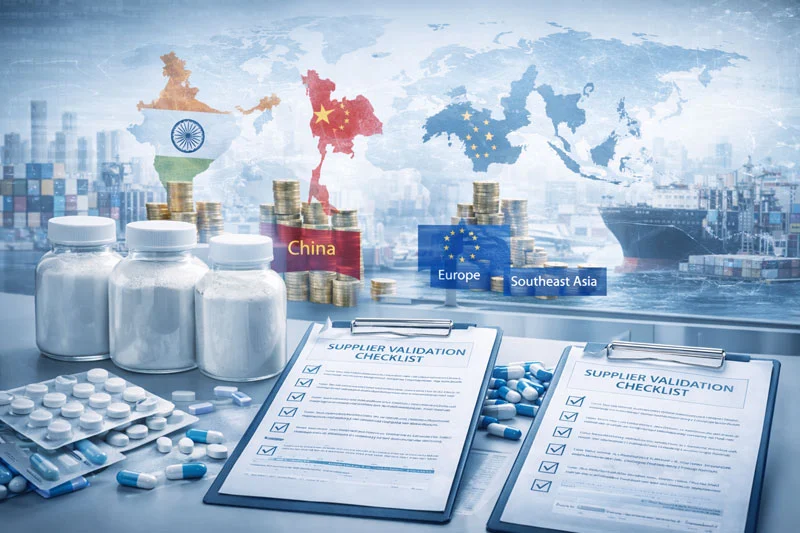
15-Point API Supplier Validation Checklist (2026 Edition)
Use this as a procurement screening template prior to engaging vendors:
Regulatory & Compliance
- Certification of Compliance for the most Recent EU-GMP / US-FDA / WHO / State Audits (Read: A Beginner’s Guide to Global Pharma Regulatory Requirements (FDA, EMA, CDSCO & More) )
- Check CAPA responses with closure evidence
- Track record in regulated-market submissions
Technical & Manufacturing
- Clear Manufacturing Flow and Reason for Impurities
- Availability of intermediates and KSM Suppliers
- Containment for HPAPI/Oncology Adequately Accomplished
Documentation & Dossier Readiness
- A Validated Certificate of Analysis (COA), Stability, Validation, and Residual Solvents
- The supplier is Prepared to Submit in CTD or DMF Formats and has a Timeline for Data Update
- Firm Change Control/Documentation Discipline & a Firm Lifecycle documentation Discipline
Operational & Commercial
- Commit to Providing Delivery Timelines and Being Available Upon Request
- Feasibility of MOQs and Batch Sizes
- Provide Clarity on Pricing Models (validation, study, and maintenance)
- Ability to Provide Continued Supply and/or Dual Sourcing Capability
Pro tip for buyers: Conduct a Two-Stage Evaluation; Prequalification (Paper Audit) Followed by Technical Survey/On-Site Assessment of Final Candidates.
When to Choose Which Region — Buyer Decision Guide
- Choose India → when you need cost + compliance + dossier support
- Choose China → for commodity APIs & intermediates at scale
- Choose Europe / USA → for high-regulatory & specialty categories
- Choose emerging hubs → to diversify risk & near-shore supply
The strongest sourcing strategies in 2026 use a dual-region or multi-region model instead of single-country dependency.
Conclusion
In 2026, Sourcing APIs will require finding a balanced average between Price, Risk, Maturity, and Support across the complete Product Lifecycle. The procurement of suppliers based on a defined Validation Framework, as opposed to price alone, has the potential to create greater delivery reliability and Regulatory Compliance.
Need Support with Sourcing APIs from Verified Global Manufacturers?
Share your API requirement — molecule, quantity, target market, and dossier needs — and we’ll connect you with verified, capability-matched manufacturers across India, China, Europe, the USA, and emerging hubs, along with technical confirmations and quotations.
Submit your API sourcing requestFrequently Asked Questions(FAQs)
1. Which country is the best for API sourcing in 2026?
There isn’t a single best country for all APIs. India offers the most balanced mix of cost, compliance, and dossier readiness, China is ideal for intermediates and high-volume commodity APIs where price and capacity matter most, while Europe and the USA are preferred for high-regulatory and specialty molecules where reliability outweighs cost. The right choice depends on molecule complexity, market destination, and risk tolerance.
2. How do I evaluate whether an API manufacturer is compliant and reliable?
A reliable manufacturer demonstrates a strong audit history, transparent technical documentation, and consistent lifecycle control. Buyers should review recent GMP or regulatory audits, verify stability and validation data, and ensure clarity around KSM and intermediate sourcing. A paper review followed by a focused technical or site audit remains the safest approach before RFQ or commercial commitment.
3. Why do API prices differ so much across regions?
Prices vary because production economics, regulatory expectations, and supply-chain structures differ across countries. Factors such as labor, energy, intermediates, batch size, documentation effort, freight, and compliance costs all influence the final price. A lower quoted price can still result in a higher total landed cost if a supplier has gaps in documentation, quality systems, or delivery reliability.
4. What lead time should buyers expect for API procurement?
Lead times depend on product complexity and manufacturing capacity. Samples or pilot batches usually take a few weeks, commercial batches may take several weeks to a few months, and tech-transfer projects require longer because of validation and documentation. Delays are more likely when suppliers rely on single-source intermediates or face regulatory queries, so buyers should plan buffers where possible.
5. What documents should I request from an API supplier before placing an order?
Before placing an order, buyers should ensure the supplier can provide a valid COA, stability and validation data, impurity profile details, relevant GMP or audit evidence, and—where applicable—CTD or DMF documentation with clear update timelines. Strong documentation readiness is a key indicator of long-term reliability and smoother regulatory acceptance.
6. How can buyers reduce risk when sourcing APIs from a new region?
Risk can be reduced by onboarding suppliers gradually, starting with smaller batches and expanding once performance is proven. Dual-sourcing or multi-region strategies help avoid dependency, while clear contractual expectations on quality and delivery provide additional assurance. Visibility into the upstream KSM supply chain further reduces disruption risk.
7. When should buyers prefer regulated-market manufacturers?
Regulated-market manufacturers are most suitable for products intended for highly controlled or tender-driven markets, as well as sensitive categories like oncology and HPAPI. Their stronger documentation discipline and compliance maturity reduce regulatory risk, even if the upfront manufacturing cost is higher.
8. Are emerging markets reliable for API sourcing?
Emerging markets can be reliable and are increasingly attractive for diversification, but performance varies by supplier. Reliability improves when buyers apply stricter validation, closer documentation review, and phased volume onboarding until consistent quality and delivery are demonstrated.