
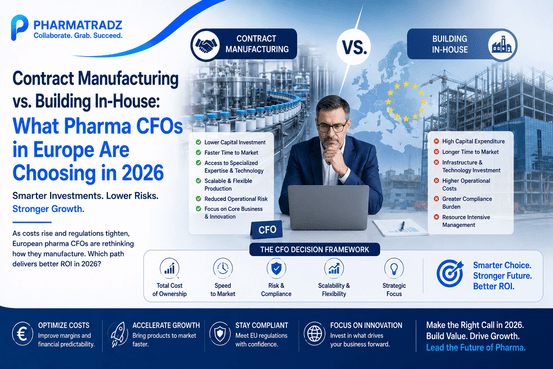
Objective: To help pharmaceutical finance and operations leaders in Europe understand the real trade-offs between contract manufacturing and in-house production, and what is actually driving those decisions in 2026.
Key Takeaways
- European pharma CFOs are under pressure to produce more while spending less, and the manufacturing model they choose shapes everything.
- Contract manufacturing offers speed and lower upfront capital, but carries dependency and quality risks.
- Building in-house gives control and long-term margin advantage, but demands serious investment and time.
- Biologics are changing the equation. Outsourcing can still work, but companies are now looking more closely at process control, capacity access, quality risk, and long-term supply security.
- Regulatory shifts in the EU are pushing companies to rethink where and how they manufacture
- The right answer depends on the molecule, the market, and what the company actually needs in the next five years.
Table of Contents
- Why This Decision Is Different in 2026
- What Contract Manufacturing vs. In-House Manufacturing Actually Means in Pharma
- The Financial Case for Contract Manufacturing
- The Financial Case for Building In-House
- Pharma Outsourcing for Biologics, A Special Challenge
- What EU Regulatory Pressure Is Changing
- How CFOs Are Actually Making This Call in 2026
- FAQs
1. Why This Decision Is Different in 2026
Three years ago, most European pharma CFOs had a fairly straightforward default: outsource what you can, keep what is strategically critical in-house. It was not a perfect framework, but it worked.
That framework is under pressure now.
Supply chain disruptions exposed how fragile outsourced manufacturing can be. The COVID-19 pandemic made it painfully clear that depending on a third-party manufacturer, especially one based outside Europe, carries risks that do not appear on a balance sheet until something goes wrong. Then they appear all at once.
At the same time, construction costs for new pharmaceutical plants have risen sharply across Europe. Energy prices hit hard. Qualified manufacturing talent is scarce in several key markets. So building in-house is not the easy fallback it might have been a decade ago, either.
In 2026, this is genuinely a harder decision than it has ever been. CFOs are weighing short-term capital pressure against long-term strategic control, and they are doing it in a regulatory environment that keeps shifting under their feet.
2. What Contract Manufacturing vs. In-House Manufacturing Actually Means in Pharma
Before getting into the numbers, it helps to be clear on what each model actually involves.
Contract manufacturing means hiring a third-party company, called a Contract Manufacturing Organization, or CMO, to produce your drug. You own the formula and the intellectual property. The CMO usually owns the facility and equipment and manufactures under an agreed technical and quality framework. The product owner still remains responsible for regulatory oversight, product quality expectations, and the terms defined in the quality agreement.
In-house manufacturing means your company owns and operates its own production facilities. You employ the staff, maintain the equipment, handle regulatory inspections, and carry the full cost, and the full control.
Most European pharma companies do not operate in one model exclusively. They outsource some products and manufacture others internally. The question is where to draw that line, and whether the current line still makes sense.
Decisions around pharma contract manufacturing are increasingly tied to product type, regulatory status, and how much supply chain risk the company is willing to absorb. Decisions around pharma contract manufacturing are increasingly tied to product type, regulatory exposure, production volume, and how much supply chain risk a company is willing to carry. For many European mid-size manufacturers, the question is no longer simply “What is cheaper?” It is “Which model protects supply, quality, and long-term control?”
3. The Financial Case for Contract Manufacturing
For a CFO staring at a capital allocation decision, the contract manufacturing model has obvious appeal. You do not need to commit tens or hundreds of millions of euros to a new facility before a product has proven its long-term commercial value.
You do not need to hire 150 qualified manufacturing staff. You do not carry the depreciation on equipment that might be obsolete in eight years. You pay for production when you need it, and you stop paying when you do not.
Where contract manufacturing makes financial sense:
- Early-stage or lower-volume products, where building a dedicated facility cannot be justified
- Generic or mature molecules where the manufacturing process is well-established, and CMO capacity is widely available.
- Products with variable or seasonal demand, where maintaining fixed production capacity would be wasteful
- Companies that need to get to market quickly and cannot wait eighteen to twenty-four months for a facility to come online
The cost flexibility is real. For smaller European pharma companies, especially, pharma outsourcing for biologics and specialty products can mean the difference between launching a product and not launching it at all.
The risks, though, are just as real.
4. The Financial Case for Building In-House
The case for in-house manufacturing is not just about control, it is about margin.
When you manufacture your own product, you capture the production margin that would otherwise go to the CMO. For a high-volume product with a strong price point, that margin can be substantial over time. The investment in a manufacturing facility might look expensive in year one, but it pays back considerably over a ten to fifteen-year horizon.
Beyond the margin argument, there is the question of what in-house manufacturing does for your regulatory position. When an EU regulatory inspection happens, your own facility is something you can prepare, manage, and respond to directly. A CMO audit finding becomes your problem regardless of whether it was your fault.
Why European CFOs are moving back toward in-house investment:
- Loss of supply security from over-reliance on single-region suppliers, non-EU manufacturing routes, or limited CMO capacity.
- EU pharmaceutical legislation is pushing for manufacturing within European borders for critical medicines
- Better long-term margin structure for blockbuster or high-demand products
- Increased control over batch records, deviations, and regulatory submissions
- Strategic value in owning the manufacturing know-how, especially for biologics and complex formulations
The pharmaceutical plant investment required to build in-house is significant, but several European governments now offer manufacturing incentives, grants, and favorable terms for domestic pharma production. That changes the math in some markets.
5. Pharma Outsourcing for Biologics, A Special Challenge
Biologics are not tablets. They are living-cell-derived therapies, antibodies, gene therapies, cell therapies, and manufacturing them is a fundamentally different kind of problem.
Pharma outsourcing for biologics has grown significantly over the past decade. Specialized CMOs with bioreactor capacity and cold chain expertise have built real capability. But the risks of outsourcing biologics are proportionally higher than those of outsourcing small molecules.
Biologics manufacturing requires extremely tight process consistency. A small deviation in cell culture conditions can alter the product's efficacy or safety profile. When that process lives in someone else's facility, your visibility into those conditions is limited by whatever quality agreement you negotiated. In biologics, even a small manufacturing disruption can affect supply timelines, regulatory planning, and commercial confidence. This is why some biotech and pharma companies are now reviewing whether critical biologic processes should remain fully outsourced or move partly in-house over time.
For molecules where process consistency is safety-critical, the argument for in-house manufacturing becomes much stronger, even if the upfront cost is harder to justify.
6. What EU Regulatory Pressure Is Changing
The EU Pharmaceutical Strategy, first proposed in 2020 and actively being implemented through 2025 and 2026, has a clear orientation: reduce European dependence on non-EU manufacturing for essential medicines. This may affect access to public procurement opportunities, strategic project support, funding routes, and faster administrative procedures for selected critical medicine projects.
What this means practically for pharma manufacturing decisions in 2026:
- Companies that manufacture within the EU may have preferential positioning for tendering on national and EU-level supply contracts.
- Regulators are scrutinizing API sourcing more closely, particularly API manufactured exclusively in China or India for critical medicines.
- Companies with EU manufacturing footprints may be better positioned to show supply resilience, local capacity, and stronger control over critical medicine production.
- EMA and the wider European medicines regulatory network are placing more attention on shortage reporting, supply monitoring, and contingency planning. This makes manufacturing resilience a more important part of commercial and regulatory planning.
For CFOs, this adds a non-financial dimension to the contract manufacturing vs. in-house manufacturing decision. The regulatory risk of being over-reliant on non-EU CMOs is increasingly a boardroom conversation, not just a supply chain one.
7. How CFOs Are Actually Making This Call in 2026
There is no single answer. But there is a pattern in how the most thoughtful pharma manufacturing decisions in 2026 are being structured.
The companies getting this right are asking these questions before choosing a model:
- What is the volume forecast? Low-volume specialty products rarely justify a dedicated facility. High-volume products almost always do, over a long enough horizon.
- How critical is the molecule to our portfolio? If this product goes out of stock, what happens to our revenue and our patient commitments?
- What is the regulatory sensitivity of the manufacturing process? Simple oral solid dosage forms carry a different CMO risk profile than sterile injectables or biologics.
- What does the next five years of demand look like, not the next twelve months? Pharmaceutical plant investment decisions are fifteen-year decisions dressed up as three-year budget decisions.
- What EU regulatory positioning do we need? Being able to say "manufactured in Europe" is worth something real in 2026.
The honest answer for most European mid-size pharma companies right now is a hybrid. Outsource the products where CMO risk is manageable, and volume does not justify a line. Build in-house for the molecules that carry your commercial future and cannot afford to be hostage to a third party's capacity decisions.
We at Pharmatradz help companies work through exactly this analysis, because the decision that looks right on a spreadsheet does not always look right when you factor in regulatory positioning, supply chain resilience, and where the business needs to be in 2030.
The wrong manufacturing model costs more than money, it costs time, supply security, and strategic control. If you are working through a contract manufacturing vs. in-house decision and want to think it through with people who follow European pharma closely, Pharmatradz is the place to start that conversation.
Frequently Asked Questions(FAQs)
Q1. What is the average cost difference between contract manufacturing and building in-house for a European pharma company?
It depends on product type, volume, and facility complexity. The cost difference depends on dosage form, volume, facility complexity, validation needs, labour costs, and regulatory requirements. In-house manufacturing usually requires major upfront capital, while contract manufacturing spreads cost through batch, unit, or service-based agreements. The real comparison should be based on total cost over several years, not only the first-year spend.
Q2. Is pharma outsourcing for biologics more or less risky than outsourcing small molecules?
More risky. Biologics manufacturing is more process-sensitive, harder to transfer between sites, and depends on specialised equipment. There are also fewer qualified CMOs, which reduces flexibility if problems arise.
Q3. How is EU pharmaceutical legislation affecting manufacturing decisions in 2026?
The EU Pharmaceutical Strategy is pushing companies toward domestic production of critical medicines. Heavy reliance on non-EU CMOs is facing more regulatory scrutiny, especially in public procurement. Many European pharma companies are now reshoring at least part of their manufacturing operations.
Q4. Can a pharma company move from contract manufacturing to in-house production during a product lifecycle?
Yes, but the process is complex. Technology transfer requires regulatory filings, validation batches, and often temporary parallel production. Most transitions take 12–24 months, depending on the product and dosage form.
Q5. What risks do companies most often underestimate with contract manufacturing?
Quality and capacity risks. If a CMO fails an inspection or faces production issues, the client company absorbs the supply impact. Capacity conflicts are also common because CMOs prioritise multiple clients at once.
Q6. Are pharmaceutical manufacturing incentives available in Europe in 2026?
Yes. Countries including Germany, France, Ireland, and several Central and Eastern European markets offer incentives tied to pharmaceutical investment. These may include grants, lower tax rates, and faster permitting, depending on the project type and location.