Ranked by total revenue for financial year 2025, the ten largest pharmaceutical companies in the world are Johnson & Johnson, Roche, Eli Lilly, Merck & Co, Pfizer, AbbVie, AstraZeneca, Novartis, Bayer and Sanofi. The next five are Bristol Myers Squibb, Novo Nordisk, GSK, Amgen and Boehringer Ingelheim. Every figure below comes from the company's own full-year 2025 results release, published between January and March 2026. Counting pharmaceutical sales only changes the order, and Eli Lilly comes first. We explain both views below. But if you source medicines rather than invest in them, a different question usually matters more than the ranking itself: which of these companies' products are losing patent protection, and when.
The top 15 pharmaceutical companies by FY2025 revenue
The table ranks companies by total group revenue as each one reported it for the 2025 financial year. Where a group also sells medical devices, diagnostics, animal health, crop science or consumer products, the note column says so and gives the pharmaceutical figure where the company publishes one.
| Rank | Company | Headquarters | FY2025 revenue as reported | Approx. US$ equivalent | Note |
|---|---|---|---|---|---|
| 1 | Johnson & Johnson | United States | US$94.2bn | US$94.2bn | Includes MedTech (US$33.8bn). Innovative Medicine alone: US$60.4bn |
| 2 | Roche | Switzerland | CHF 61.5bn | US$74.1bn* | Includes Diagnostics (CHF 13.8bn). Pharmaceuticals alone: CHF 47.7bn (about US$57.4bn*) |
| 3 | Eli Lilly | United States | US$65.2bn | US$65.2bn | Pharmaceuticals only |
| 4 | Merck & Co (MSD outside the US and Canada) | United States | US$65.0bn | US$65.0bn | Includes Animal Health (US$6.4bn). Pharmaceutical segment: US$58.1bn |
| 5 | Pfizer | United States | US$62.6bn | US$62.6bn | Pharmaceuticals and vaccines |
| 6 | AbbVie | United States | US$61.2bn | US$61.2bn | Includes an aesthetics business |
| 7 | AstraZeneca | United Kingdom | US$58.7bn | US$58.7bn | Total revenue; product sales were US$55.6bn, the rest is alliance and collaboration revenue |
| 8 | Novartis | Switzerland | US$54.5bn | US$54.5bn | Innovative medicines only |
| 9 | Bayer | Germany | €45.6bn | US$51.5bn* | Includes Crop Science (€21.6bn) and Consumer Health (€5.8bn). Pharmaceuticals alone: €17.8bn (about US$20.2bn*) |
| 10 | Sanofi | France | €43.6bn | US$49.3bn* | Consumer health business no longer consolidated; reported as a discontinued operation |
| 11 | Bristol Myers Squibb | United States | US$48.2bn | US$48.2bn | Pharmaceuticals only |
| 12 | Novo Nordisk | Denmark | DKK 309.1bn | US$46.7bn* | Pharmaceuticals only |
| 13 | GSK | United Kingdom | £32.7bn | US$43.1bn* | Pharmaceuticals and vaccines |
| 14 | Amgen | United States | US$36.8bn | US$36.8bn | Total revenues; product sales were US$35.1bn |
| 15 | Boehringer Ingelheim | Germany | €27.8bn | US$31.4bn* | Privately owned. Includes Animal Health (€4.9bn). Human Pharma alone: €22.7bn |
* Our conversion, not the company's. Non-dollar figures are converted at the 2025 annual average exchange rates published by the US Federal Reserve (G.5A release, 5 January 2026): US$1.1306 per euro, US$1.3192 per pound, CHF 0.8305 per US dollar and DKK 6.6137 per US dollar. Companies that report in US dollars are shown as reported. A different exchange rate would move the converted figures by a few per cent, and could swap neighbouring positions.
Just outside the top 15 are Takeda, whose financial year runs to March, and Gilead Sciences (US$29.4bn in 2025). Drug wholesalers and distributors are left out of this list, because most of their revenue comes from reselling other companies' medicines.
How we ranked, and the pharmaceutical-only view
We ranked by total group revenue because that is the figure every company reports in the same way. It is also the measure most people mean by "largest". But group revenue flatters diversified groups. If you count pharmaceutical sales only, using the segment figures in the note column, the order changes:
- Eli Lilly moves to first place (US$65.2bn), followed by Pfizer, AbbVie (including aesthetics), Johnson & Johnson (Innovative Medicine, US$60.4bn), AstraZeneca, Merck & Co (pharmaceutical segment, US$58.1bn) and Roche (Pharmaceuticals, about US$57.4bn).
- Bayer drops out of the top 15, because its pharmaceutical division (€17.8bn) is smaller than its crop science business.
- Boehringer Ingelheim falls back once animal health is removed: its Human Pharma business (€22.7bn, about US$25.7bn*) is smaller than Gilead Sciences (US$29.4bn).
Neither order is wrong. They measure different things, so check which method a list uses before you compare it with another one.
Why published rankings disagree with each other
Search for the largest pharmaceutical companies and you will find lists that contradict each other. The disagreement is mostly about method, not facts:
- Total revenue vs pharmaceutical revenue. Johnson & Johnson reports both medicines and MedTech, Roche includes diagnostics, Merck & Co and Boehringer Ingelheim include animal health, and Bayer includes crop science and consumer health. A company can rank first on group revenue and fourth on medicines alone.
- Revenue vs market capitalisation. These give very different orders. Eli Lilly became the first drugmaker to reach a US$1 trillion market value on 21 November 2025. At that point it was worth more than twice its closest pharmaceutical peer, even though Johnson & Johnson had higher revenue.
- Reporting year and currency. Most companies report on the calendar year, but some Japanese companies, such as Takeda, run their financial year to 31 March. Swiss, European, British and Danish companies report in their own currencies, and the exchange rate used to convert them can reorder companies with similar revenue.
- Actuals vs guidance. Some lists published during 2026 mix 2025 actual results with 2026 forecasts. The table above uses 2025 actuals only.
For sourcing, the ranking position matters less than which company holds which product, and when that product's protection ends.
The major originators and the brands they hold
If you source generics or biosimilars, these are the companies whose reference brands appear on your specifications. Knowing which originator holds which product is the practical use of this list. FY2025 product sales are from each company's full-year release.
- Johnson & Johnson: immunology and oncology. Darzalex (daratumumab, US$14.4bn in 2025), Stelara (ustekinumab, now facing biosimilars), Tremfya, and Xarelto (rivaroxaban) in the US.
- Roche: oncology, neurology and diagnostics. Ocrevus (CHF 7.0bn in 2025), Hemlibra, and Herceptin and Avastin, both now facing biosimilars.
- Eli Lilly: metabolic disease. Mounjaro (US$23.0bn in 2025) and Zepbound (US$13.5bn), both tirzepatide, plus Trulicity (dulaglutide) and Humalog.
- Merck & Co: oncology and vaccines. Keytruda (pembrolizumab, US$31.7bn in 2025), Gardasil (US$5.2bn) and Januvia (sitagliptin).
- Pfizer: a broad portfolio. Eliquis (apixaban, with Bristol Myers Squibb), Prevnar, Vyndaqel and Ibrance.
- AbbVie: immunology. Skyrizi (US$17.6bn in 2025), Rinvoq (US$8.3bn) and Humira (adalimumab, US$4.5bn, now biosimilar).
- AstraZeneca: oncology, cardiometabolic and respiratory. Tagrisso (osimertinib), Imfinzi, Farxiga (dapagliflozin) and Symbicort.
- Novartis: cardiovascular, immunology and oncology. Entresto (US$7.7bn in 2025, now facing generic competition in the US), Cosentyx (US$6.7bn) and Kisqali (US$4.8bn).
- Bayer: cardiovascular and oncology. Xarelto outside the US, Kerendia and Nubeqa.
- Sanofi: immunology and vaccines. Dupixent (dupilumab), its largest product, and Lantus (insulin glargine).
- Bristol Myers Squibb: oncology, haematology and cardiovascular. Eliquis (US$14.4bn in 2025), Opdivo (nivolumab, US$10.0bn) and Revlimid (lenalidomide, now generic).
- Novo Nordisk: diabetes and obesity. Ozempic, Wegovy and Rybelsus (all semaglutide), and NovoRapid.
- GSK: vaccines, respiratory and HIV. Shingrix, Trelegy and Dovato.
- Amgen: bone health, cardiovascular and inflammation. Prolia, Repatha and Enbrel.
- Boehringer Ingelheim: cardiometabolic and respiratory. Jardiance (empagliflozin, with Eli Lilly), Ofev and Spiriva.
Generic and biosimilar manufacturers
Rankings of the largest pharmaceutical companies measure originators by value. By volume, most medicines dispensed worldwide are generics, made by thousands of manufacturers in Europe, North America, India, China, Latin America, the Middle East and elsewhere. Biosimilars come from a narrower group, because developing them takes far more analytical, clinical and manufacturing investment. When a reference product loses exclusivity, the right manufacturer depends on the product, the dosage form, the regulatory dossier you need and the markets you plan to supply. Choose on GMP status, documentation and track record, not on country of origin.
The patent cliff: where the change is happening
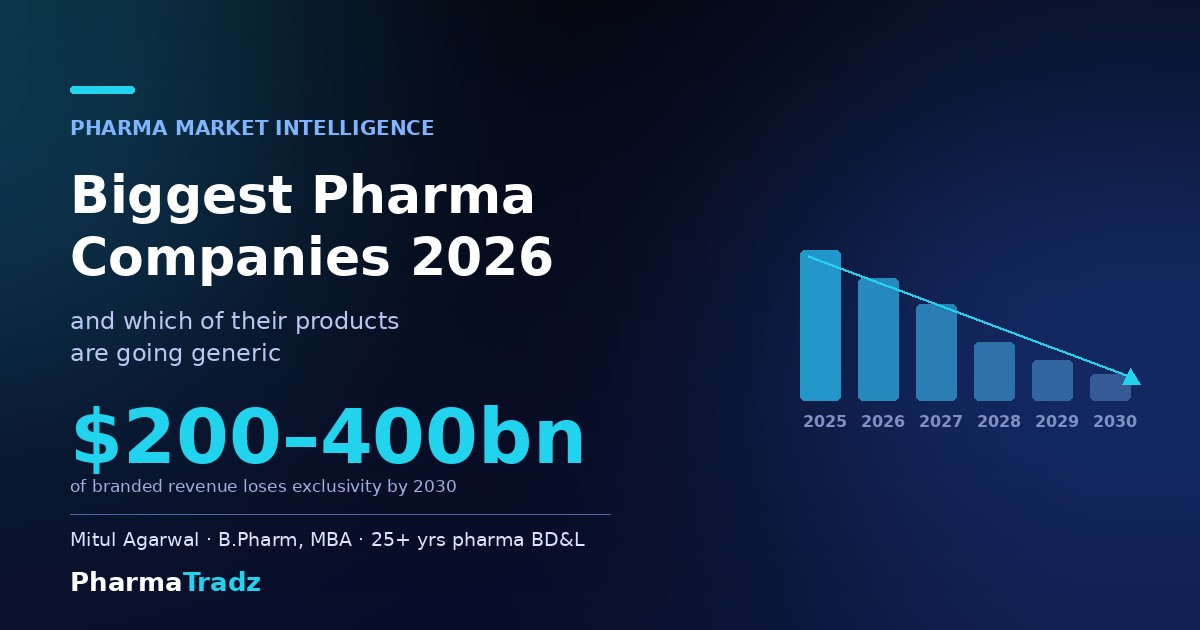
Evaluate, the industry analytics firm, estimates that more than US$300 billion of prescription drug revenue will lose exclusivity between 2025 and 2030. Each expiry turns a protected, high-priced product into a competitive generic or biosimilar market. The dates below are checked against company filings and results releases and are correct as of October 2026.
Products already in their generic or biosimilar era
- Ustekinumab (Stelara, Johnson & Johnson). The first US biosimilar launched in January 2025, and at least four were on the US market within weeks. Stelara was about 6.5% of Johnson & Johnson's 2025 revenue, roughly US$6.1bn, down from more than US$10bn in 2023. The company expects biosimilar launches to continue globally.
- Adalimumab (Humira, AbbVie). The reference case for large-scale biosimilar entry. Biosimilars have been sold in Europe since October 2018, and the first US biosimilar launched on 31 January 2023. Humira's sales were US$4.5bn in 2025, a fraction of its peak.
- Trastuzumab (Herceptin) and bevacizumab (Avastin), both Roche. These are mature biosimilar markets. In 2025, Herceptin sales fell 22% to CHF 1.0bn and Avastin sales fell 17% to CHF 1.0bn.
Major expiries approaching
- Apixaban (Eliquis, Bristol Myers Squibb and Pfizer). BMS reported US$14.4bn of Eliquis revenue in 2025. In the European Union, the composition-of-matter patents and their Supplementary Protection Certificates expire in November 2026, and Japan's exclusivity also ends in 2026. Pfizer already reports generic entry in certain international markets. In the US, generic companies that settled with BMS may launch in 2028, and court rulings have been widely reported as protecting the brand until 1 April 2028.
- Pembrolizumab (Keytruda, Merck & Co). US$31.7bn in 2025 sales, the largest single product in this cycle. Merck lists the US compound patent as expiring in 2028, with two related US patents running to 2029. Major EU markets follow in 2031 and Japan in 2032–2033. A subcutaneous version, Keytruda Qlex, was approved by the FDA on 19 September 2025 and is also approved in the EU.
- Nivolumab (Opdivo, Bristol Myers Squibb). US$10.0bn in 2025. BMS gives its estimated minimum market exclusivity as 2028 in the US, 2030 in the EU and 2031 in Japan. Together with Eliquis, this makes Bristol Myers Squibb one of the most exposed companies of this cycle.
For a year-by-year view of launch dates, see medicines going generic in 2026 and 2027.
What this means if you source generics
A patent expiry is not a starting gun. By the time a product is actually available, the manufacturers who prepared for it are already supplying it. In practice:
- Dossier development starts years before expiry. Manufacturers developing a generic for a 2028 expiry are working on it now. If you intend to distribute that product, the conversation with a manufacturer belongs in 2026, not 2028.
- Expiry dates differ by market. Eliquis shows this clearly: European protection ends in November 2026, while settled US generic entry is not until 2028.
- Biosimilars are not generics. Small-molecule generics need bioequivalence data. Biosimilars need comparative analytical and clinical data, much higher investment, and manufacturing capacity that fewer companies have. Treat them as different sourcing problems. Many biosimilar programmes rely on contract manufacturing, and our guide to top global CDMO companies in 2026 explains how to assess that capacity.
- Early entrants capture the margin. Generic prices fall steeply as competitors enter, so arriving first rather than third makes a large commercial difference.
The mistake I see most often: assuming a patent expires everywhere at once
In 25 years of international business development and licensing, the most common and most expensive error I see is this. A buyer reads that a product has "gone off patent" and starts planning and investing on that basis, without checking the intellectual property position in the specific country they intend to supply.
Patent protection is territorial. A molecule can be freely manufactured and sold in one market while still fully protected in another for years. Investment decisions based on a headline expiry date, rather than country-level IP status, end with product that cannot legally be sold where it was meant to go.
Semaglutide is the clearest current example. The compound patent expired on 20 March 2026 in India and China, with Brazil also in the 2026 wave, and Canada's patent had already lapsed. Generic launches followed quickly in several of these markets. In Europe, the position is entirely different: Supplementary Protection Certificates keep exclusivity in place until around 2031. A manufacturer supplying semaglutide legitimately in one of the open markets in 2026 cannot supply the same product into the European Union for several more years. Our semaglutide patent expiry by country guide sets out the position market by market.
What to do instead
- Establish the IP position country by country before committing. Compound patents, secondary patents, formulation and device patents, Supplementary Protection Certificates and regulatory data exclusivity all run on separate clocks in separate territories.
- Obtain a Freedom to Operate (FTO) opinion for each target market. An FTO analysis establishes whether manufacturing, importing and selling the product in that jurisdiction would infringe any right still in force. For any material investment, this is the document that decides whether the plan is viable.
- Check regulatory data exclusivity separately from patents. A product can be free of patents but still blocked from registration because the originator's data package is protected.
- Plan the sequence around territories, not the molecule. Supplying each market as it opens is usually stronger than waiting for the largest one, and far safer than assuming they all open together.
This takes planning time and professional advice, and it is the step most often skipped. It is also the step that decides whether a sourcing programme creates value or creates stock that cannot be sold.
Using this in practice
If you are planning a portfolio for the next three to five years, studying company rankings is less useful than mapping expiries against your target markets. For each product, find out when it loses protection, in which territory, and which manufacturers already hold or are developing a dossier for it.
PharmaTradz connects buyers with verified GMP-certified manufacturers offering finished formulations, APIs and dossiers for licensing, including products with completed bioequivalence data and dossiers ready for filing in CTD, EU-CTD and ACTD formats. To be matched with manufacturers for a specific molecule, market and pack, post a request for quotation.
Revenue figures are taken from each company's full-year 2025 results release or annual report (published January to March 2026). Patent dates are taken from company filings and are subject to litigation, settlements and regulatory decisions, so always confirm the position for your market before acting on it.
Brand names are trademarks of their respective owners and are used for identification only; PharmaTradz is not affiliated with them.
Frequently Asked Questions(FAQs)
Which is the largest pharmaceutical company in the world?
It depends on what you measure. On total revenue for 2025, Johnson & Johnson is the largest, with US$94.2bn of sales. That figure includes US$33.8bn from its MedTech business. On pharmaceutical sales alone, Eli Lilly is the largest, with US$65.2bn in 2025. Lilly is also the most valuable drugmaker by market capitalisation.
What are the top 10 pharmaceutical companies?
By total FY2025 revenue, the top 10 pharmaceutical companies are Johnson & Johnson, Roche, Eli Lilly, Merck & Co, Pfizer, AbbVie, AstraZeneca, Novartis, Bayer and Sanofi. On pharmaceutical revenue only, Bayer drops out and Bristol Myers Squibb joins the top 10, and Eli Lilly moves to first place.
Which pharma company has the highest market cap?
Eli Lilly. On 21 November 2025 it became the first drugmaker to reach a market value of US$1 trillion. At the time it was worth more than twice its closest pharmaceutical peer, Johnson & Johnson. Its value has been driven mainly by demand for tirzepatide (Mounjaro and Zepbound). Market values change daily, so check a current quote for an up-to-date figure.
Which major drugs from these companies are losing patent protection soon?
Eliquis (apixaban) loses its composition-of-matter patent and SPC protection in the European Union in November 2026, and settled US generic entry is expected from 1 April 2028. Merck & Co lists 2028 as the US compound patent expiry for Keytruda (pembrolizumab), with major EU markets in 2031. Bristol Myers Squibb gives 2028 as the US minimum market exclusivity date for Opdivo (nivolumab). Stelara (ustekinumab) has faced US biosimilars since January 2025.
Do patents expire at the same time in every country?
No. Patent protection is territorial. Semaglutide lost compound patent protection in India and China on 20 March 2026, but remains protected in the European Union until around 2031. Before making any sourcing decision, confirm the patent and regulatory data protection status for the destination market, ideally with a Freedom to Operate opinion. Do not assume a single global expiry date.