On January 3, 2026, U.S. military forces took control of Venezuelan President Nicolás Maduro through a military intervention that's presently changing the entire pharmaceutical industry in South America. The President of the U.S., Donald Trump, stated that the U.S. shall "run Venezuela" for the foreseeable future, and if you're in pharma, this matters far beyond Venezuela's borders.
Here's why you should care. And what you need to do about it.
One Market's Decline Triggers Broader Economic Downturn
With an estimated 8 million people having migrated out of the now-terrorized country since 2015, more than 85 percent of those people moved to neighboring Latin American countries (which includes almost the entire Paraguay population).
Three million of these migrants live in Colombia. An additional several million Venezuelan migrants make their home in Peru, Chile, Ecuador, and Brazil. These are not vacationing tourists; rather they are people who left a country with ongoing medical needs, and with no prescription drug access back home due to being unable to afford it (or get it on the black market).
This means that the demand for medical services in areas close to the Colombian and Brazilian borders will suddenly be much higher due to the huge number of patients who had previously had little to no access to medical care and medicines in their home country. Healthcare systems in these regions were designed to serve the needs of their local populations only; therefore, those same systems will likely be inundated with two or three times (or more) the number of patients. (Also Read: Latin America Pharmaceutical Market: A Comprehensive Guide for Global Pharma Buyers )
Venezuela: From Powerhouse to Cautionary Tale
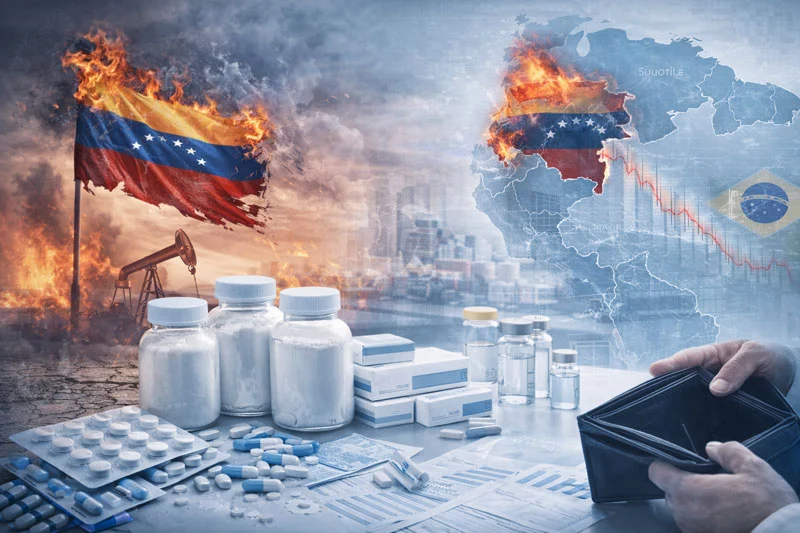
Here is a cautionary look at how quickly things can go wrong: Venezuela went from being a powerhouse of pharmaceutical production (5.7 billion to 12.6 billion dollar drug market from 2009 to 2015) and overall very strong competitor in the Latin America pharmaceutical industry, now to a country that has fallen to the depths of despair with its drug supply.
The same market faces 85% drug shortages in drugstores and 95% in hospitals. A nation that once created wealth from its oil now drains healthcare resources from its neighbors.
The drug supply chain? It's in shambles. About 85% of Venezuela's medicine needs go unmet pushing desperate people to seek care across borders. Cold storage often fails when the power goes out. Production has stopped. (Also Read: The State of the Pharmaceutical Market in Venezuela: Opportunities and Challenges)
Colombia: Where the Impact Hits Hardest
Colombia shoulders the biggest load. The country gave temporary legal status to over 2.5 million Venezuelans allowing them to access healthcare services. This is kind - but also taxing.
Border towns like Cúcuta face a tough spot. Healthcare centers built for local populations now treat waves of Venezuelan patients with untreated long-term illnesses, nutrition problems, and disease outbreaks. The count of reportable public health cases among Venezuelans in North Santander jumped from 182 in 2015 to 865 in the first half of 2018. (Read: The State of the Pharmaceutical Market in Colombia: Opportunities and Challenges)
For drug companies working in Colombia, this creates both hurdles and chances:
The Hurdles:
- Sudden demand spikes put pressure on domestic supply chains
- Governments looking for cheap solutions create pricing challenges
- Border areas see distribution networks struggle to cope
- More companies join the market to meet growing needs
The Opportunities:
- Markets near borders grow in Cúcuta, Maicao, and Arauca
- Contracts to provide humanitarian aid for governments
- Huge rise in demand for generic drugs
- More people use telemedicine and digital health platforms
Brazil: Infrastructure Can't Keep Up
Brazil faces a different but tough situation. The country gave humanitarian visas to Venezuelans letting them become permanent residents. Migrants can use public healthcare—but the system is at its breaking point.
Brazil's biggest tertiary hospital in Roraima saw its patient numbers grow by more than 100% in a year facing drug and supply shortages never seen before. When a major hospital reaches its limit, the whole regional network feels the pressure. (Read: Brazil Pharmaceutical Market Overview: Opportunities, Trends, and Challenges )
To understand pharmaceutical operations in Brazil keep an eye on these changes:
- The federal government is spending more on healthcare in border states
- International aid money is going to Roraima and Amazonas
- The need for generic drugs is growing faster than the supply in northern areas
- The government is speeding up the process to buy essential medications
Peru, Chile, and Ecuador: Areas Feeling the Ripple Effects
These countries have taken in over 2 million Venezuelan migrants together. While they're not dealing with the same intense border crisis as Colombia and Brazil, their healthcare systems are under a lot of strain.
Peru has given legal status to 500,000 Venezuelans. Chile now houses 1.6 million immigrants in total. Ecuador struggles to manage 425,000 immigrants with its limited healthcare system.
Each market faces different challenges:
Peru: The high number of informal jobs means many Venezuelans can't access regular healthcare leading to more out-of-pocket spending on medicines. (Read: The State of the Pharmaceutical Market in Peru: Opportunities and Challenges)
Chile: The more organized healthcare system can handle migrants better, but growing political issues around immigration might affect access policies.(Read: Pharma Market in Chile 2025: Growth, Regulation & Opportunities for Global Manufacturers)
Ecuador: With fewer resources and a large number of migrants relative to its population, Ecuador has an urgent need for affordable essential medicines.
South American Drug Markets See Big Changes
The crisis in Venezuela is changing South American pharmaceutical markets in ways that will last for years:
1. Generic Medications Dominate
Across the region, brand-name drugs matter less and less. Venezuelan migrants can't buy them. People in host countries feeling the economic squeeze from migration costs, can't buy them either. Venezuelan migration has boosted GDP growth in countries that took them in by 0.10 to 0.25 percentage points. However, health care spending related to migrants ranges from 0.1 to 0.5 percent of GDP.
2. Humanitarian Partnerships Grow
UNHCR, IOM, PAHO, and many NGOs work together on big regional responses. Smart drug companies set themselves up as trustworthy partners. USAID alone gave tens of millions to help Venezuelan refugees in Colombia and Brazil. This creates chances to secure contracts and build a good name.
3. Cross-Border Supply Chains Evolve
Supply chains that once focused on national borders are changing. Products now move to areas with high demand—often near borders that companies used to ignore. Businesses that can shift their distribution networks stand to gain more customers.
4. Infectious Disease Monitoring Intensifies
Measles has come back, and malaria and diphtheria have increased in Venezuela. This has worried countries where Venezuelans are moving. Brazil Colombia, and Ecuador have seen outbreaks. More countries in the region are giving out vaccines. People want more vaccines—for measles, diphtheria, and common childhood diseases.
5. Public Health Infrastructure Investment Accelerates
Governments know they need to make their healthcare systems stronger. Brazil, Colombia, and Peru are putting money into building up their border areas. This means new buildings buying more supplies, and updating how they move goods around.
What January 2026 Changes
The U.S. military action and the power gap that follows in Venezuela add new things to think about in an already tricky situation:
Right Away:
- More people might leave if things get worse
- Or fewer might leave if U.S. control brings calm and hope
- Countries in the area will make their borders tighter
- Money for helping people might go up or move around based on world politics
Looking Ahead:
If the U.S. helps Venezuela get back on its feet , some people might go back home, which could ease the burden on healthcare in nearby countries. But don't bank on this. Most Venezuelans have started new lives elsewhere and won't hurry back to an uncertain future.
If things stay shaky or get worse more people will leave Venezuela. This would put even more strain on healthcare in Colombia Brazil, and Peru.
Venezuela's Drug Industry Rebuild:
When Venezuela becomes stable, it will need to rebuild its drug industry from the ground up. This could be a chance worth keeping an eye on—but not something to count on soon. The country has lost over 75% of its wealth. Getting back on track will take years maybe even decades.
Steps Pharma Companies Can Take
Here's what you can do with this info:
If you do business in Colombia:
- Boost distribution ability in Norte de Santander, La Guajira, and Vichada
- Team up with IOM and UNHCR on humanitarian supply deals
- Create programs to make products affordable for migrants
- Put money into Spanish-language materials to educate patients
- Connect with Colombia's Ministry of Health migration response teams
If you work in Brazil:
- Put your efforts into Roraima and Amazonas states—these areas need help the most
- Growing your generic product line in these regions will be worth it
- Look into working with the federal government on health projects at the border
- Think about using mobile pharmacies or online doctor visits for far-off areas
If you work in Peru, Chile, or Ecuador:
- Keep a close eye on policy shifts—immigration rules are changing fast
- Basic generic drugs remain the smart choice
- City markets (Lima, Santiago, Quito) show more stable integration trends
- Rural and border regions need unique distribution plans
For regional drug company leaders:
- Line up your supply chain with where people are moving—demand has moved to new areas
- Look over your pricing plans—keeping costs low is key in all affected markets
- Look into teaming up with aid groups—it's good for business and image
- Think about setting up regional hubs instead of just country-based operations
- Boost your cold chain strength—infrastructure everywhere is under pressure
For big pharma eyeing South America:
- The region's drug market basics stay strong even with hurdles
- People moving around is changing how markets work, not ruining them
- Businesses that get these new facts will do better than those acting like nothing's changed
- The mix of patients has shifted—your sales plans should change too
(Also Read: How Venezuelan Companies Can Source Indian Pharma Products & CDMO Services)
The Wild Card of Catching Diseases
This is a big deal. Venezuela's health system falling apart has made it easy for diseases to spread, and now the whole area has to deal with it.
We almost got rid of measles in the Americas. Now it's back spreading through groups of people moving who couldn't get shots in Venezuela. More people are getting malaria. Diphtheria—a sickness most doctors in rich countries have never seen—is showing up again.
For drug companies, this means:
- The need for vaccines will stay high for a long time
- More antibiotics and antiparasitic drugs are needed
- Markets for diagnostic tests are growing near borders
- Building of public health monitoring systems is underway—chances to team up for testing and screening
The World Health Organization and PAHO are watching this closely. Regional governments are coordinating vaccination efforts. This isn't a short-term blip—it's a structural shift in regional public health that pharma companies need to address.
Beyond Venezuela: Regional Pharmaceutical Resilience
The Venezuelan crisis exposed fragilities in South American pharmaceutical supply chains that existed before but are now impossible to ignore:
Over-reliance on imports: Multiple countries depend heavily on pharmaceutical imports, leaving them vulnerable to disruptions. Domestic manufacturing capacity is growing in Brazil and Colombia, but slowly.
Infrastructure gaps: Cold chain reliability, distribution to remote areas, and last-mile delivery all need strengthening. The crisis accelerated awareness but solutions lag behind.
Affordability challenges: Even before the migration surge, many South Americans struggled to afford medications. Adding millions of economically vulnerable migrants compounds the problem.
Regulatory harmonization: Different countries maintain different approval processes, pricing controls, and importation requirements. Regional coordination is improving but remains fragmented.
Smart pharmaceutical companies are using the current crisis as a catalyst to build more resilient, flexible operations that can adapt to future disruptions—because there will be future disruptions.
The Bottom Line
Venezuela’s deteriorating health system is not only an issue for the people of Venezuela; rather, it has repercussions for how healthcare is delivered and viewed throughout the entire continent of South America as a whole.
Eight million migrants have not merely moved across national boundaries; they also have migrated with various healthcare requirements. Chronic illnesses, epidemic outbreaks, complications during pregnancy and delivery, pediatric healthcare needs, and mental health concerns are now regional problems requiring coordinated responses at a regional level.
Pharmaceutical companies should not perceive the crisis in the Venezuelan pharmaceutical sector as something to avoid. It represents an emerging market trend for analysis and strategy.
The opportunities are real:
- Increased growth of border market sectors, as compared to traditional urban centers.
- Increased humanitarian partnership opportunities yielding stable contracts supporting higher volume quantities of medications.
- Excess demand for generic pharmaceuticals relative to available supply in key economies.
- Increasing adoption of digital health and telehealth technologies.
- Increasing government budgets for procuring healthcare infrastructure.
The challenges are equally real:
- Increasing complexity of regulatory requirements across multiple jurisdictions.
- Increasing pricing pressure from governments and humanitarian organizations
- Increasing challenges related to providing efficient distribution channels within underserved border areas.
- Increasing political instability surrounding immigration and healthcare policies is creating challenges.
- Increasing competition as more pharmaceutical companies are beginning to explore and recognise similar opportunities.
The Challenge: Transformation will occur over a period of 10 years, not quarterly earnings. The companies that invest the time to learn about migration patterns, develop strategic relationships with humanitarian organisations, offer a portfolio of affordable products and develop flexible distribution capabilities will be the winners.
The Venezuelan crisis changed the map. Make sure your strategy reflects the new reality.
This analysis reflects conditions as of January 6, 2026. Given rapidly evolving circumstances, readers should verify current conditions before making operational decisions.
Reference Sources
- PBS NewsHour - U.S. military operation and Maduro capture
https://www.pbs.org/newshour/world/us-strikes-venezuela-and-says-its-leader-maduro-has-been-captured-and-flown-out-of-the-country - Council on Foreign Relations - Venezuela conflict analysis and regional impact
https://www.cfr.org/global-conflict-tracker/conflict/instability-venezuela - IMF Regional Spillovers Study - Economic and migration impacts on Latin America
https://www.elibrary.imf.org/view/journals/087/2022/019/article-A001-en.xml - Johns Hopkins University - Border health crisis in Colombia and Brazil
https://journals.sagepub.com/doi/full/10.1177/2331502419860138 - Pharmaceutical Technology - Venezuela pharmaceutical market analysis
https://www.pharmaceutical-technology.com/research-reports/report-venezuelas-economic-crisis-hit-domestic-pharmaceutical-market/