
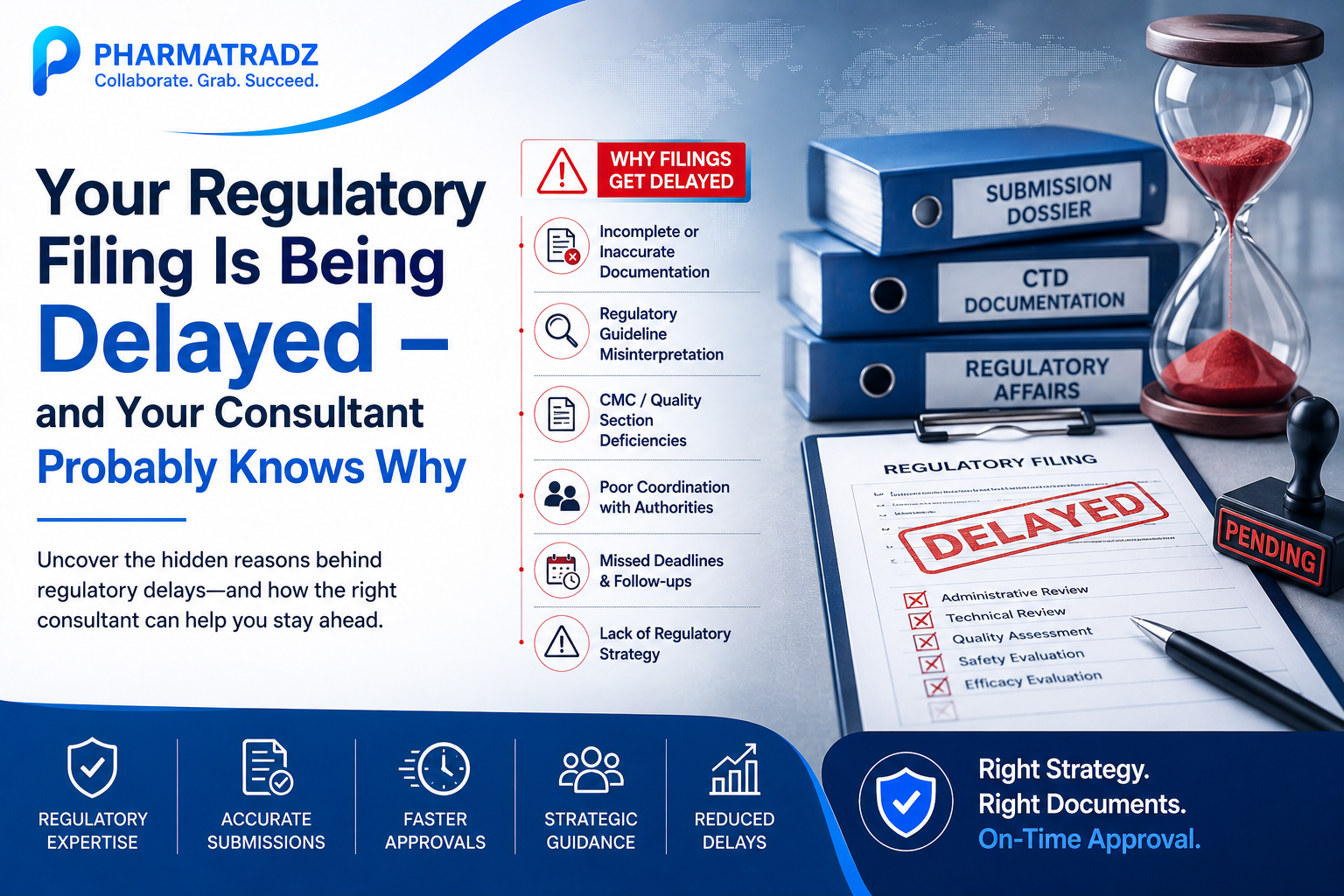
You submitted your documents, waited for updates, and expected progress within a set timeline. But weeks turn into months, and the approval still does not move forward. Many companies face this situation and start questioning what went wrong. If you are dealing with common reasons for FDA filing delays, it is important to understand that most delays are not random.
At some point, many businesses decide to hire a pharma consultant to support handling submissions and compliance. Platforms like Pharma Tradz are often used to explore such connections and gain better visibility into regulatory processes across markets.
As per the research done by the Pharmatradz Global Ventures Pvt Ltd, delays are often linked to documentation gaps, miscommunication, or missing regulatory expectations rather than external factors alone.
Key Takeaways
- Regulatory delays usually happen due to documentation and compliance gaps
- Consultants play a role, but internal preparation is equally important
- Most delays can be avoided with better planning and review
- Understanding the submission process helps reduce uncertainty
- Early identification of issues can save time and cost
What Does a Regulatory Filing Involve in Pharma?
Before looking at delays, it helps to understand the process. The pharma regulatory submission process involves the preparation of a detailed dossier, submission to regulatory authorities, and awaiting review and approval.
At this stage, many businesses also start wondering how long drug regulatory approval takes, as timelines can vary widely depending on the country, product type, and completeness of the submission.
This process entails several processes including data compilation, validation, documentation, and compliance checks. Even small errors at any stage can slow down the overall timeline.
Why Regulatory Filings Get Delayed
Regulatory filing delays in the pharma industry have a number of causes, most of which are avoidable.
1. Incomplete Documentation
Lack of information in submissions or inconsistencies might result in queries and rework.
2. Limits in Dossier Preparation
The wrong formatting or absent parts frequently lead to delays in the review.
3. Changing Regulatory Requirements
Guidelines keep on being updated and failure to keep up may bring about setbacks.
4. Poor Coordination
Lack of communication between internal teams and consultants can slow progress.
5. Review Backlogs
In some cases, even officials are characterized by a large number of applications, and it contributes to the waiting time as well.
Understanding these factors can help identify where the delay is actually coming from.
How to Identify Where Your Filing Is Stuck
Delays in regulatory submission are not always the most difficult part, but it can be hard to figure out where the problem actually lies. Most businesses presume that the hold-up is on the side of the authority, yet that does not invariably happen.
In most situations, the delay can be traced back to a specific stage in the process:
- Initial dossier review where missing or unclear data raises queries
- Longer than expected internal review cycles.
- To and fro communication between company teams and consultants.
- Questions that are asked by the regulatory authority and need further explanation.
- Final approval stage, where minor issues can still slow things down.
A time spent in tracking every stage may serve to determine whether the delay is a result of documentation, coordination, or external review timelines. This clarity makes it easier to resolve issues rather than waiting without direction.
The Role of Consultants in Filing Delays
The role of the consultants is to guide the submission process, however, their effectiveness is determined by the information they get.
In some cases, issues are identified early but not communicated clearly. In others, missing data from the company side delays the process further. This is where pharma regulatory consulting is not only document writing but also includes the coordination of activities, follow-ups and updates.
Instead of pointing the finger at one side, it is more appropriate to consider the process as a collective responsibility.
Common Mistakes That Slow Down Approvals
Some of the errors are recurrent in various submissions.
- Filing incomprehensive or contradictory dossiers.
- Ignoring country-specific guidelines
- Low quality data or formatting problems.
- Lacking validation information or stability information.
- Last-minute changes prior to submission.
These are some of the common regulatory submission mistakes that usually result in duplicated questions and more review processes.
The Real Cost of Regulatory Delays
- Delays are not only related to timelines. They also impact business outcomes.
- Late products lower the market potentials.
- This is because there are other costs associated with repeated submissions.
- The competitors can get in the market sooner.
- The internal resources are held longer before they are utilized.
All these factors lead to the general delays in drug approval, which may influence the revenues and planning.
How to Avoid Regulatory Filing Delays
Although no delays can be completely removed, most of the delays can be minimized through more effective preparation.
- Start documentation well in advance
- Check all information prior to submission.
- Be informed with the latest guidelines.
- Ensure effective communication among teams.
- Collaborate with consultants with a long experience.
Focusing on these steps can improve timelines and reduce rework.
What to Expect from a Good Regulatory Consultant
Finding the appropriate consultant would help in determining the ease of the process.
- Effective communication of schedules and anticipations.
- Frequent communication of submission status.
- Early detection of gaps or missing data.
- Help in managing regulatory inquiries.
A well-managed process reduces the chances of pharmaceutical dossier preparation mistakes that often lead to delays.
How Digital Platforms Are Supporting Regulatory Processes
Availability of regulatory expertise has been enhanced through online platforms. Businesses are now able to research consultants, compare services and have a clearer understanding of processes.
Pharma Tradz is one such platform that helps companies connect with industry professionals and explore regulatory support options across regions. This makes it easier to find the right expertise without relying only on local networks.
Conclusion
Regulatory delays are often seen as unavoidable, but in most cases, they point to gaps in preparation, communication, or compliance. Understanding these issues early can help businesses avoid repeated setbacks and improve submission timelines.
Platforms like Pharma Tradz can support companies in exploring regulatory expertise and understanding the process better, especially when dealing with complex approvals across different markets.
If your filings are taking longer than expected, now is a good time to take a closer look at Pharma Tradz and see how businesses are connecting with experienced consultants, improving coordination, and moving their regulatory processes forward with greater clarity.
Frequently Asked Questions(FAQs)
1. What is the duration of drug regulatory approval?
The time frame depends on the country and the type of product, but it may require several months to years, based on complexity.
2. What are typical causes of regulatory delays?
They are incomplete documentation, gaps in compliance as well as poor communication.
3. Is it possible to avoid regulatory delays?
Not necessarily, but with proper planning and reviewing, chances can be reduced to a significant level.
4. What is a pharmaceutical dossier?
It is a set of documents that give specifics about a drug to be approved by the regulatory authority.
5. What to do to accelerate the approval of the regulations?
To improve timelines, ensuring full documentation, adhering to guidelines, and consulting with experienced consultants can be helpful.