
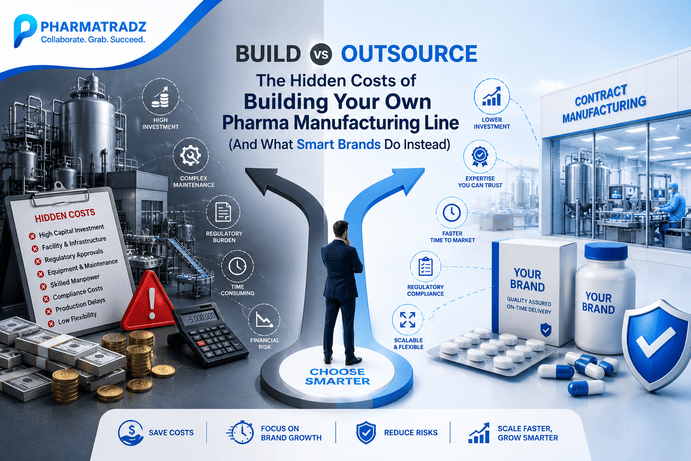
Building your own pharmaceutical manufacturing line often feels like a strong step towards control and long-term growth. Many companies assume that owning production will reduce costs and improve margins over time. However, the cost of setting up a pharmaceutical manufacturing plant goes far beyond initial expectations, especially when hidden factors begin to surface.
This is where many businesses start rethinking their plans and exploring alternatives like pharma contract manufacturing to stay flexible in a competitive market. Many companies also turn to platforms like Pharma Tradz to explore verified partners and understand global manufacturing options more clearly.
As per the research done by the Pharmatradz Global Ventures Pvt Ltd, several companies underestimate the long-term financial impact of setting up and running their own facilities, which leads to delayed returns and operational challenges.
Key Takeaways
- Building a pharma manufacturing unit involves more than infrastructure and equipment costs
- Hidden expenses often appear after operations begin
- Regulatory approvals and compliance can significantly increase investment
- Outsourcing is becoming a preferred option for many growing brands
- Choosing the right model depends on scale, budget, and long-term plans
What Does It Really Cost to Set Up a Pharma Manufacturing Line?
Setting up a manufacturing unit may seem like a one-time investment, but it involves multiple layers of ongoing costs.
|
Cost Component |
Description |
|
Land and Infrastructure |
Facility construction, clean rooms, utilities |
|
Machinery and Equipment |
Production lines, packaging units |
|
Regulatory Approvals |
Licensing, inspections, documentation |
|
Staffing |
Skilled workforce and training |
|
Operations |
Maintenance, utilities, quality control |
Even the simplest breakdown of the pharma production costs reveal that the costs are distributed over the various stages instead of being concentrated at one point of investment.
How to Estimate Your Total Investment Before You Start
Before setting up a manufacturing unit, it is important to look beyond initial costs and calculate the full financial picture. Many businesses focus only on infrastructure and equipment, but a realistic estimate should include long-term operational expenses as well.
You can begin by dividing your investment into major aspects:
- The initial cost of set up includes land, construction, and machinery.
- Regulatory and licensing costs.
- Staffing and training needs.
- The continuing operation expenses such as utilities and repairs.
- Contingency funds for delays or unexpected issues.
Creating a detailed cost projection helps in understanding whether the investment aligns with your business goals. It also enables you to have a clearer picture of in-house manufacturing and outsourcing options before deciding on the final option.
The Hidden Costs Most Pharma Businesses Overlook
Most of the difficulties commence once the setup is done and the real operations commence.
1. Regulatory Delays
Timelines of approval may take more time than anticipated. The FDA approval process of a new manufacturing plant does not only involve monetary expenditure, but also incorporates significant time lag, which makes it hard to enter the market on schedule. Many companies choose to hire pharma consultant experts early in the process to avoid costly submission errors and accelerate approvals.
2. Quality Control and Compliance
To ensure quality standards, it is important to constantly test, conduct audits and make documents. Such expenses will be incurred in the lifecycle of the facility.
3. Underutilised Capacity
The production capacity is usually not utilized in the initial phases. This implies that there is a lot of investment without corresponding output.
4. Workforce and Training
Recruiting talent and keeping the talents as a recurring cost.
5. Maintenance and Downtime
Unexpected breakdowns can interrupt production and increase repair costs.
These factors together form the hidden costs of pharmaceutical production that many companies fail to calculate in advance.
Real Financial Impact Over Time
The long-term financial impact is often underestimated.
- A large initial investment may require years to pay off.
- Revenue generation is slower due to delays in approvals.
- Continued compliance expenses lower the overall profitability.
- Production planning can be influenced by changes in market demand.
These constant costs fall under the larger invisibility of pharma manufacturing costs, which only becomes apparent when a company starts its operations.
In-House Production vs Outsourcing
When businesses understand the difference between models, they are able to make better decisions.
|
Factor |
In-House Manufacturing |
Outsourcing |
|
Initial Investment |
Very high |
Lower |
|
Flexibility |
Limited |
High |
|
Time to Market |
Longer |
Faster |
|
Risk |
Higher |
Shared |
This comparison highlights the growing relevance of CDMO vs in-house manufacturing discussions across the industry.
What Smart Pharma Brands Are Doing Instead
Many companies are currently collaborating with contract manufacturers as opposed to spending huge sums of money on infrastructure.
By doing this they can:
- Specialize in branding and product development.
- Do not invest a lot of capital.
- Enter markets faster.
- Production according to demand.
It is easier to investigate such partnerships through such platforms as Pharma Tradz which provide businesses with access to global manufacturers.
Advantages of Outsourcing Pharma Manufacturing
Outsourcing is becoming popular because it has a number of benefits.
- Less initial investment than constructing a facility.
- Quickened product introduction schedules.
- Availability of licensed production plants.
- Reduced regulatory burden.
- Increased scalability with increased demand.
These points highlight the growing interest in outsourcing pharma manufacturing benefits among new and mid-sized companies.
When Should You Build Your Own Facility?
Regardless of the difficulties, in-house production can still be effective in some situations.
- When the volume of production is constant.
- When companies have strong financial backing
- When the investment is justified by long-term product pipelines.
- Where the overall control of the process is important.
Even in these situations, proper planning is still needed to control the cost of establishing an efficient pharmaceutical plant.
How Digital Platforms Are Changing Pharma Manufacturing Decisions
The way companies explore manufacturing options is changing. The availability of global suppliers, partners who have been verified, and simplified comparison of options are all available through digital platforms.
This displacement enables businesses to base their decisions on information, accessibility, and dependability as opposed to the restricted local networks. One such site is Pharma Tradz that assists businesses to investigate such opportunities in a well-organized manner.
Conclusion
Building your own pharmaceutical manufacturing line can offer control, but the financial and operational challenges often go beyond initial expectations. From regulatory hurdles to ongoing compliance and maintenance, the overall pharma manufacturing setup cost can increase significantly over time.
Many businesses today are exploring flexible alternatives to manage these challenges more efficiently. Platforms like Pharma Tradz can help companies discover global manufacturing options and connect with verified partners, making it easier to evaluate different paths before making a long-term investment decision.
If you are planning your next move, it might be a good time to explore the pharma investment opportunities listed on Pharma Tradz, where businesses are already finding verified manufacturing partners, flexible production options, and new growth avenues in one place.
Frequently Asked Questions(FAQs)
1. How much does it cost to set up a pharmaceutical manufacturing plant?
The cost is dependent on scale, location, and type of product, but typically requires a substantial investment in infrastructure, equipment and compliance.
2. What are the latent costs in pharma manufacturing?
They consist of regulatory delays, quality control costs, maintenance, labour costs, and idle capacity.
3. Is it more appropriate to outsource than to manufacture in-house?
It depends on business goals, but outsourcing offers flexibility and lower initial investment.
4. What is a CDMO in pharma?
A CDMO is a contract development and manufacturing organisation that provides production services to pharmaceutical companies.
5. How many days will it take to establish a pharma manufacturing plant?
The process may take months or years based on approvals, construction, and compliance requirements