
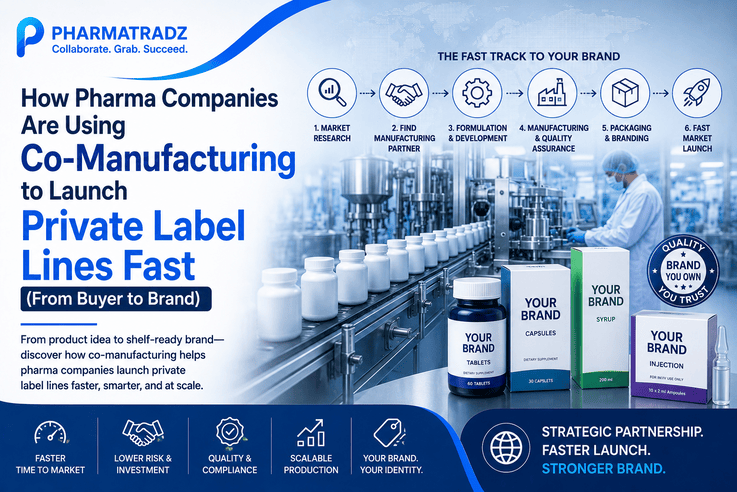
Launching a pharmaceutical brand no longer requires owning a manufacturing facility. Today, many businesses are exploring how to launch a private label pharma brand by working with existing manufacturers and focusing on market demand instead of infrastructure. This shift is helping companies move faster and reduce entry barriers.
Many distributors who once relied only on sourcing products are now stepping into white-label pharmaceuticals to build their own identity in the market. After exploring different options, businesses often turn to platforms like Pharma Tradz to understand how co-manufacturing partnerships work across regions and product categories.
As per the research done by the Pharmatradz Global Ventures Pvt Ltd, companies that choose flexible manufacturing models tend to launch products faster and adapt better to changing market demand.
Key Takeaways
- Co-manufacturing helps businesses launch pharma brands without heavy investment
- It allows faster product entry compared to setting up facilities
- The buyer-to-brand transition is becoming common in the industry
- Partner selection plays a key role in long-term success
- Clear planning helps avoid delays and quality issues
What Is Co-Manufacturing in Pharma?
Co-manufacturing in pharma refers to a collaboration where one company handles production while another focuses on branding, marketing, and distribution. Instead of building a facility, businesses partner with manufacturers who already have approved infrastructure and processes.
This model has a strong association with pharma co-manufacturing where both parties have a responsibility to share based on their strengths. It allows companies to enter the market without waiting for years to set up operations.
How Pharma Businesses Move from Buyer to Brand Successfully
The journey from buyer to brand is becoming more structured in the pharmaceutical industry. The company can start as a distributor or trader, realize that there is an opportunity in a product and then collaborate with a manufacturer to introduce its own branded product. This change is beneficial over time in establishing brand value and customer confidence.
This model also supports private label pharma manufacturing, where businesses sell products under their own brand while production is handled by a third party.
Why Pharma Companies Are Choosing Co-Manufacturing
Companies are shifting towards this model due to a number of reasons.
- Reduced initial investment than constructing a plant.
- Quick penetration into the market.
- There is no necessity to control the manufacturing processes.
- Availability of skilled production plants.
- Scalability of product lines.
These factors make co-manufacturing a preferred choice for businesses entering new markets or expanding their product range.
Step-by-Step Process to Launch a Private Label Pharma Brand
Launching a pharma brand through co-manufacturing involves a series of steps.
Step 1: Market Research
Determine the demand, competition, and product gaps in your target market.
Step 2: Product Selection
Select products according to the demand and regulatory viability.
Step 3: Find a Manufacturing Partner
Choose a partner who has appropriate certifications and production capacity.
Step 4: Regulatory and Documentation
Full approvals, licensing, and compliance needs.
Step 5: Packaging and branding
Pay attention to packaging and branding in pharma white labels to establish a solid presence in the market.
Step 6: Production and Launch
Start the production process and launch the product into the market.
Understanding the timeline to launch a white-label pharma product helps businesses plan better and avoid delays.
Co-Manufacturing or In-House Production: What Should You Choose?
|
Factor |
Co-Manufacturing |
In-House Manufacturing |
|
Investment |
Low |
High |
|
Time to Market |
Fast |
Slow |
|
Control |
Shared |
Full |
|
Risk |
Moderate |
High |
This comparison highlights why many businesses prefer models like pharma contract manufacturing instead of setting up their own facilities.
Common Challenges in Co-Manufacturing
Although the model is beneficial, it also has challenges.
- Reliance on the manufacturing partner.
- Consistency of quality between batches.
- During production, there are communication gaps.
- Slow processing of approvals or documents.
- Limited control over operations.
Early intervention to address these challenges can enhance long-term outcomes.
How to Choose the Right Co-Manufacturing Partner
Choosing an appropriate partner is the key to success.
- Check certifications and compliance standards.
- Review past production experience.
- Evaluate product range and capacity.
- Confirm regulatory approvals.
- Assess communication and transparency.
Working with reliable partners ensures smoother execution and better product quality.
How Digital Platforms Are Making It Easier
The digital platforms are making the task of identifying and screening manufacturers easier. They give access to supplier information, certifications and product description in a single location.
Pharma Tradz is one such platform that helps businesses explore global manufacturing options and connect with suitable partners. This enhances visibility and minimizes time wastage incurred due to manual searches.
When Should You Choose Co-Manufacturing?
This model works well in several scenarios.
- When entering a new market
- When expanding product lines
- When investment capacity is limited
- When speed to market is important
Many companies exploring how to launch pharma brand strategies are now choosing this route for faster growth.
Key Factors to Consider Before Launching
Beyond manufacturing, several elements influence success.
- Product demand and competition
- Regulatory requirements
- Partner reliability
- Branding and positioning
- Distribution network
These factors are part of a complete pharma brand launch process and should be planned carefully.
Conclusion
Co-manufacturing is changing how pharmaceutical brands are built. It enables the business to shift its position in terms of being a buyer to being an owner of the brand without having to incur the cost of establishing manufacturing plants. This shift is helping companies enter markets faster and expand their product range with greater flexibility.
Understanding the process, choosing the right partner, and planning each stage carefully can improve the chances of success. Platforms like Pharma Tradz can support businesses in exploring manufacturing options and connecting with suitable partners.
If you are ready to take your business from sourcing to building your own brand, now is the time to act. Explore Pharma Tradz to find trusted manufacturing partners, compare opportunities, and move forward with clarity. Your next pharma brand could start with the right connection today.
Frequently Asked Questions(FAQs)
1. What is co-manufacturing in pharma?
It is a partnership where one company produces medicines while another handles branding and distribution.
2. How long does it take to launch a private-label pharma product?
The schedule is also determined by approvals and production, however, it is typically quicker than establishing a facility.
3. Will it be profitable to manufacture a private label pharma?
It may be profitable provided that the product selection, price, and distribution are well managed.
4. What is the difference between co-manufacturing and third-party manufacturing?
Co-manufacturing is a process with shared functions whereas third-party manufacturing, pharma specializes in manufacturing.
5. Do I need a licence to launch a pharma brand?
Yes, regulatory approvals and licences are required depending on the market.